


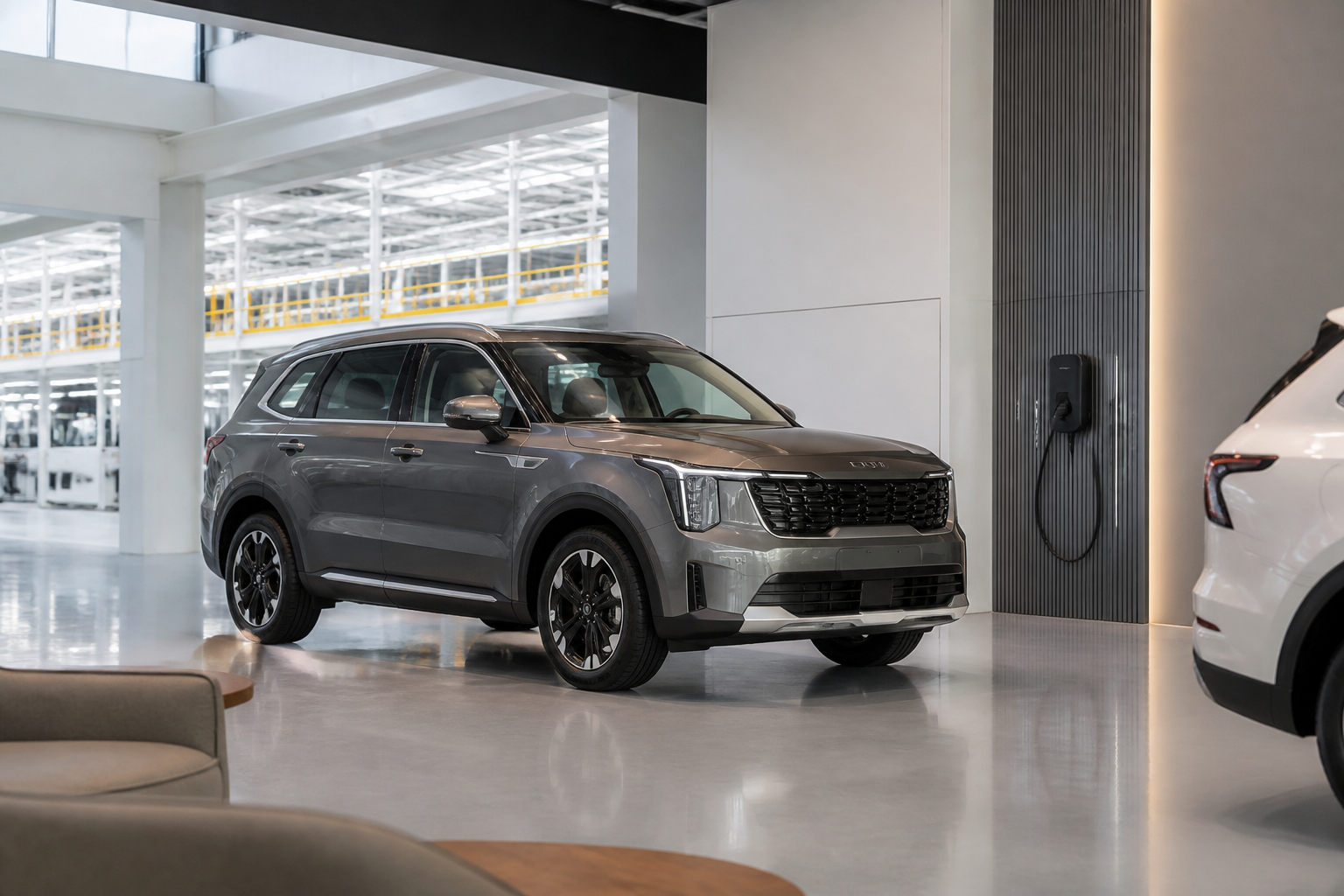
Kia India’s launch of the Sorento in strong-hybrid and diesel versions is more than a new entry in the premium seven-seater SUV market. It illustrates how automakers are attempting to navigate an Indian transition to cleaner vehicles without assuming that electrification will follow a single, uniform path.
The Sorento, launched with prices ranging from ₹27.99 lakh to ₹40.39 lakh, arrives as Kia India argues that the country’s vehicle market remains open to several powertrain technologies. In an interview with The Hindu BusinessLine, Kia India Managing Director and Chief Executive Officer Gwanggu Lee said the company needed to prepare for CNG, plug-in hybrids, strong hybrids, electric vehicles and conventional engines while responding to the government’s direction towards electrification.
That position places the company between two pressures. The first is policy-driven: the Indian government is encouraging vehicle electrification and has indicated that manufacturers should prepare for stricter internal-combustion-engine norms. The second is market-driven: customers, segments and regions may adopt different technologies at different speeds. Kia’s strategy, as described by Lee, is to keep multiple routes open during that interim period.
The result is a powertrain strategy based less on choosing one immediate replacement for the internal-combustion engine and more on maintaining flexibility. Lee said India differed from several other markets because it remained open to a wider range of powertrains. He pointed to the rapid growth of CNG in some segments as an example of how demand can develop faster than manufacturers expect. The company is now preparing for similar variation in hybrid and electric vehicle demand.
A transition without one mainstream technology
The Indian government’s direction towards electrification is not disputed by Kia India’s leadership. Lee said the company was also moving towards electrification and supported government measures, including tax benefits. The challenge, in his account, is managing the period before one technology becomes dominant across the market.
This distinction is important for understanding the current structure of the vehicle transition. Electrification is a policy direction, but the route taken by individual buyers can still depend on vehicle segment, price, usage pattern and the availability of suitable products. The interview does not provide market-wide sales data comparing these technologies, but it does show how one global manufacturer is interpreting the uncertainty.
Kia’s response is to maintain products across several categories. The company has introduced the Sorento in strong-hybrid and diesel configurations and has also referred to CNG, electric and other hybrid options. Lee cited the Syros EV as part of the company’s electric vehicle plans. He also said plug-in hybrids remained a niche product in global markets and that Kia would assess the direction India takes before determining how important that technology could become domestically.
This approach also reflects the uneven nature of vehicle adoption. A technology may gain traction in one segment while remaining limited in another. Lee’s comments suggest that Kia does not expect a single national preference to determine the entire product portfolio. Instead, the company is preparing for different powertrains to serve different portions of the market.
The policy challenge for manufacturers
For automakers, the policy environment described by Kia combines a clear long-term direction with uncertainty about the transition period. Lee said the government had asked manufacturers to prepare for stricter norms for internal-combustion engines while also developing ways to support electric vehicles. He characterised changing regulations as a challenge that businesses must manage, rather than as a reason to oppose the direction of travel.
The practical consequence is that manufacturers must invest in several forms of readiness at the same time. They need products that meet evolving emissions requirements, electric models for segments where demand is developing, and alternatives such as CNG and hybrids for buyers who may not move directly to battery-electric vehicles. The source material does not establish the scale of Kia’s investment in each technology, but the company’s product positioning indicates that it is treating powertrain diversity as a strategic requirement.
This creates a difficult balance between policy compliance and commercial viability. A manufacturer that shifts too quickly towards one technology risks misjudging demand in particular segments. A manufacturer that moves too slowly may be less prepared for tighter regulation or faster adoption of electric vehicles. Kia’s stated approach is to reduce that exposure by keeping several options available.
The same tension affects vehicle pricing. Kia described the Sorento’s segment as competitive but underdeveloped, and said more aggressive pricing was necessary to build the market. The company’s pricing strategy therefore becomes part of its powertrain strategy: new technologies and premium models must be positioned not only as technical alternatives, but also as products that customers are willing to consider within an existing market structure.
Exports add another layer of complexity
Kia India’s plans are not limited to domestic demand. Lee said India was functioning as an export hub for the company and that Kia was continuing to ship vehicles from the country to around 100 nations. These markets include countries in Asia, West Asia, Africa, Central America and South America. The company exports both completely built units and completely knocked-down kits.
That geographic spread makes a single powertrain strategy even more difficult. Each export market can have different regulations, incentives, infrastructure and consumer preferences. Lee noted that some countries require original-equipment manufacturers to establish local production capacity and that local policies influence whether companies export completely built vehicles or kits.
India’s role as a manufacturing and export base therefore depends on more than domestic electrification. Kia must develop products and production arrangements that can serve multiple regulatory environments. The company’s comments suggest that powertrain flexibility is not only a response to Indian consumers, but also a way of preserving the usefulness of its Indian operations across different markets.
The interview does not specify future export volumes or identify particular models and destinations for expansion. It does, however, establish that exports are an ongoing priority and that Kia sees further opportunity in using India as a production base. This makes the domestic powertrain debate relevant to industrial policy as well as mobility policy.
The infrastructure question remains open
A multi-powertrain market also places demands on the wider mobility system. Electric vehicles require charging access, while other technologies depend on their own supply, servicing and regulatory arrangements. The supplied material does not provide data on charging infrastructure, fuel availability, grid capacity or ownership costs, so it cannot establish which constraints are most significant for Indian cities or consumers.
What it does show is that manufacturers are preparing for a market in which infrastructure and customer behaviour may not change at the same pace. Kia’s reference to CNG, hybrids and electric vehicles as parallel options indicates that the transition will be experienced through several overlapping systems rather than one immediate replacement cycle.
For urban mobility, that means the outcome will not be determined only by vehicle launches. It will also depend on how quickly supporting systems develop and whether different technologies can be accommodated across vehicle segments. Kia’s product strategy provides evidence of the industry’s response, but not yet of which option will become dominant.
What Kia’s strategy confirms and what it does not
Kia India’s position confirms that vehicle electrification is now central to manufacturers’ planning, even when companies continue to sell diesel and develop other alternatives. It also confirms that the transition is being managed as a period of adaptation, with businesses attempting to respond simultaneously to policy signals, consumer demand and export-market requirements.
The Sorento launch gives that strategy a visible product form. Its strong-hybrid and diesel variants target a premium SUV segment that Kia described as competitive and still capable of further development. The company’s broader portfolio, including its references to CNG, hybrids and the Syros EV, shows an effort to maintain coverage across technologies rather than commit immediately to a single route.
Several questions remain unresolved. The interview does not establish how India’s powertrain mix will evolve, how quickly plug-in hybrids could expand, what future regulatory milestones will require from manufacturers, or how Kia’s export volumes will change. It also does not provide comparative sales or production data for the company’s different technologies.
The clearest conclusion is therefore narrower. Kia India is treating India’s vehicle transition as a multi-stage process in which electrification is the long-term policy direction, but CNG, hybrids, diesel and electric vehicles may coexist for some time. The company’s future product decisions, export plans and response to stricter norms will show whether that flexibility can remain commercially sustainable as the market develops.
