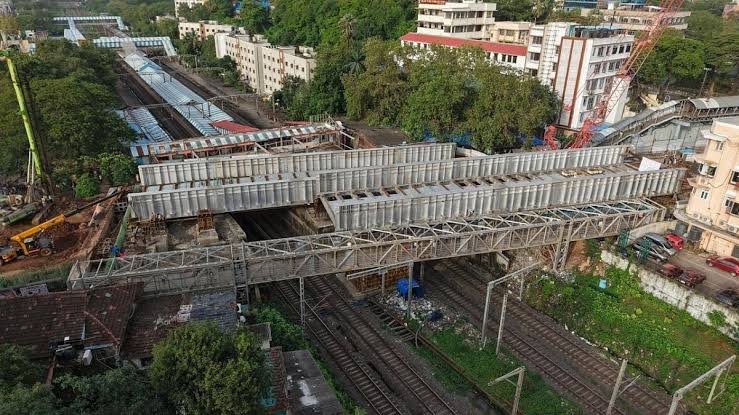
Mumbai’s Sion Railway Over Bridge (ROB) is approaching a critical milestone, with reconstruction targeted for completion by September 30 after more than two years of disruption. The project is being coordinated between Central Railway and the BMC, alongside upgrades to connecting roads and subways. Its reopening could restore a key east-west connection while supporting the expansion of suburban rail infrastructure between CSMT and Kurla. The 112-year-old bridge was shut to traffic in August 2024 after being assessed as unsafe. Its closure altered daily travel patterns across Sion and neighbouring areas, pushing road users towards alternative routes and adding pressure to already congested corridors.
Construction of the replacement structure has now moved into its finishing stage. Central Railway has completed concrete work for the deck slabs on both girders. Workers are completing crash barriers and the concrete wearing layer, which forms the final road surface. The remaining section of the old bridge has also been removed. The project is not limited to the bridge itself. The BMC is rebuilding the approach connecting LBS Marg with Sant Rohidas Marg in Dharavi, an important part of restoring smooth traffic movement once the ROB becomes operational. Two associated subways have already reopened this year, with the LBS Marg subway returning to service in February and the Sant Rohidas Marg subway following in July.
For commuters, the significance of the Sion ROB reconstruction lies in restoring network connectivity rather than simply replacing an ageing structure. A bridge closure of this duration demonstrates how vulnerable urban mobility becomes when a single crossing is taken out of service. The impact extends to buses, taxis, goods vehicles and local traffic, with delays creating additional fuel consumption and travel costs. The rebuilding is also linked to Central Railway’s wider capacity expansion under the Mumbai Urban Transport Project Phase 2. The bridge needs to accommodate additional railway lines planned between CSMT and Kurla. This makes the project part of a larger effort to increase rail capacity while keeping road connectivity functional above and around the railway corridor. Urban infrastructure specialists say the final design and maintenance strategy will matter as much as the opening date. Safety barriers, drainage, pedestrian access and the condition of approach roads will determine whether the new crossing performs reliably through Mumbai’s heavy monsoon conditions and intense daily traffic.
The Sion ROB reconstruction therefore carries significance beyond one junction. Its completion should remove a longstanding mobility constraint, but the wider benefit will depend on how effectively the bridge integrates with surrounding roads, public transport and pedestrian infrastructure. With finishing work underway, the immediate priority is completing the structure safely and ensuring that the connected road network is ready for traffic when the bridge reopens.