


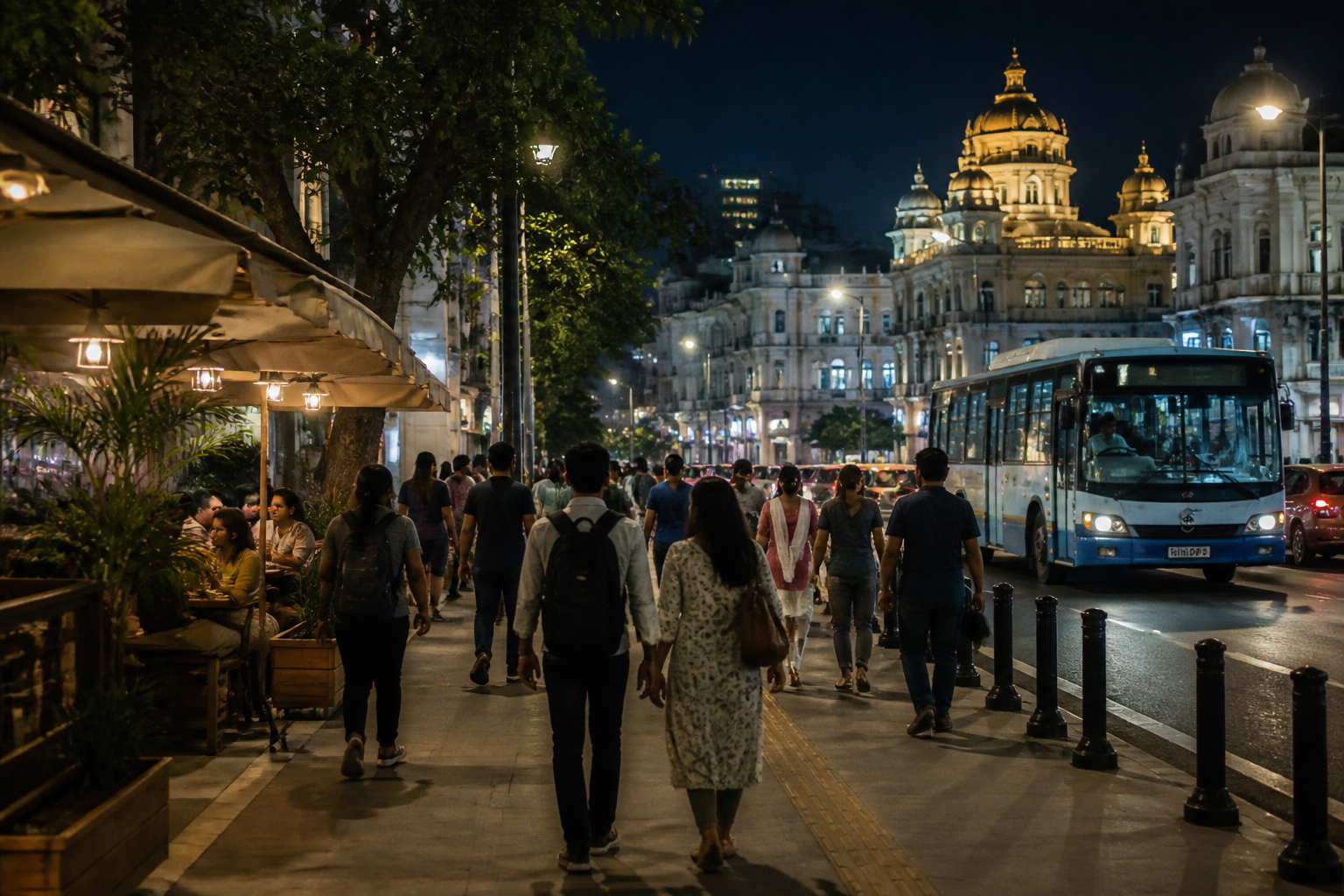
Bengaluru nightlife has acquired a new global label. According to a report by Vijay Karnataka, Time Out’s 2026 list of the world’s best nightlife cities places Bengaluru 17th, making it the only Indian city in the top 20. The ranking puts the city alongside destinations such as Bangkok, Berlin, New York, Melbourne and São Paulo. The result is being presented not simply as a recognition of pubs and bars, but as evidence of a city whose economy, population and daily rhythms have changed substantially.
That distinction matters. A nightlife ranking is a cultural marker, but it is also an urban governance question. A city’s night-time identity depends on far more than venues. It requires transport, policing, licensing, street management, waste collection, public toilets, parking controls, noise enforcement and safe access to homes. Bengaluru’s challenge is therefore not whether it should accept or reject nightlife. It is whether the city can make night-time activity compatible with the needs of residents, workers, visitors and businesses.
The supplied report does not detail Time Out’s methodology, the cities considered, the indicators used or the comparative margin separating Bengaluru from other destinations. Those details are important before the ranking is treated as a formal measure of the city’s night-time economy. What the report does establish is the strength of Bengaluru’s emerging international association with evening entertainment, food, music and social activity. It also provides a useful starting point for examining how that reputation has been produced and what it demands from public institutions.
Bengaluru’s current nightlife is closely connected to the transformation of its economy. The report links the city’s changing lifestyle to globalisation and the expansion of the information technology and biotechnology sectors. Large numbers of young professionals from different parts of India and from overseas have come to the city for work. Alongside them have grown new patterns of consumption, including cafés, craft beer, restaurants, music venues, fashion and other forms of entertainment.
This is not a complete break with the city’s past. Bengaluru was built through several layers of investment in trade, education, science, water, electricity, manufacturing and public institutions. The report traces that history from the foundations associated with Kempe Gowda to the contributions of Mysore-era administrators, engineers, scientists and industrial institutions. The Indian Institute of Science, Hindustan Aeronautics Limited, Indian Telephone Industries, Bharat Electronics, Hindustan Machine Tools and Bharat Earth Movers Limited are cited as parts of the city’s knowledge and industrial inheritance. The growth of the space sector and the later rise of Electronics City added further layers to Bengaluru’s economic identity.
This history changes the meaning of the nightlife debate. The city’s present entertainment culture did not emerge in isolation from its earlier development. It followed the creation of employment, institutions, universities, industrial clusters and technology companies that attracted a mobile workforce. Night-time consumption is one visible outcome of that wider economic and demographic change. It is not, however, the only measure of whether the city is successful, and it cannot substitute for the basic systems on which its residents depend.
The report makes a broader argument: nightlife should be understood as a possible tourism and local economic asset rather than reduced to alcohol consumption. Dinner, live music, dance, theatre, art, shopping, cafés, local food, cultural programmes and heritage walks can all form part of a city’s night-time economy. This wider definition is significant because it opens the discussion to more types of workers and enterprises, including restaurants, performers, artisans, retailers, guides and small food businesses.
For Bengaluru, the tourism opportunity also lies in connecting the city’s evening offer with Karnataka’s wider cultural and commercial landscape. The report names local food, Mysuru silk, Channapatna toys and handicrafts as products that could be introduced to visitors. It also identifies Bengaluru’s position as a gateway to destinations such as Mysuru, Hampi, Kodagu, Chikkamagaluru, Kabini, Bandipur and coastal Karnataka. These connections are presented as opportunities, not as evidence of an existing integrated tourism programme. Realising them would require coordination between tourism agencies, city authorities, transport operators, businesses and cultural institutions.
The central planning issue is spatial. Night-time activity does not affect every part of a city in the same way. Commercial districts, entertainment clusters, transport hubs, heritage areas and residential neighbourhoods have different operating conditions and different expectations from public authorities. A single rule for the entire city may be simple to announce but poorly suited to these differences. The report therefore argues for a zone-sensitive approach in which activity, operating hours and enforcement are related to the character of each area.
Such an approach would not mean giving commercial areas unlimited freedom. It would require clearly defined responsibilities. Venues would need to comply with licensing and safety requirements. Authorities would need to enforce noise limits, prevent obstructive parking, manage traffic and maintain public spaces. The report specifically identifies noise control, cleanliness, parking, police patrols, closed-circuit cameras and women’s safety as necessary parts of a regulated night-time environment. Without these systems, the economic benefits of extended activity can be accompanied by costs imposed on people who do not participate in it.
The question of mobility is equally important. A night-time economy cannot be judged only by the number of venues open after dark. It must also be judged by how employees and visitors travel between those venues and their homes. The report calls for late-night metro and Bengaluru Metropolitan Transport Corporation services, taxis, tourist vehicles and last-mile connections to support nightlife. It also stresses strict action against drunk driving.
The supplied material does not establish the current availability, frequency or coverage of late-night public transport in Bengaluru. Nor does it provide data on night-time ridership, road crashes, parking demand or the distribution of entertainment venues. These gaps limit what can be concluded about the city’s readiness for a larger night-time economy. They also point to the information that policymakers would need before expanding operating hours or designating new entertainment zones.
Safety is not only a policing issue. It is also shaped by street design, lighting, transport availability, the presence of other people, the reliability of emergency response and the ability to reach a safe destination. Women’s safety, in particular, cannot be addressed through surveillance alone. The report mentions policing and cameras, but a complete public framework would also need to account for the journey to and from venues, the conduct of operators and the accessibility of transport. These are analytical implications of the issue; the supplied source does not provide an assessment of Bengaluru’s current performance on them.
Noise and residential privacy reveal the conflict most clearly. An all-night commercial district may support restaurants, cultural activity and employment, while an adjacent residential street may experience music, vehicle horns, informal parking and late-night movement. The report rejects both a blanket early closure of the city and an unqualified idea of a 24-hour Bengaluru. Its preferred distinction is between a 24-hour economy and 24-hour disturbance. That distinction is useful because it separates the question of economic activity from the question of public nuisance.
This also raises an institutional challenge. A night-time policy would cut across departments responsible for urban planning, policing, transport, licensing, tourism, public health, sanitation and local administration. The source does not identify a single coordinating authority or an existing city-wide framework. In practice, the effectiveness of any policy would depend on whether these responsibilities are clearly assigned and whether residents have a way to report violations and obtain timely action.
The city’s built form will influence the outcome. Bengaluru contains established commercial districts, technology corridors, mixed-use areas, older neighbourhoods and residential enclaves. The report does not provide a map or inventory of nightlife locations, so it is not possible from the supplied evidence to determine where activity is concentrated or which areas face the greatest pressure. That absence is important. A serious policy cannot rely only on the city’s reputation; it needs location-specific information about land use, access, noise, parking, waste and public safety.
The ranking may nevertheless be valuable as a signal. It suggests that Bengaluru’s urban identity is being read internationally through more than its technology and employment sectors. The city is increasingly associated with experiences available after office hours. For tourism planners and businesses, that creates an opportunity to present food, culture, performance, retail and heritage alongside nightlife venues. For city administrators, it creates a responsibility to ensure that the public realm and transport network can support these activities.
The larger urban question is whether Bengaluru can add a night-time layer without weakening the qualities that made it attractive in the first place. The report’s historical account emphasises education, scientific research, industry, infrastructure and quality of life as central to the city’s development. Its argument is not that contemporary nightlife should be rejected, but that the new city should not erase the older city. That means treating heritage, neighbourhood life and residential peace as planning concerns rather than obstacles to commercial growth.
The available evidence confirms one clear point: Bengaluru has gained international visibility as a nightlife destination, with Vijay Karnataka reporting a 17th-place position in Time Out’s 2026 list. It does not establish the ranking methodology, the size of the city’s night-time economy, the impact on tourism or the adequacy of existing services. Those questions require primary ranking material and city-level data. The developments worth monitoring are therefore practical: whether authorities create differentiated operating rules, how late-night mobility is organised, whether safety and noise standards are enforced, and whether the benefits of night-time activity reach local businesses and cultural workers as well as large venues. Bengaluru’s global nightlife reputation will ultimately be tested not by its place on a list, but by how well the city manages the systems that allow people to live, work and move after dark.
