


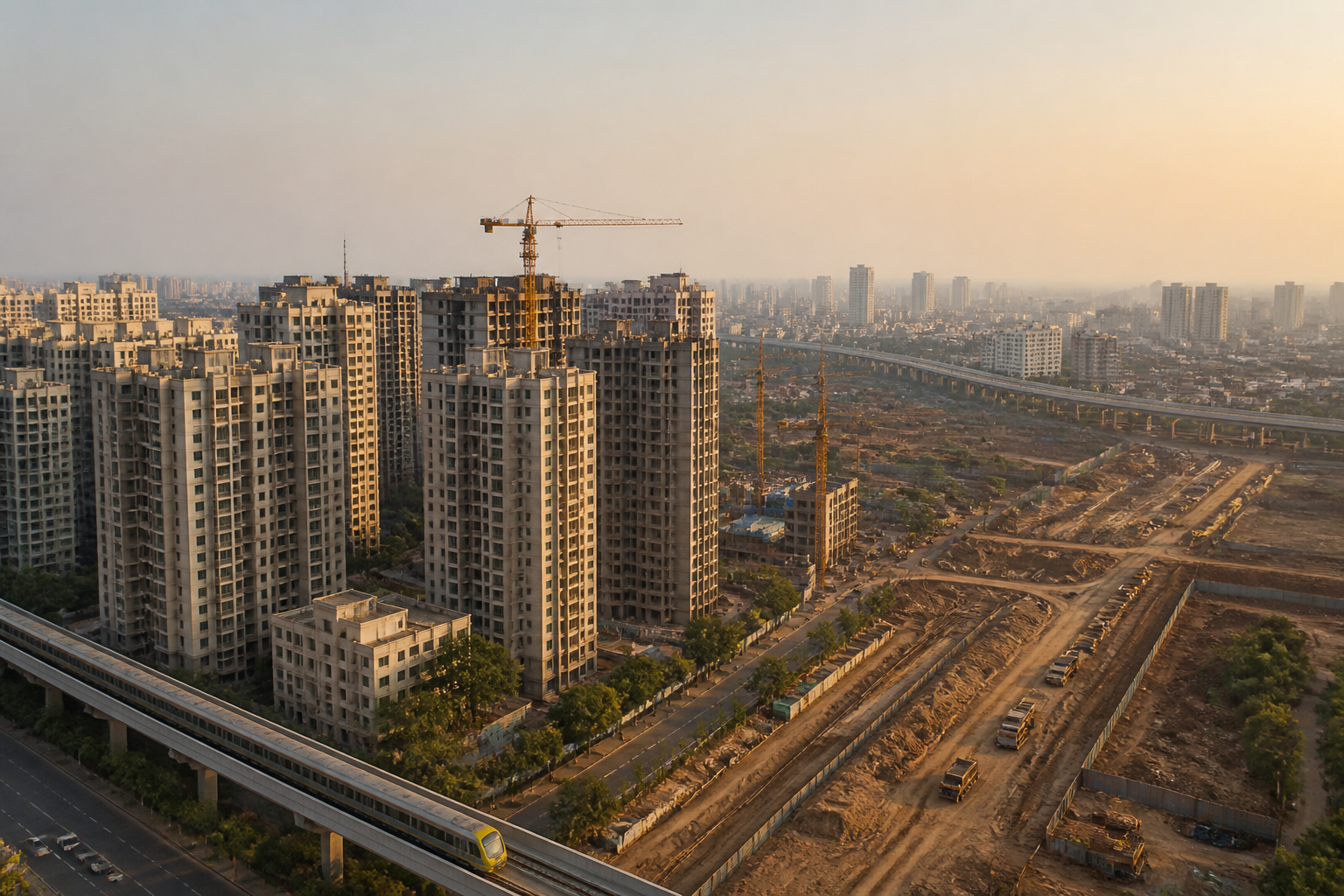
India’s housing market has entered a phase in which the price of a home is being shaped less by the physical cost of constructing it and more by land, location, connectivity and market power. New figures from Anarock Research, reported by Business Standard, show that average residential capital values across the country’s top seven cities rose 59% between 2021 and 2025, while construction costs increased 34% over the same period.
The difference is important because it changes how housing affordability should be understood. A rise in construction costs can explain part of a home-price increase, but the figures indicate that the final price paid by buyers has been moving considerably faster than the cost of building the structure itself. Anarock described the gap as a widening disconnect between the physical cost of producing homes and their final price.
Average residential prices increased from ₹5,826 per sq ft in 2021 to ₹9,260 per sq ft in 2025. Over the same period, the average construction cost of a standard-plus residential project rose from ₹2,681 per sq ft to ₹3,604 per sq ft. In annualised terms, residential capital values grew by approximately 12%, compared with a 6.9% annualised increase in construction costs.
These averages cover the top seven cities and therefore do not describe every neighbourhood or project. They nevertheless establish a broad market pattern: the escalation in housing prices has outpaced the increase in the cost of core physical production. The difference raises a larger urban question about what buyers are paying for when they purchase homes in India’s strongest employment and infrastructure markets.
A substantial part of the answer is land. According to Anarock, land values across the top seven cities rose by approximately 50% to 120% between 2021 and the first half of 2026. In the National Capital Region, the increase was estimated at around 70% to 130%, while Bengaluru recorded land-value growth of approximately 60% to 120%. The sharpest appreciation occurred in established, high-demand corridors, where infrastructure improvements can raise land values even before a project is launched.
This means that connectivity and future development potential are increasingly capitalised into the price of a home. A property near employment centres, transport links or improving infrastructure may become more expensive not because its construction is materially different, but because the land beneath it has gained market value. The location premium can therefore become a larger determinant of affordability than the incremental cost of materials or labour.
Anarock attributed around 66% of the increase in residential prices between 2021 and 2025 to construction expenses, with the remaining 34% linked primarily to rising land costs, developer margins and changing demand-supply dynamics. That attribution sits alongside the report’s separate comparison of a 59% rise in residential capital values and a 34% rise in construction costs. The supplied material does not provide a detailed methodology reconciling those measures, so the precise contribution of each factor should be treated as an estimate rather than a complete accounting of the price increase.
Even with that qualification, the land figures show why construction-cost data alone cannot explain housing inflation. Land is a scarce urban input, and its value is closely connected to access. When infrastructure improves the accessibility of a corridor, the resulting appreciation can be captured by landowners and reflected in project pricing. Buyers may ultimately pay for the expected benefits of a location years before all planned development is completed.
The price difference becomes more visible at the household level. A 1,000 sq ft home priced at the 2025 average residential capital value of ₹9,260 per sq ft would cost approximately ₹92.6 lakh, before registration charges, taxes and other expenses. At the 2021 average price of ₹5,826 per sq ft, the same home would have cost approximately ₹58.3 lakh. The increase is more than ₹34 lakh in five years.
That additional cost affects more than the headline purchase price. Buyers need larger down payments, higher loan amounts and greater monthly repayment capacity. Those unable to absorb the increase may choose smaller homes, extend loan tenures or move farther from established employment and infrastructure hubs. Such choices can transfer the affordability problem into the mobility system, as households trade lower housing costs for longer commutes and weaker access to jobs and services.
The market is also facing a new round of construction-cost pressure. Anarock estimated that continuing tensions in the Middle East could add another 8% to 10% to overall construction costs through higher prices for steel, fuel-linked logistics, imported finishing materials and mechanical, electrical and plumbing systems. This is an estimate of potential additional pressure, not a confirmed increase already reflected across all projects.
The cost components identified in the report show why the effect will not be uniform. Steel prices have risen by approximately 20%, with TMT bar prices reaching around ₹72,000 per tonne. Fuel and site-logistics costs have increased by 15% to 20%. Finishing materials including tiles, glass and hardware have become 8% to 12% more expensive, while mechanical, electrical and plumbing costs have risen by 9% to 13% amid higher copper and aluminium prices. Labour, which accounts for approximately 25% to 30% of project costs, increased by a comparatively moderate 5% to 6%. Cement costs rose by around 4% to 5%.
The distinction between core construction and building systems is becoming particularly significant. Across the top seven cities, average core building costs rose 13% between 2023 and 2025, from ₹1,956 per sq ft to ₹2,212 per sq ft. MEP costs increased by more than 17%, from ₹672 per sq ft to ₹788 per sq ft, and accounted for nearly 22% of total construction costs in 2025. Mumbai recorded the sharpest MEP increase, at 19.6% between 2023 and 2025.The report links this rise to the growing technical sophistication of residential projects, including electrical infrastructure, plumbing, heating, ventilation and air-conditioning systems, lifts and fire-safety installations. Higher equipment costs and shortages of skilled contractors have added to the pressure. As buildings become more service-intensive, their cost structure is influenced not only by concrete, steel and labour but also by the availability and price of specialised systems.
For developers, the timing of a project determines how much of the increase can be absorbed or passed on. Projects that have already been launched and sold offer limited scope to reprice units. If costs rise after sales commitments have been made, the immediate effect is likely to be pressure on project-level margins. New projects provide greater pricing flexibility, but developers still have to balance higher land and construction costs against buyer affordability and competition in the local market.This creates different pressures across housing segments. Premium and luxury housing may be better positioned to absorb higher costs because buyers in those categories are generally less price-sensitive. Affordable and mid-income housing has less room for increases: even a modest rise in the ticket size can affect eligibility, loan requirements and demand. The same inflationary pressure can therefore have different consequences depending on the income profile of the target buyer and the location of the project.
The likely responses identified by Anarock include calibrated price increases, changes to project specifications, adjustments to product mix, slower launch timelines and a shift towards locations or segments with stronger pricing power. These are market responses described in the supplied research; their extent will depend on individual project costs, sales performance and local competition.
The evidence points to a housing market in which affordability is being determined by the interaction of three systems: land, construction and finance. Construction costs set one part of the price floor. Land values determine the premium attached to location. Household borrowing capacity determines whether buyers can convert advertised prices into actual purchases. When all three move under pressure, the result is not simply more expensive construction but a narrower set of feasible housing choices.
The findings also show why infrastructure-led urban growth requires careful attention to land markets. New connectivity can improve access, but it can also raise land prices along established and emerging corridors. The supplied material does not establish how much of the reported land appreciation was caused by specific infrastructure projects, nor does it provide city-level housing affordability or sales data. It does, however, identify infrastructure improvements as one factor that can push land values higher before a project is launched.What the evidence confirms is that India’s top-city housing prices rose substantially faster than standard-plus construction costs between 2021 and 2025. It also shows that land appreciation, demand-supply conditions, developer pricing and location premiums are central to the final price paid by buyers. What remains uncertain is the precise contribution of each factor and how the projected 8% to 10% construction-cost pressure will affect different projects. The next indicators to watch are pricing decisions on new launches, margin pressure in already sold projects, MEP and material-cost movements, and the impact on affordable and mid-income housing demand.
