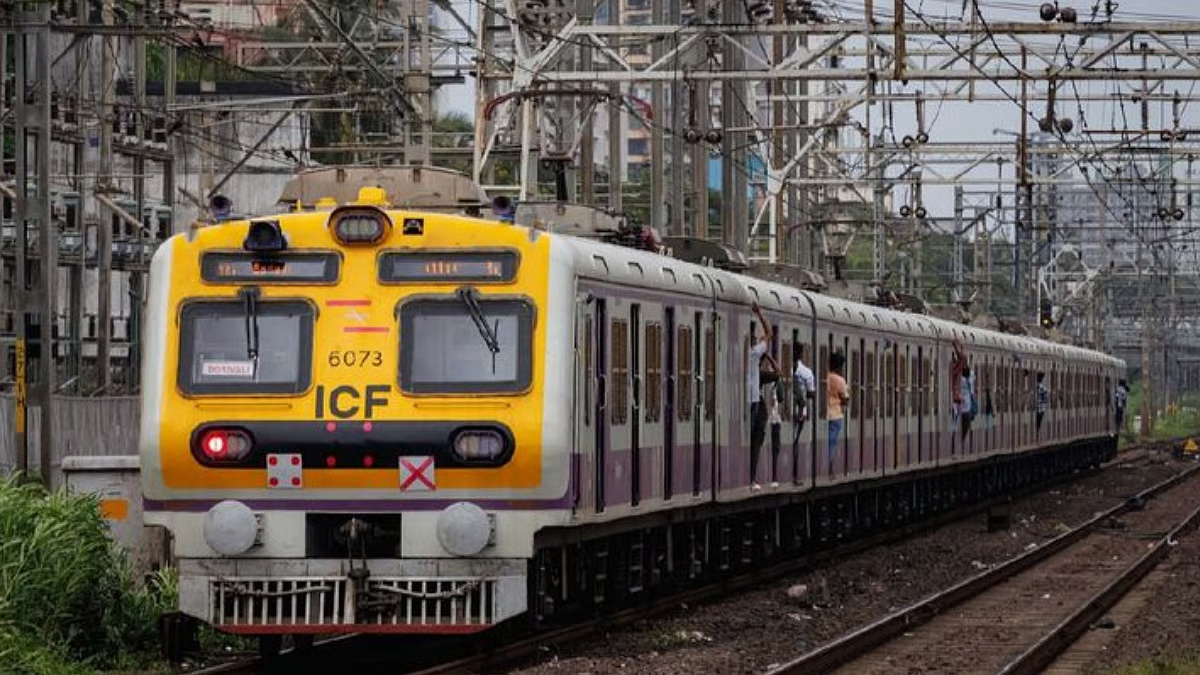
Mumbai’s Western Railway network has entered a new timetable regime aimed at reducing evening congestion at Borivali without adding to the overall number of daily suburban services. From September 1, two Churchgate–Virar trains are skipping Borivali on a trial basis, while additional AC and late-night services have been introduced elsewhere. The changes show how the railway is trying to extract more capacity from an already heavily used corridor. The two affected services are the 6.22pm Churchgate–Virar AC local and the 7.05pm Churchgate–Virar local. Both continue to stop at Dahisar but bypass Borivali during the evening peak. Railway authorities have attributed the experiment to prolonged boarding and alighting at Borivali, where heavy passenger volumes can increase platform dwell time and disrupt the sequence of trains behind them.
For Borivali-bound passengers, the change is being partly offset by a 6.28pm Churchgate AC local that continues to serve the station. The approach effectively separates passengers across nearby services rather than increasing train frequency at the busiest point. That distinction matters because Western Railway is retaining 1,414 suburban services overall, with six new services created by withdrawing six lower-demand services and reallocating their train paths. The revised timetable also expands weekday AC capacity from 145 to 147 services. Two existing non-AC trains, the 5.28pm Churchgate–Borivali and 6.24pm Borivali–Churchgate services, have been converted to AC operations without changing their basic timings or routes. Meanwhile, a 10.24am Churchgate–Borivali AC slow service has been shortened to Goregaon. Beyond Borivali, the timetable attempts to strengthen connections at the outer edge of the metropolitan region. The 8.23am Virar–Dadar service now continues to Churchgate, reaching South Mumbai at 9.48am. A direct Dadar–Dahanu Road service has also been created by integrating services that previously operated separately between Dadar, Virar and Dahanu Road.
Late-night services have been added on parts of the Borivali, Bhayandar and Virar corridor as well. These include new journeys between Borivali and Bhayandar, Borivali and Virar, and a late Virar–Borivali service. The changes recognise that public transport demand does not disappear once the traditional office peak ends. For commuters, however, timetable optimisation comes with a trade-off. Skipping Borivali may improve the movement of trains through a congested station, but passengers travelling to the suburb must adjust their routines and potentially wait for another service. The success of the trial will therefore depend on whether faster train movement translates into more reliable end-to-end journeys. The larger issue is capacity. Western Railway cannot keep solving congestion solely through timetable adjustments as population and employment expand along the northern suburban corridor. Better interchange design, station crowd management, accessible pedestrian routes and stronger integration with buses and Metro services will be increasingly important.
The revised schedule is therefore more than a change in stopping patterns. It is a test of whether Mumbai can make better use of existing rail infrastructure while building a wider, lower-carbon public transport system capable of serving its expanding metropolitan population.