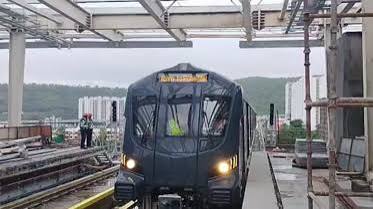
Pune: Pune Metro Line 3 is moving towards passenger operations in September, with the first operational section between Maan and Balewadi having secured safety clearance. The development could reshape daily travel between western Pune and the city’s major employment districts, particularly Hinjewadi, where road congestion has become a persistent cost for workers, businesses and the wider urban economy.
The first section comprises 12 stations and was authorised for passenger services by the Commissioner of Metro Rail Safety (CMRS) on July 23. Officials are now completing operational checks, staff preparation and system reviews ahead of the launch. A confirmed inauguration date has yet to be announced, although officials expect services to begin during September. The significance extends beyond the railway network itself. Pune Metro Line 3 is designed as a 23.2-km elevated corridor connecting Hinjewadi with Shivajinagar through Balewadi, with 23 planned stations. Its primary urban function is to create a mass-transit alternative for one of Pune’s busiest employment corridors, where dependence on private vehicles and road-based transport has intensified pressure on existing infrastructure. For commuters, the immediate benefit will depend on how effectively the new service connects with workplaces, residential neighbourhoods and existing public transport. Hinjewadi’s large concentration of technology and business activity means that even a partial opening could alter travel patterns, but the impact will remain limited until more of the corridor becomes operational.
The project also illustrates the challenge of delivering large urban infrastructure on schedule. PMRDA’s own project records show that the corridor had an original completion target of March 2025, later extended to March 2026. By early 2026, physical progress had reached about 94.6%, while financial progress stood at 97.4%. That delay matters because transport projects generate value only when completed infrastructure becomes usable infrastructure. For Pune’s expanding urban economy, reducing travel time and road dependence requires not simply more kilometres of metro track, but reliable services, safe pedestrian access, convenient interchange facilities and affordable last-mile connections.
The September opening therefore represents an important step, rather than the end of the project. The next priority will be expanding the operational corridor while ensuring that surrounding streets and public spaces can support the additional passenger movement. If integrated well, Pune Metro Line 3 can help shift mobility towards public transport and support a less congested, lower-emission pattern of urban growth.