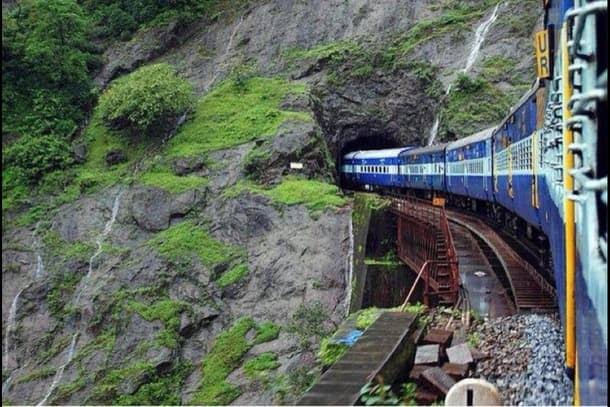
A section of the Pune–Mumbai rail corridor is turning to a nature-based method to tackle one of the Western Ghats’ recurring monsoon risks: unstable slopes. Central Railway has begun testing vetiver grass across 5,300 square metres in vulnerable ghat sections, seeking to reduce erosion and runoff while strengthening protection for railway operations during periods of intense rainfall.
The intervention covers parts of the Bhor Ghat and Thal Ghat systems, where steep terrain and heavy monsoon precipitation can contribute to soil movement, debris and boulder falls. For a rail network connecting major economic centres, even a localised slope failure can lead to service disruptions, maintenance work and wider effects on passenger and freight movement. Vetiver, scientifically known as Chrysopogon zizanioides, is being used because of its dense root structure. The roots grow predominantly downwards and bind soil, while rows of vegetation can slow rainwater flowing across exposed slopes. This makes the grass a form of soil erosion control that can work alongside conventional engineering measures. Pilot planting has been carried out at two locations. Around 1,050 square metres has been covered near the Khandala–Monkey Hill stretch, while another 4,250 square metres has been treated between Thakurwadi Cabin and Palasdhari. The sites will help assess how the approach performs under the demanding conditions of the ghats.
The experiment is significant for Pune because the rail connection through Bhor Ghat remains an important link towards Mumbai. The route carries both passenger and freight traffic, making resilience of the surrounding slopes a transport-planning concern rather than only an environmental issue. The use of vegetation does not eliminate the need for conventional safeguards. Retaining structures, drainage systems, rockfall protection and regular geological inspections remain important at high-risk locations. The potential value of vetiver lies in adding another layer of protection that can address surface runoff and erosion before they develop into larger slope-management problems. That distinction matters as rainfall patterns become harder for infrastructure managers to predict. Short periods of intense rain can rapidly saturate slopes and increase surface runoff. Maintaining vegetation cover and improving natural water management can therefore complement engineered infrastructure in climate-risk planning.
The pilot also offers a relatively low-impact alternative for ecologically sensitive sections of the Western Ghats. However, its wider adoption will depend on evidence from the trial, including survival rates, maintenance requirements and measurable changes in erosion and slope stability. For Pune’s wider transport network, the objective is ultimately practical: keeping a strategically important rail corridor safer and more reliable through the monsoon. Soil erosion control will need to remain part of a broader, integrated approach that combines ecological restoration with robust railway engineering.