


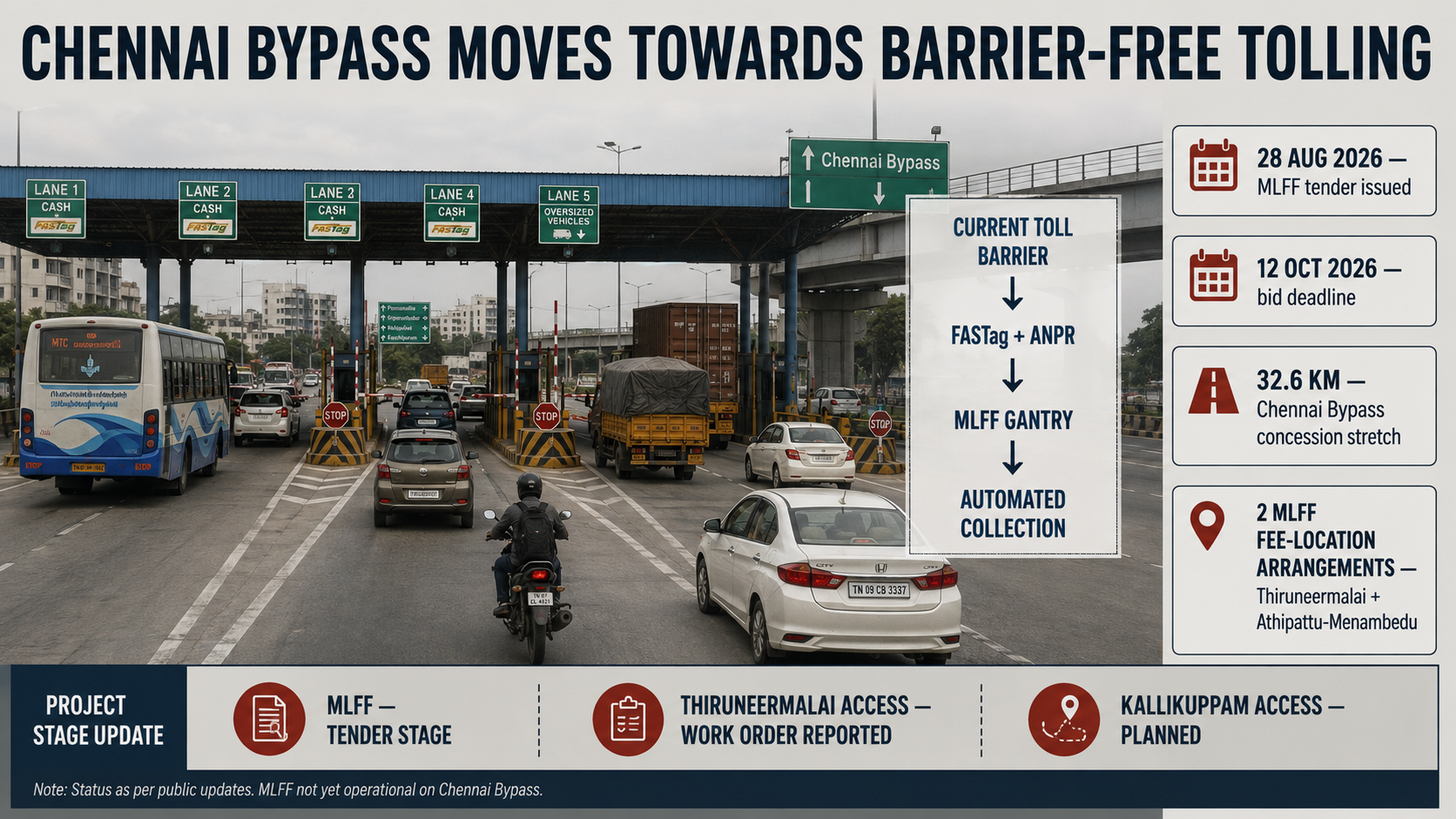
IHMCL has opened bidding for FASTag-ANPR Multi-Lane Free Flow toll collection at Thiruneermalai and Athipattu-Menambedu. But the technology is not yet operational, and the bypass’s proposed new access points are at different stages of delivery.
CHENNAI — The transition of the Chennai Bypass towards barrier-free tolling has entered a formal procurement stage, with the Indian Highways Management Company Limited, an NHAI-promoted company responsible for electronic tolling systems, inviting bids for Multi-Lane Free Flow user-fee collection at Thiruneermalai and Athipattu-Menambedu.
The tender was published on August 28 and seeks an acquiring bank for a FASTag- and Automatic Number Plate Recognition-based system. Bids close on October 12, with opening scheduled for October 13.
That distinction matters. The Chennai Bypass has not yet become barrier-free. The fresh development is procurement of the collection architecture required for MLFF operation.
Under MLFF, RFID readers identify FASTags while ANPR cameras provide a second vehicle-identification channel, allowing vehicles to cross without stopping at physical toll barriers. India began commercial MLFF operation at Choryasi in Gujarat in May 2026.
Toll redesign is only one part of a wider bypass restructuring
The tolling procurement sits alongside a longer-running attempt to change how the Chennai Bypass interfaces with surrounding neighbourhoods.
DT Next reports that NHAI has issued a work order for entry and exit facilities around Thiruneermalai, intended to improve access towards MEPZ, the airport and southern Chennai. It also reports another access connection at Kallikuppam, near Menambedu, but describes that intervention as planned, rather than awarded or under construction.
The Thiruneermalai intervention itself is not new. NHAI floated a broader EPC package in 2025 covering a six-lane vehicular underpass at Vanagaram, relocation of the toll facility, entry-exit ramps, a Cooum crossing, pedestrian infrastructure and Surapattu improvements. Earlier reporting had already identified the Thiruneermalai ramps as part of that package.
The meaningful August 2026 update is therefore project progression, not first announcement.
Kallikuppam exposes the bypass’s urban-access problem
The northern part of the bypass illustrates a different issue.
Residents around Kallikuppam, Ambattur, Pudur and neighbouring areas have long argued that the discontinuous service road forces lengthy local detours. Earlier reporting documented demands for access near Patravakkam and described additional journeys of roughly 6-8 km in some cases.
A direct Kallikuppam connection could improve local accessibility. But an access ramp onto a high-speed bypass is not automatically the same solution as restoring a continuous service-road network across the railway interface.
Urban Acres therefore considers the design question unresolved: is NHAI providing a neighbourhood connectivity solution, or adding another interchange onto a through-traffic corridor?
That distinction affects weaving movements, safety, local-road loading and the long-term function of the bypass.
Existing toll locations remain part of the notified framework
The Chennai Bypass is a 32.6-km six-lane tolled asset. A March 2026 Central Government notification records NHAI’s agreement with Raajmarg 1 Projects Pvt Ltd for tolling, operation and maintenance of the corridor and identifies Vanagaram and Surapattu as the fee-plaza locations.
The new procurement instead names Thiruneermalai and Athipattu-Menambedu.
Urban Acres did not locate a later fee notification, among the documents reviewed, formally substituting the old locations. Publication of the applicable revised toll framework therefore becomes an important pre-operation milestone.
MLFF removes a physical barrier but creates a digital service chain
Barrier-free tolling changes where failure becomes visible.
Under a conventional plaza, failure appears as a queue. Under MLFF, the critical chain becomes:
Vehicle → FASTag/RFID read → number-plate recognition → vehicle matching → toll deduction → reconciliation → e-notice → grievance resolution
That makes transaction accuracy just as important as vehicle speed.
Recent experience elsewhere in India illustrates the risk. An Indian Express analysis of five operational MLFF plazas found 10.52 lakh e-notices between May and July, representing nearly one in ten vehicle crossings in the dataset examined where toll payment had not been completed normally.
That does not predict Chennai’s performance. It does show why NHAI should publish transaction-success, false-read, e-notice and grievance-resolution data when the Chennai system goes live.
The financial numbers require separation
The earlier civil-works package and the new MLFF procurement are different procurements.
The ₹63.23-crore figure reported in 2025 relates to an earlier estimate for the broader road-safety and access package. Public tender databases now display inconsistent later figures for the same tender, so the final EPC award value should not be stated until the NHAI award document is produced.
Similarly, the ₹111.49-crore and ₹90.35-crore figures reported by DT Next for Thiruneermalai and Athipattu-Menambedu represent indicative annual electronic toll collections based on 2025-26 data, according to the newspaper. They are not project expenditure.
The current official MLFF procurement page retrieved by Urban Acres shows a ₹30-lakh EMD and ₹25,000 tender fee. It does not provide enough accessible information to establish a verified final procurement value. Third-party tender databases give inconsistent interpretations, so Urban Acres would exclude such a figure from the headline or lead.
What motorists should eventually be able to measure
The programme will succeed only if three outcomes occur together: toll queues fall, local access improves and payment errors remain low.
Moving a tolling point or replacing boom barriers with cameras addresses only one interface. If merging traffic increases around new ramps, if neighbourhood streets absorb more bypass traffic, or if motorists trade physical queues for unresolved digital toll notices, the system will have shifted rather than eliminated friction.
The next meaningful milestones are therefore not another announcement. They are the MLFF contract award, statutory fee-location update, installation and testing, opening of the Thiruneermalai ramps, a formal decision on Kallikuppam, and publicly measured post-opening performance.
