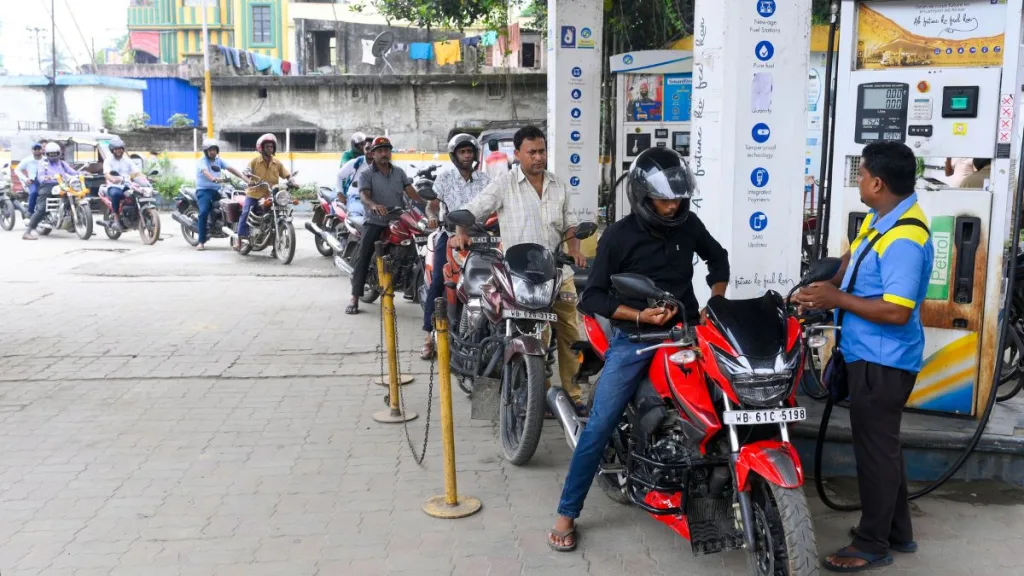
Petrol and diesel prices in Kolkata remained unchanged on Friday, keeping pump rates steady even as international crude markets continued to face geopolitical uncertainty. Petrol was priced at ₹113.51 a litre, while diesel stood at ₹99.82 a litre. For households, commuters and businesses dependent on road transport, the stability offers short-term predictability, although fuel remains a significant component of everyday mobility costs.
The Kolkata fuel prices reflect a broader pattern of price stability in the city. Available price records show petrol has remained at ₹113.51 a litre through August so far, while diesel has held at ₹99.82. That means motorists have not faced a fresh pump-price increase despite continued movement in global energy markets.The stability is particularly relevant for Kolkata’s urban economy. Fuel costs influence not only private vehicle users but also buses, taxis, goods vehicles, delivery services and other road-based activities. A sustained increase can eventually feed into logistics expenses and household budgets, while stable rates give transport-dependent businesses greater certainty when planning operating costs.However, unchanged retail rates do not mean the wider energy market is insulated from risk. International crude prices remain sensitive to disruptions involving major shipping routes and geopolitical tensions.
On August 28, Brent crude was trading around $88.35 a barrel, while West Texas Intermediate was near $83.29, with market participants watching developments affecting global oil supply and maritime trade.India’s retail fuel pricing also depends on more than the international crude benchmark. The rupee-dollar exchange rate, refining costs, central and state taxes, dealer margins and other components influence the final amount paid at filling stations. IndianOil states that daily petrol and diesel price changes are implemented from 6 am, while also noting that prices can vary between individual outlets within a city or sales area.For Kolkata, the immediate picture is therefore one of price stability rather than relief. Stable petrol and diesel rates can help commuters and businesses manage short-term budgets, but they do little to reduce the city’s underlying dependence on fossil-fuel-based mobility.
As Kolkata expands and transport demand grows, the longer-term economic question is how effectively the city can reduce exposure to fuel-price shocks through efficient public transport, cleaner mobility and better-connected neighbourhoods. For residents, that transition could matter as much as the next movement in the pump price.