


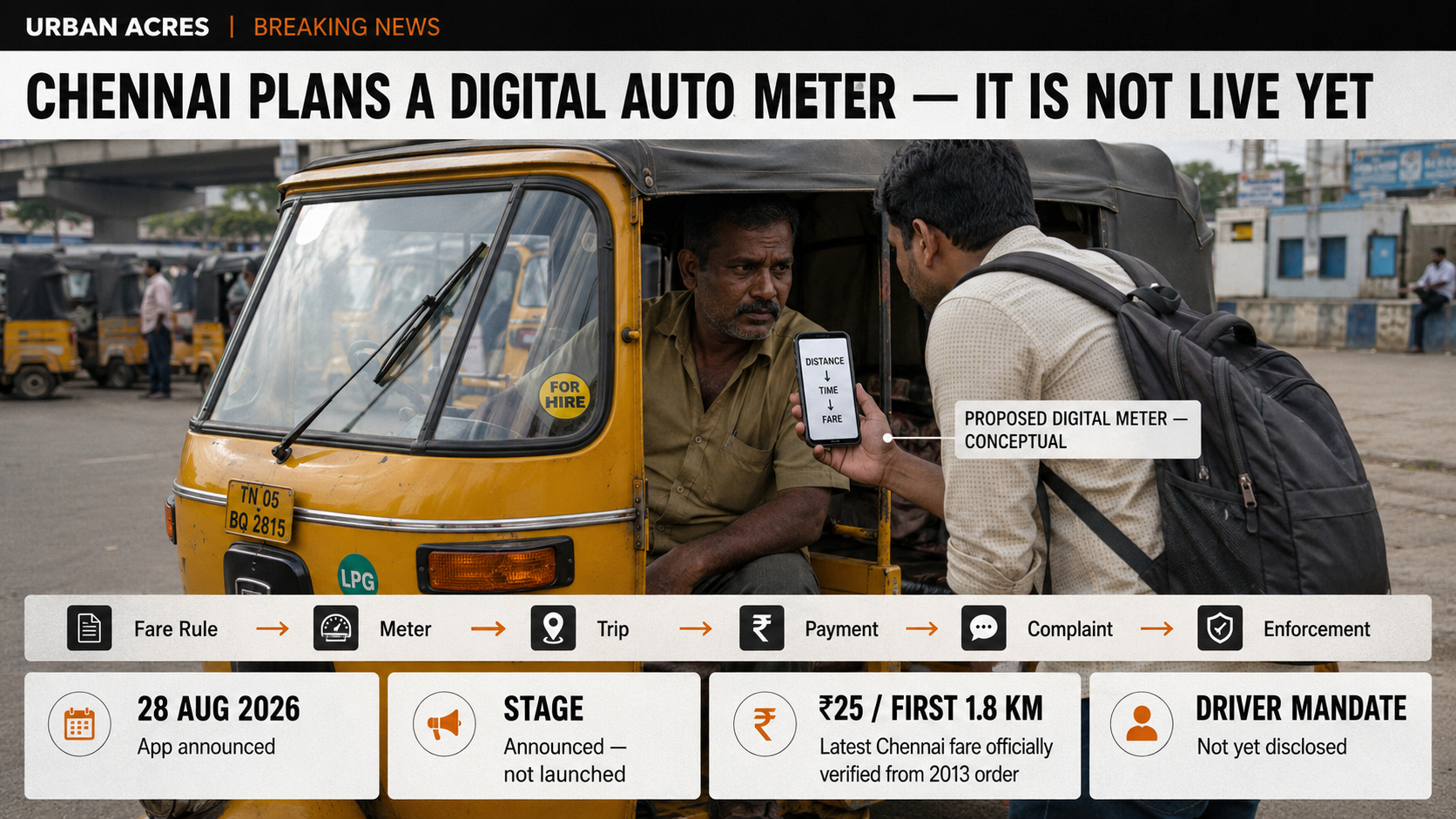
Tamil Nadu has announced a digital-meter-based platform for Chennai’s autos and taxis, but the service has not yet been launched. The proposal could extend transparent fare calculation beyond app bookings to autos picked up at stands, yet its launch date, driver mandate, technical specification, procurement, cost and relationship with the existing Chennai One mobility app remain undisclosed.
CHENNAI — The Chennai Unified Metropolitan Transport Authority is planning a digital-meter-based application for autorickshaws and taxis, seeking to combine trip booking, fare calculation, payments and complaints within a government-managed mobility system.
The announcement was made in the Tamil Nadu Legislative Assembly on 28 August. Reports describe a proposed application in which a passenger can request an auto, a driver can accept the booking and a digital meter can then display the trip’s distance, duration and applicable fare. Cash and UPI payments would remain possible.
The proposal is potentially more consequential than a conventional ride-hailing app because the meter is also intended to serve passengers who take an auto directly from a stand. If implemented that way, the platform could reach the large part of Chennai’s para-transit market that still operates outside pre-booked app journeys.
But describing the system as already “launched” overstates its status.
No publicly verified evidence reviewed by Urban Acres establishes that passengers can currently activate the proposed CUMTA meter, that drivers have been onboarded specifically for it, or that an operational rollout has begun.
Chennai already has a CUMTA mobility app
The new announcement also needs to be distinguished from Chennai One, CUMTA’s existing multimodal platform.
Launched in September 2025, Chennai One integrates buses, Metro and suburban rail with last-mile services. CUMTA’s current Google Play listing explicitly advertises bookings for autos and cabs, and the authority included those modes in its description of Chennai One at launch.
That makes the unresolved product architecture important.
CUMTA has not yet publicly established whether the digital meter will become a Chennai One function, operate as a separate app, reuse the existing Namma Yatri technology stack or require a fresh procurement.
That distinction matters financially too. Chennai One was previously reported as a roughly ₹8-crore project maintained under a five-year contract with Moving Tech Innovations. There is no basis yet to treat that amount as the budget for the newly announced meter system.
The meter problem predates the smartphone
Chennai has attempted to solve essentially the same fare-governance problem for more than a decade.
The State’s August 2013 autorickshaw fare order fixed a minimum of ₹25 for the first 1.8 km and ₹12 for each subsequent kilometre, with waiting and night charges. It also instructed that electronic digital meters be recalibrated and envisaged meters combined with printers and GPS for vehicle tracking.
The same order proposed free electronic digital meters with printers and GPS for existing Chennai autos, at an estimated government cost of ₹80.49 crore, financed through the Road Safety Fund, together with a GPS-linked complaint system.
That history makes the 2026 announcement significant for a different reason: Chennai is once again trying to connect fare calculation, vehicle tracking and grievance handling, this time through a software platform.
The technology has changed. The governance test has not.
A digital meter needs a settled fare
The immediate complication is that Tamil Nadu is simultaneously reconsidering the autorickshaw tariff.
Official Transport Department material continued to list the 2013 Chennai tariff in its latest information publication reviewed by Urban Acres. Meanwhile, discussions in August 2026 have produced sharply different proposals from drivers, passengers and officials.
Those negotiations cannot be converted into an app tariff before the legally applicable fare is established.
The sequence therefore matters:
Fare assessment → authorised tariff → meter configuration → technical verification → driver onboarding → passenger use → complaints → enforcement → periodic revision.
Skipping the first stages would merely digitise uncertainty.
CUMTA now has stronger fare-governance powers
There is an important institutional change since the earlier meter programme.
The amended CUMTA Act gives the metropolitan authority explicit functions around fares for para-transit. Its Executive Committee is empowered to recommend fare structures based on periodic assessment, while the Authority can approve them. The Transport Commissioner is also a member of that Executive Committee.
At the same time, existing fare enforcement operates through the Transport Department and police, while the current fare-revision discussions have involved the Transport Commissioner and State government.
The government should therefore disclose the exact institutional chain through which the 2026 autorickshaw tariff will be recommended, approved, notified, encoded into the application and enforced on the street.
The presence of several institutions is not necessarily a conflict. But passengers and drivers need to know which decision is authoritative.
The app also raises a meter-certification question
Tamil Nadu’s motor-vehicle rules already contain requirements relating to vehicle taximeters, including testing, sealing and keeping meters operational.
A GPS- or phone-based fare calculation system therefore needs a clear technical and regulatory basis.
CUMTA should specify whether the proposed digital meter:
- is simply a passenger-facing representation of an approved vehicle meter;
- independently calculates distance and waiting time using GPS;
- replaces the conventional meter;
- or combines hardware and software through a certified system.
The answer has practical consequences. GPS can drift in dense streets, under flyovers or during weak connectivity. Waiting-time calculation, route deviations and interrupted trips also require defined rules if the displayed amount is to function as an enforceable fare rather than only an estimate.
Downloads will not prove the programme works
CUMTA should resist measuring success primarily through registrations or downloads.
A successful system would mean that passengers can obtain an auto at the notified fare without negotiation, drivers receive an economically credible tariff, the fare calculation can be independently audited, complaints produce timely decisions and the same protections extend to passengers who hail a vehicle without using a smartphone.
The more useful performance indicators would include the percentage of licensed autos onboarded, percentage of trips operated on the approved meter, ride refusals and cancellations, fare-related complaints, resolution times, differences between displayed and legally applicable fares, application uptime and driver earnings after any platform charges.
The 28 August announcement is therefore a legitimate mobility story, but it is an implementation commitment rather than a delivered service.
For Chennai residents, the meaningful milestone will not be when another app appears in an app store.
It will be when a passenger can enter an auto, see a legally valid fare being calculated, pay that amount without negotiation and obtain effective redress when the system fails.
