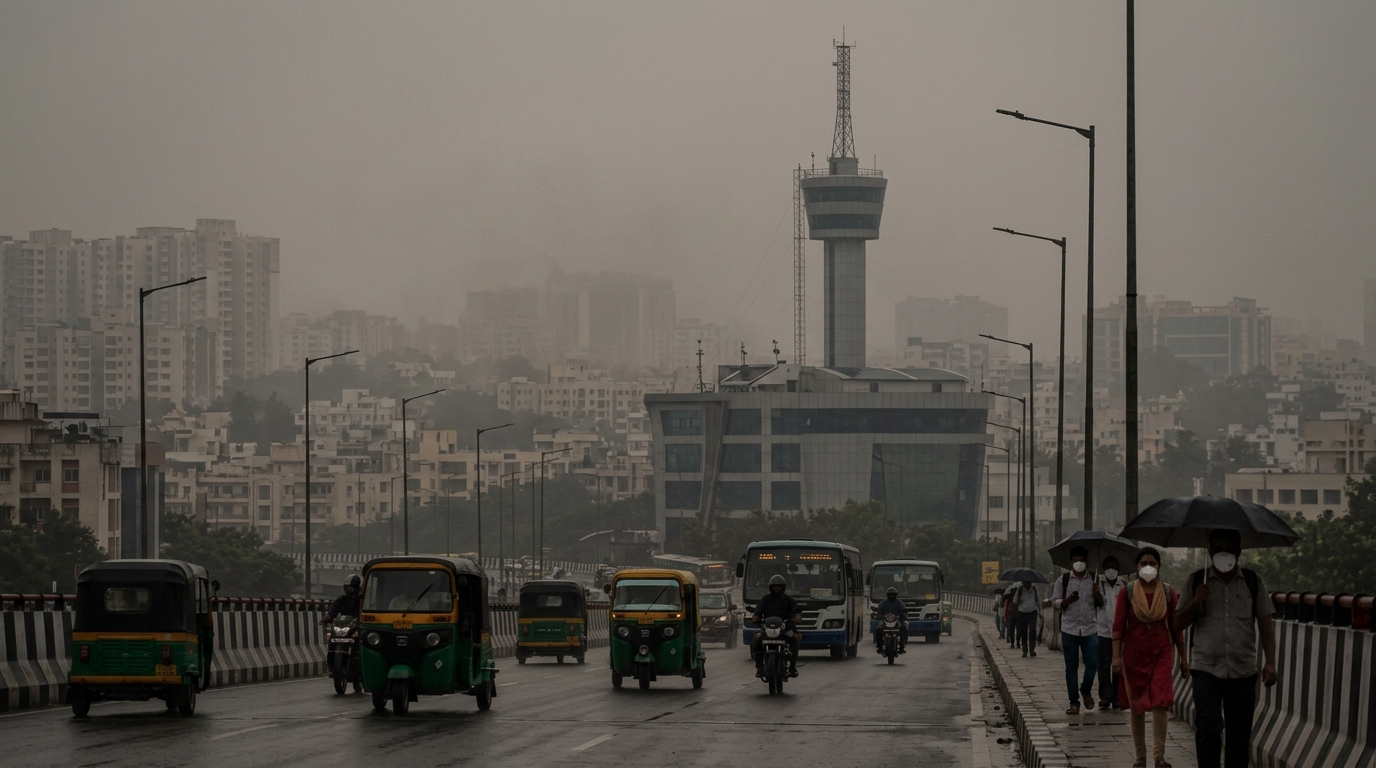
Bengaluru AQI Improves As Monsoon Washes Out Pollution
Bengaluru’s air quality has moved into the “Good” range amid continued monsoon activity, with reported AQI readings around 35–38 on August 26. Other Karnataka cities also recorded relatively clean conditions. The improvement offers temporary relief for residents and highlights how rainfall and atmospheric circulation can quickly alter pollution levels across dense urban areas.
The reported Bengaluru AQI is well within the Central Pollution Control Board’s “Good” category, which covers readings from 0 to 50. At this level, the expected health impact is considered minimal. However, AQI is a short-term indicator and can change significantly between monitoring locations and across different times of the day. Monsoon weather is playing an important role. Rain can remove suspended particulate matter from the atmosphere, while stronger winds can disperse pollutants rather than allowing them to accumulate over built-up areas. The combination is particularly relevant in a city such as Bengaluru, where traffic, construction activity and road dust remain persistent sources of urban emissions. The reported improvement was not limited to the state capital.
Dharwad, Mysuru, Mangaluru and Hubballi were also described as experiencing favourable air conditions, with Dharwad cited at around 18–22. Independent monitoring on August 26 also showed Dharwad in the “Good” category, although readings differed from the figures cited in the report, underlining the importance of station-specific and time-specific measurements. For citizens, cleaner air can make outdoor activity more comfortable, particularly for children, older residents and people who are sensitive to air pollution. Yet a temporary monsoon-driven improvement should not be mistaken for a structural reduction in urban emissions. Once rainfall weakens and atmospheric conditions become more stagnant, particulate pollution can rise again. The Bengaluru AQI therefore remains a useful measure not only of daily environmental conditions but also of how urban systems respond to weather. Sustained improvement will depend on reducing pollution at source through cleaner mobility, better dust management, effective construction practices and stronger public transport connectivity.
For a rapidly expanding metropolitan region, the immediate priority is to use periods of cleaner air as an opportunity to strengthen long-term pollution controls. Consistent monitoring across neighbourhoods will also help ensure that citywide averages do not obscure differences in exposure faced by communities living near busy roads and construction zones.