


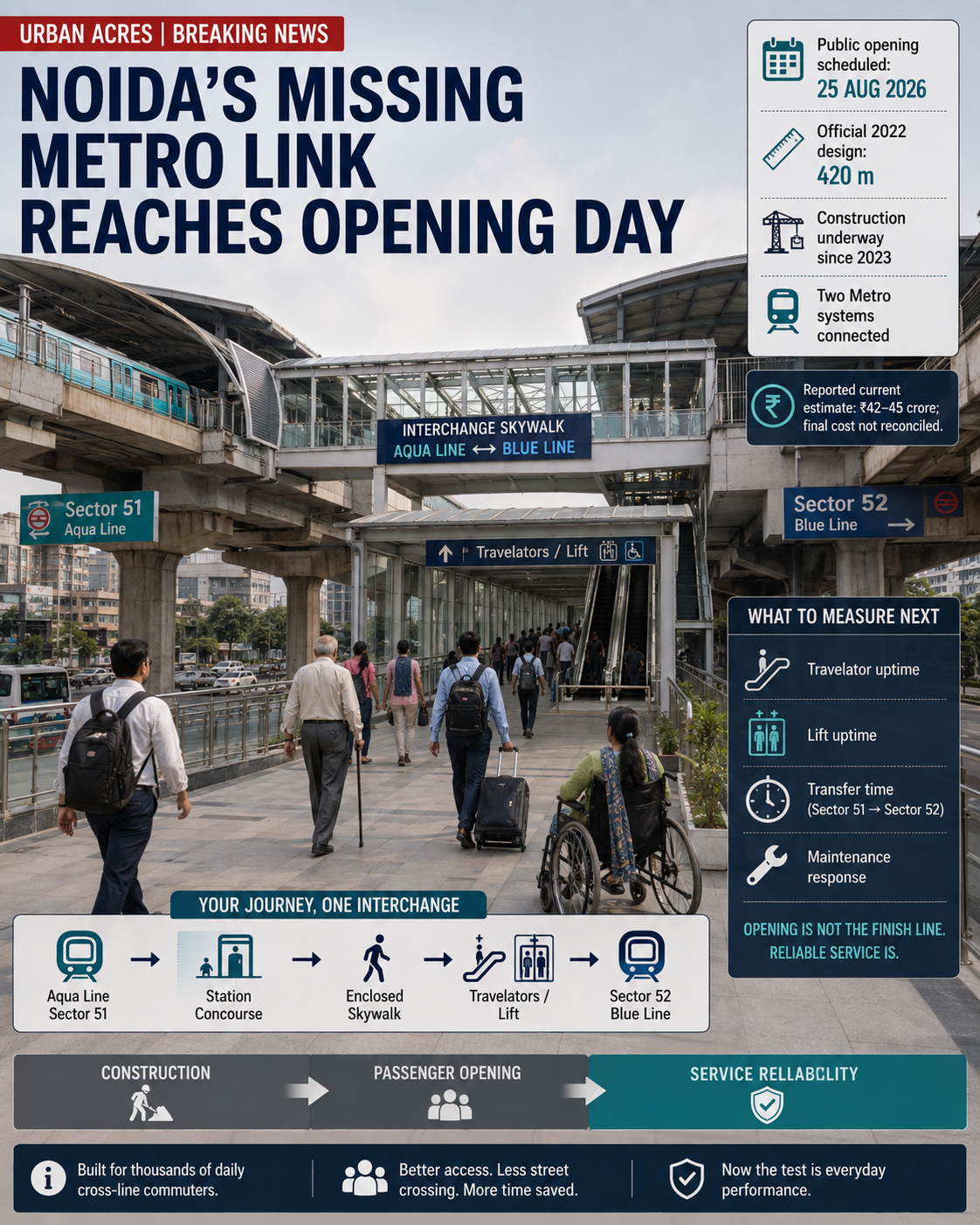
The elevated pedestrian connection between Noida Metro’s Aqua Line and Delhi Metro’s Blue Line is scheduled to enter passenger use on August 25. After repeated delays and design changes, the next test is whether the link delivers a reliable, accessible interchange—and whether authorities disclose its final cost and pending quality-control information.
NOIDA, August 25: The long-delayed pedestrian skywalk linking Noida Metro’s Sector 51 station on the Aqua Line with Delhi Metro’s Sector 52 station on the Blue Line is scheduled to be opened to passengers on Tuesday, potentially closing one of the most persistent interchange gaps in Noida’s Metro network.
Images taken on August 24 show the enclosed structure substantially finished, while reports on August 23–25 say preparations have been completed for public use. At Urban Acres’ 09:43 IST verification cut-off, however, independently verified evidence of ordinary passengers already using the facility was not yet available. The precise formulation therefore matters: the skywalk is set to open, rather than confirmed operational.
The distinction is particularly important because the project has crossed several previous completion and opening targets.
A missing interchange since the two networks met
Sector 51 is the northern terminal of NMRC’s Aqua Line, while nearby Sector 52 serves DMRC’s Blue Line. The two stations belong to different Metro systems and were never built as a conventional integrated interchange.
NMRC attempted to reduce that inconvenience soon after Aqua Line operations began. Its 2019 year-end report records the inauguration of a walkway between the two stations along with free e-rickshaw connectivity.
A permanent elevated connection followed.
NMRC’s formal procurement documents from 2021–22 proposed a covered foot overbridge approximately 420 metres long, connecting the concourses of the two stations. The project was originally pursued on a build-operate-transfer basis. When private participation did not materialise, Noida Authority moved towards publicly developing the link.
Construction itself then created another temporary connectivity problem. In June 2023, NMRC said the dedicated pedestrian route had been blocked by FOB construction and restored an e-rickshaw service on a modified route.
Why a pedestrian link took years
What appears to be a relatively simple connection between two adjacent stations became a multi-agency engineering interface.
During execution, the project underwent alignment changes and encountered underground infrastructure. Later, an existing structural beam at the Sector 51 station connection became another obstacle. Reporting in early 2026 said the beam had not been adequately represented in the information used for the planned connection, requiring another engineering solution rather than simply completing the original alignment.
Those changes are also why Urban Acres does not recommend publishing a single definitive length without an as-built record. The official 2022 RFP said 420 metres; subsequent public reports have described approximately 400, 460 and 480 metres at different stages.
The discrepancy may be explainable by redesign and extensions, but the final as-built length should come from the completed-project documentation rather than another estimate.
The cost also needs an as-built reconciliation
Current photo-agency material puts the project at an estimated ₹42–45 crore, while earlier execution reporting cited smaller figures. In July 2024, the project was described as roughly ₹26 crore across civil and electrical components; later that year, an additional ₹6 crore was approved as the design and scope changed. By 2026, approximately ₹40 crore had become the commonly cited figure.
Those numbers should not simply be added together because they may overlap.
What the public needs now is a straightforward completion account showing the original sanctioned scope, original contract values, approved variations, additional packages and final expenditure.
Opening also raises an immediate disclosure question
The project was subject to a quality-control intervention shortly before its scheduled opening.
Noida Authority said in August that steel samples associated with the skywalk had been taken for independent testing after an inspection raised concerns about alleged sub-standard material. Officials said contractor payments would remain withheld until laboratory results were received and that action would follow if the steel failed specifications.
That process should not be interpreted as proof of a structural defect.
But if the skywalk is entering passenger service, publication of the completed test outcome—or an authoritative statement confirming its disposition—would remove unnecessary ambiguity.
The next test is operational reliability
The skywalk is more than a steel pedestrian bridge. It incorporates systems such as air-conditioning, travelators, CCTV, fire detection and firefighting equipment and electrical infrastructure.
A Noida Authority procurement issued in May 2026 included a DG set and a year of operational staffing covering internal electrical systems, air-conditioning, fire systems, CCTV, travelators and caretaker functions for the Sector 51–52 skywalk.
That makes O&M performance central to whether the project succeeds.
A travelator that regularly fails, an inaccessible lift, non-functioning air-conditioning or poor crowd management would convert an expensive “seamless interchange” back into a long walk.
Opening day therefore measures only the completion of the capital project.
The public-service test starts the day after.
What commuters should be able to measure
The strongest evidence of success will be straightforward:
transfer time between the two stations, travelator and lift uptime, accessibility for wheelchair users and elderly passengers, crowding during peaks, weather protection, maintenance response times and actual passenger interchange volumes.
The project originated because two Metro systems were physically close but operationally inconvenient to transfer between.
If the skywalk reliably removes that friction, it will represent a meaningful mobility improvement.
If authorities stop reporting after the ribbon—or, in this case, the opening gate—the public will know that a structure was completed, but not whether the interchange actually works.
