


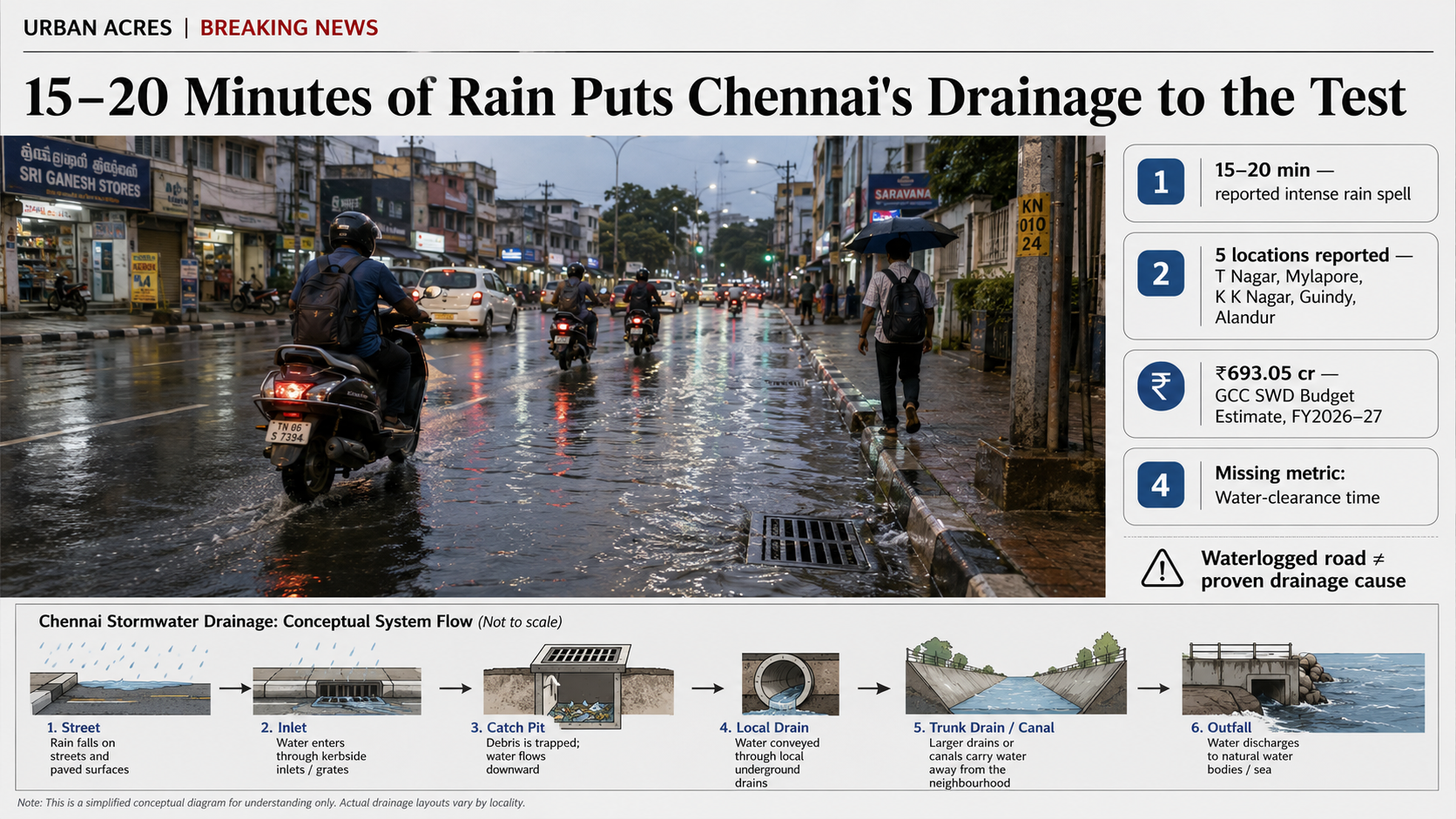
Short-duration thunderstorms left ankle-deep water on roads in T Nagar, Mylapore, K K Nagar, Guindy and Alandur on Monday evening. The event is fresh; the cause of the waterlogging is not yet established. The real infrastructure test is how rapidly each location drained—and why some streets accumulated water at all.
CHENNAI — A short burst of intense evening rainfall left roads waterlogged across several parts of Chennai on August 24, creating another real-world test of the city’s stormwater drainage system ahead of the northeast monsoon.
The Times of India reported ankle-deep water in T Nagar, Mylapore, K K Nagar, Guindy and Alandur after approximately 15–20 minutes of intense rainfall, with pedestrians and motorists forced to negotiate waterlogged roads.
The rainfall itself was not unexpected. The Regional Meteorological Centre had forecast moderate evening and night rain with thunderstorms and lightning over Chennai for August 24 and August 25. Its meteorological assessment pointed to a weak trough along and off the Tamil Nadu coast, with atmospheric conditions supporting convection.
But the rainfall forecast and the urban-service outcome are different questions.
For Chennai’s drainage system, the important measurement is not simply whether rain fell. It is whether runoff could move through the entire chain:
Street surface → inlet → catch pit → lateral stormwater drain → trunk network → canal/waterway → river or final outfall.
Water accumulating on a street may indicate a constraint somewhere along that chain. It does not, by itself, identify the constraint.
What Monday’s waterlogging proves—and what it does not
The event establishes that several streets reportedly accumulated enough water to disrupt normal pedestrian and vehicle movement.
It does not yet establish that Chennai’s stormwater system was structurally incapable of handling Monday’s rainfall.
The distinction depends heavily on recession time.
If a very intense convective burst temporarily overwhelms street inlets but water clears soon after rainfall eases, that represents a different engineering and maintenance problem from water remaining for several hours because of blocked drains, missing links, inadequate outfalls or pumping constraints.
No authoritative street-by-street clearance-time dataset for Monday’s affected locations was located during this review.
That is the most important missing information.
Chennai has already invested heavily in drainage
This waterlogging occurred against a substantial programme of stormwater investment.
GCC’s current stormwater-drainage webpage says approximately 225 km of SWD work has been completed at an estimated ₹699 crore, while another 70.26 km is described as being under implementation at ₹276.54 crore, across funding mechanisms including Singara Chennai 2.0, flood-relief, disaster-mitigation and other funds.
Separately, GCC’s 2025–26 climate-budget documentation describes 236 stormwater and culvert work packages with an overall multiyear project cost of about ₹5,553.3 crore, funded through sources including ADB, KfW, State mitigation funding, Singara Chennai 2.0 and the Corporation’s own resources.
Those numbers must not be casually added together: they refer to different scopes, programmes and financial classifications.
For FY2026–27, the Corporation’s budget-at-a-glance puts the Storm Water Drain Department Budget Estimate at ₹693.05 crore, against a revised estimate of ₹1,290.05 crore for 2025–26.
Again, that is an allocation, not proof of money spent or drainage capacity delivered.
Maintenance matters as much as construction
GCC says stormwater drains are desilted on a cyclic basis, generally twice annually, with inlet chambers and chute pipes also cleaned periodically.
The Corporation separately reported in June that more than 21,000 silt-catching pits had been cleaned across its zones during a 15-day monsoon-preparedness campaign.
Monday’s waterlogging therefore creates a useful operational test.
For each recurrent hotspot, GCC should be able to establish:
Was the inlet functional?
Was its connected drain clear?
Was there an uninterrupted downstream connection?
What rainfall intensity was recorded?
When did stagnation begin?
When did it clear?
Without those measurements, the public sees only two competing narratives—“the rain was intense” and “the drains failed”—when the engineering reality may differ from street to street.
Geography also matters
The triggering report groups Alandur among Chennai’s suburban areas. Administratively, however, Alandur is GCC Zone XII.
That matters because urban flood reporting should follow drainage catchments and responsible institutions rather than imprecise city-versus-suburb labels.
Likewise, T Nagar, Mylapore, K K Nagar and Guindy cannot be treated as a single drainage problem merely because they experienced waterlogging on the same evening. Different roads may connect to different local drains, canals and downstream systems.
Urban Acres should therefore resist a single citywide diagnosis until locality-level evidence becomes available.
What Chennai should publish after every significant rain event
GCC’s own climate-budget framework lists reduction in water-stagnation locations among the KPIs for stormwater infrastructure.
That principle can be made operational.
Instead of reporting only kilometres of drains constructed, Chennai could publish a rainfall-response dashboard showing, for every established hotspot:
rainfall intensity → maximum water depth → time to peak stagnation → time to complete drainage → pump deployment → drain or inlet obstruction → corrective action.
That would allow residents to see whether capital spending and maintenance are actually improving service from one storm to the next.
Monday evening’s rain is therefore more than another weather update.
It is a repeatable performance test.
And the meaningful measure is not whether Chennai can claim more drains, more desilting or more expenditure.
It is whether the same streets become usable faster after the next comparable burst.
