


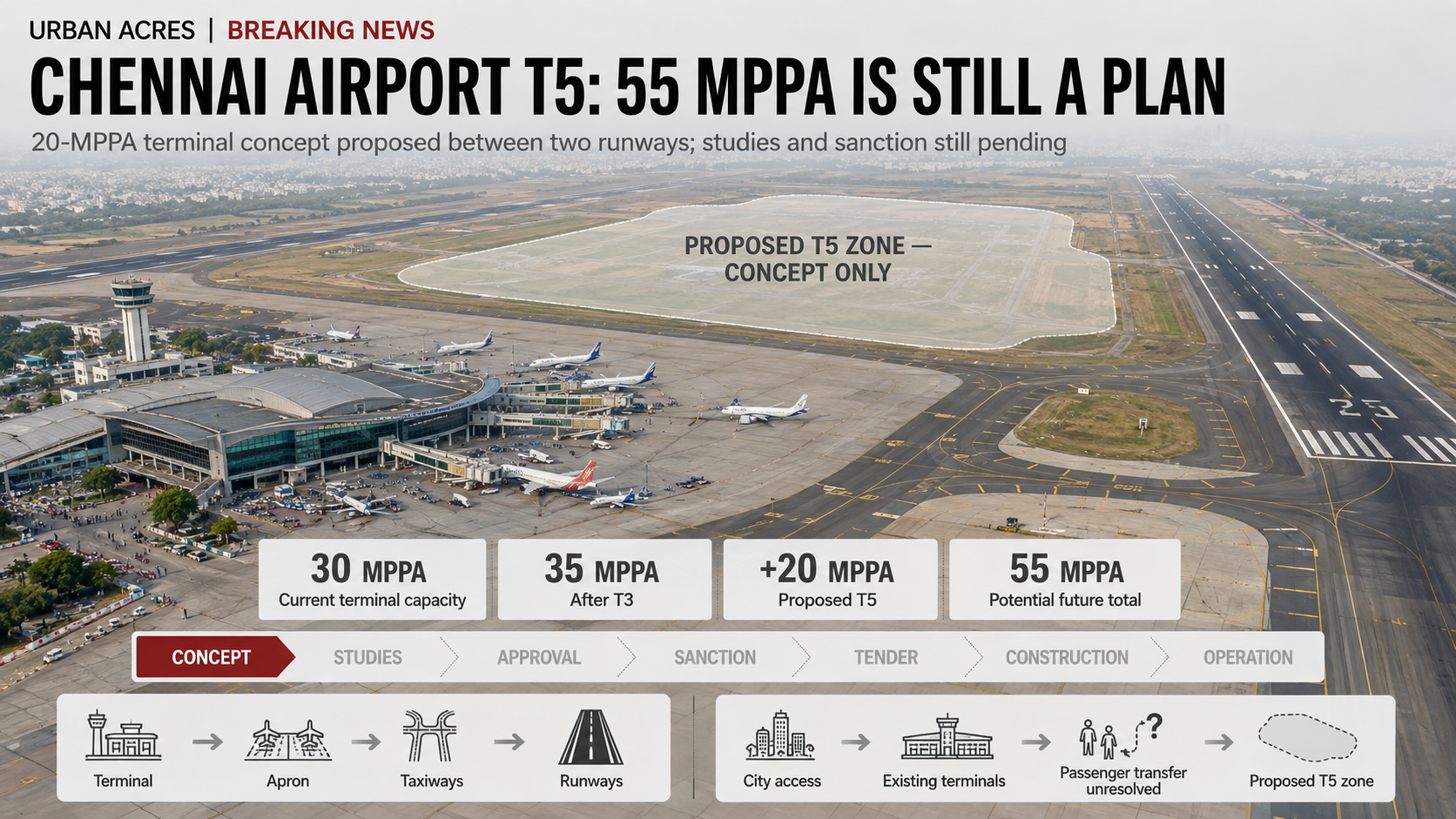
AAI is examining a fifth passenger terminal between Chennai Airport’s two runways as part of a plan that could eventually lift terminal capacity to about 55 million passengers a year. But the project remains at an early planning stage: technical and traffic studies have not yet been commissioned, its cost and approvals are undisclosed, and even the passenger connection between the proposed terminal and the existing terminal complex has not been finalised.
Chennai International Airport could eventually acquire a fifth passenger terminal capable of handling another 20 million passengers annually, but the proposal announced this week should not yet be read as a sanctioned construction project.
The Airports Authority of India is examining a Terminal 5 in the “V” shaped area between Chennai Airport’s two runways, according to AAI officials quoted by The New Indian Express. If eventually delivered, the additional terminal is expected to take the airport’s stated passenger-handling capacity to approximately 55 million passengers per annum.
That 55-million figure requires an important qualification.
Chennai Airport currently has a stated terminal capacity of about 30 MPPA following the first phase of its integrated-terminal expansion. The ongoing Terminal 3 project is intended to increase that capacity to 35 MPPA. Only after adding the proposed 20-MPPA Terminal 5 would the airport theoretically reach the 55-MPPA figure.
A concept, not yet a construction project
The most important detail in the announcement is therefore not its capacity number but its project stage.
AAI told TNIE that no technical or traffic studies have yet been commissioned for T5 and that only a concept has been presented. The authority has also not finalised how passengers would move between the existing terminal complex and a terminal located across the airfield, although an automated people mover is among the options being considered.
No publicly verified T5 DPR, administrative sanction, expenditure sanction, final project cost, financing plan, construction tender, contract award or implementation schedule has been identified by Urban Acres.
AAI’s own capital-expenditure documentation provides useful confirmation of the stage. It lists “Development of Chennai Airport – PH III” as “Under Planning.”
That distinction matters because the present announcement answers only one question—where AAI might place additional terminal capacity—while leaving most of the engineering and financial questions unanswered.
Terminal 5 itself is not an entirely new idea
The capacity-expansion process also predates this week’s announcement.
AAI floated a tender in 2022 for a technical consultant to advise on enhancement of Chennai International Airport’s existing capacity.
By February 2026, reporting carried in AAI’s corporate press archive was already referring to an AAI plan for a satellite or T5 terminal towards the rear side of Chennai Airport, alongside discussions over whether cargo facilities should also shift westward.
The latest development is therefore better understood as an evolution and public elevation of an existing Phase-III capacity concept, now tied more visibly to Tamil Nadu’s altered airport strategy after the government abandoned the proposed Parandur greenfield airport site.
The State has said it will look for an alternative site for Chennai’s eventual second airport. Reuters reported on August 24 that the State simultaneously intended to expand the existing airport towards 55-MPPA capacity.
T5 should consequently not be presented automatically as a permanent substitute for a second airport. At this stage, the two strategies remain parallel: extracting additional capacity from Meenambakkam while identifying another site for longer-term metropolitan aviation growth.
Terminal capacity is only one part of airport capacity
Whether Chennai can reliably process 55 million passengers annually depends on substantially more than another terminal building.
An airport functions as a chain:
Road/Metro access → terminal processing → security/immigration → gates and aircraft stands → taxiways → runways → airspace → baggage/cargo → onward access
A bottleneck at any one of those interfaces can prevent nominal terminal capacity from becoming usable passenger capacity.
AAI is already expanding the airside.
A separate project for eight rapid-exit taxiways on Runway 07-25 and three on Runway 12-30, along with parallel and link taxi-track works, was awarded in October 2025. The contract is valued at approximately ₹248.22 crore and carries a scheduled completion date of December 31, 2026.
A Parliamentary record identifies the broader sanctioned cost of the rapid-exit-taxiway and associated taxi-track programme as ₹480.06 crore.
These are material airside improvements, but they must be kept financially and editorially separate from T5. They do not constitute sanction for the terminal.
There is also an unresolved numerical question. The latest TNIE report says the future plan envisages ten rapid-exit taxiways, while the existing AAI contract is explicitly for eleven.
The scopes may have changed or may refer to different components, but the difference should not be reconciled by assumption.
Landside access may be as important as terminal design
The proposed location also creates an unusual passenger-access problem.
AAI has acknowledged that the connection between the existing terminals and T5 remains unresolved. If the terminal is physically separated by active airfield infrastructure, transfer time, baggage logistics, emergency access and the reliability of any people-mover system become fundamental operating questions rather than secondary architectural details.
Road access presents another interface.
The latest proposal is being discussed alongside airport-access and cargo-corridor ideas intended to create additional connectivity from the Chennai Bypass and Outer Ring Road side. CUMTA has previously argued for moving cargo towards the western side of the airport and establishing more direct freight access from Chennai’s western industrial clusters.
Tamil Nadu’s Integrated Logistics Plan has already identified restricted 24-hour access and high dwell times at Chennai’s air-cargo complex as constraints.
Again, however, these proposals are not interchangeable with T5 approval.
The traffic case needs to be published
Perhaps the most consequential missing document is the new traffic study.
AAI’s 2023 commercial tender documents contained an indicative forecast of approximately 30.14 million passengers for FY2025-26 at Chennai Airport.
AAI figures subsequently reported for FY2025-26 show actual traffic of about 23.02 million passengers, around 24% below that earlier indicative forecast.
That does not establish that T5 is unnecessary.
Airport investment must consider peak-hour demand, airline schedules, aircraft stands, cargo growth, international traffic, long planning and construction lead times, resilience and expected metropolitan growth rather than annual passenger totals alone.
But it does establish why a new, independently scrutinised traffic forecast is essential before a 55-MPPA programme progresses.
AAI should disclose the demand year at which 35 MPPA is expected to become constrained; expected domestic and international passenger splits; peak-hour passenger demand; aircraft-movement assumptions; runway throughput; apron requirements; cargo forecasts; and the role assigned to the eventual second airport.
The next milestone is evidence, not construction
For now, Terminal 5 represents a significant planning direction rather than physical infrastructure.
Its public-interest importance lies precisely there.
Chennai is trying to extract another major increment of capacity from a geographically constrained airport while simultaneously reconsidering the location of its future greenfield airport. That makes Phase III not merely a terminal-building exercise but a test of how much additional performance can realistically be obtained from the entire Meenambakkam aviation system.
The next meaningful milestone should therefore not be another capacity announcement.
It should be publication of the studies showing that the proposed terminal, airfield, passenger-transfer, road-access and cargo systems can collectively deliver the 55-million-passenger outcome being discussed.
