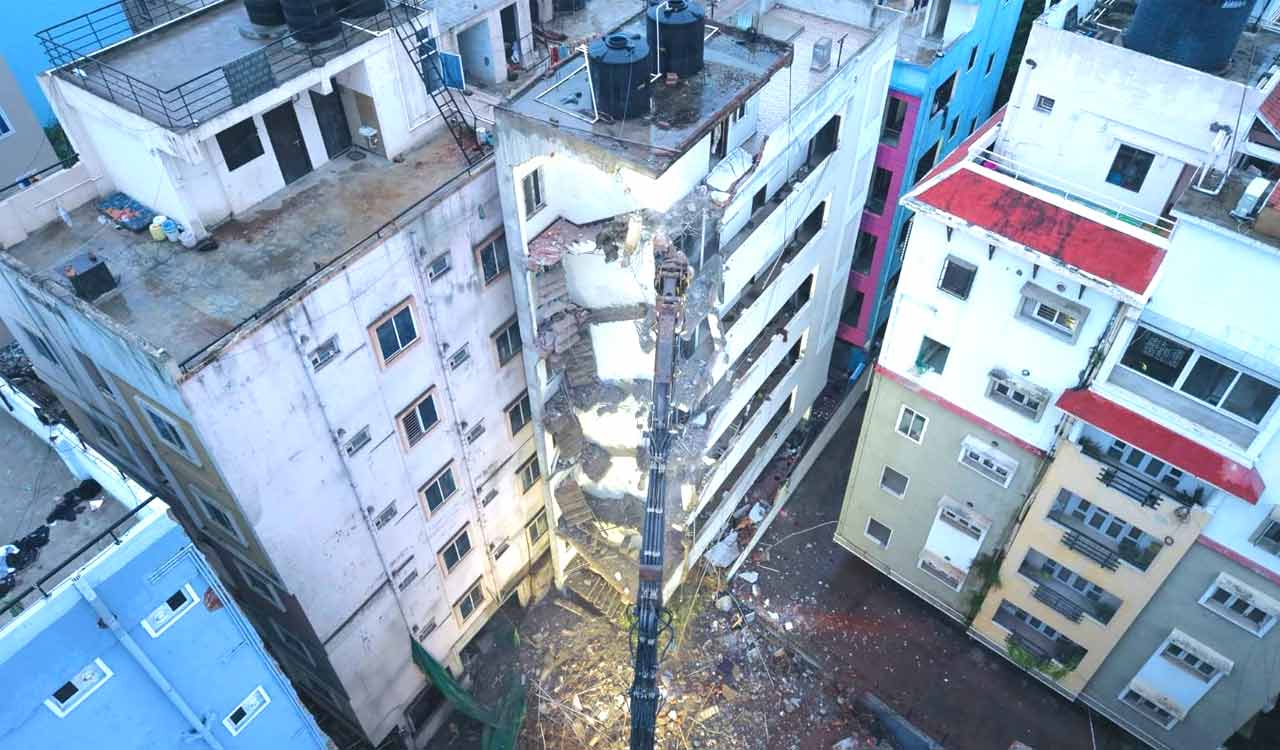
Hyderabad Orders Action On Unauthorised Structures
HYDERABAD: Hyderabad’s newly constituted Cyberabad Municipal Corporation has stepped up enforcement against unauthorised construction, with officials directed to identify structures that breach building rules and take demolition action where required. The move puts renewed focus on safety and regulatory compliance as the city continues to see rapid residential development and construction pressure.
The latest direction comes shortly after the collapse of an unauthorised seven-storeyed building in Gachibowli on August 22, in which two migrant workers were killed. The incident has intensified scrutiny of construction activity and the effectiveness of local enforcement mechanisms. Under the instructions, officials have been asked to examine buildings within Cyberabad Municipal Corporation limits and act against structures that do not comply with approved building norms. Particular attention has been drawn to buildings constructed on plots of up to 75 square yards where the structure exceeds seven metres in height. The threshold is significant because Telangana’s building approval framework provides an instant-registration route for individual residential buildings on plots up to 75 square yards, subject to a maximum height of seven metres. Buildings that exceed these parameters fall outside that simplified category and require compliance with the applicable approval process.
For property owners, the enforcement push underlines the financial and legal risks of treating building permissions as a formality. Unauthorised additions or construction beyond approved limits can also create problems for buyers, lenders and insurers, particularly when ownership or occupancy changes hands. For the city, however, enforcement is about more than removing individual structures. Unregulated construction can place additional pressure on roads, drainage, water supply, emergency access and other neighbourhood infrastructure. In densely developing areas, buildings that exceed planned capacity can also reduce safety margins and complicate disaster response. Urban planners say consistent enforcement needs to be accompanied by clear approval processes, accessible records and timely inspections. A system that identifies violations only after construction is complete can leave residents, workers and neighbouring properties exposed to avoidable risks.
The creation of Cyberabad Municipal Corporation earlier this year has also changed the administrative landscape. Telangana reorganised the former Greater Hyderabad Municipal Corporation into three civic bodies — Cyberabad, Malkajgiri and a restructured GHMC — with Cyberabad covering the Serilingampally, Kukatpally and Quthbullapur zones. The immediate test will be whether illegal building enforcement becomes routine rather than reactive. For a rapidly expanding metropolitan region, stronger compliance can help align real estate growth with safer neighbourhoods, infrastructure capacity and more resilient urban development.