


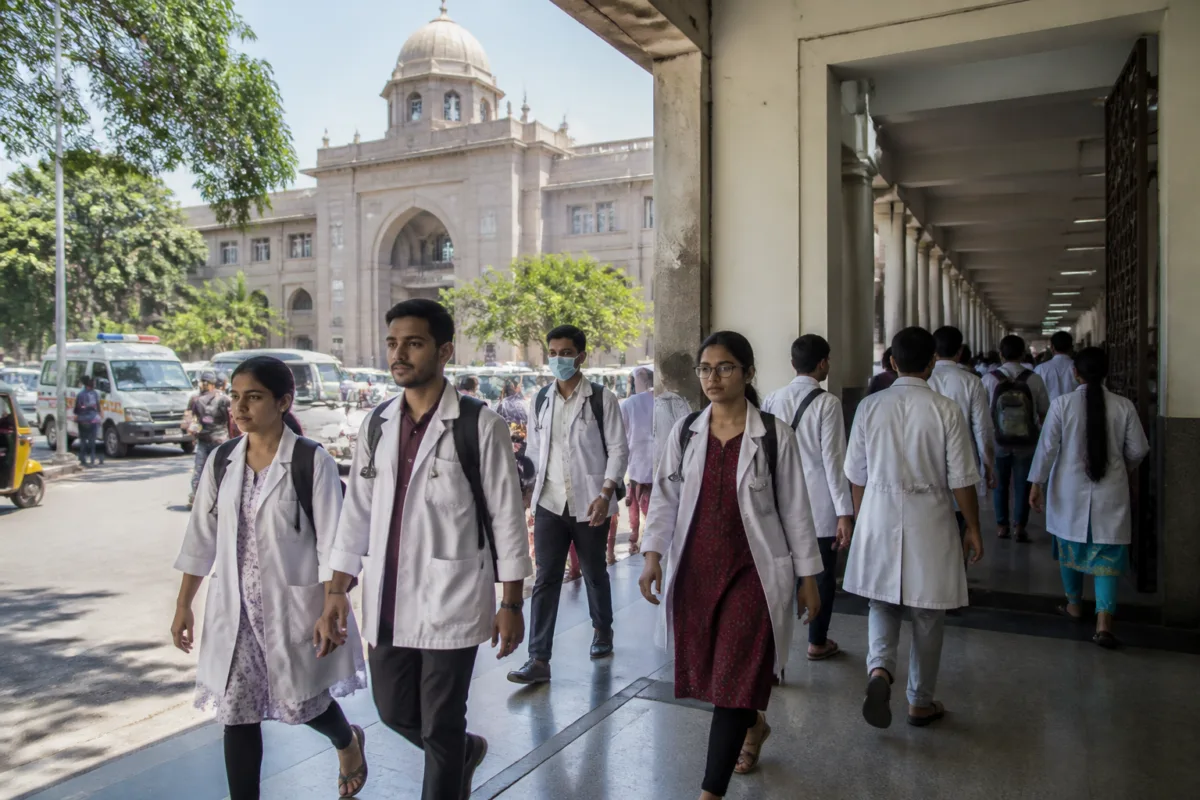
Osmania General Hospital has capped the weekly duty hours of junior residents and interns at 48 hours, introducing structured shifts and a mandatory weekly day off after concerns over uneven workloads and extended periods of duty.
The hospital superintendent’s circular, dated October 27, directs all heads of departments to implement and monitor the revised schedule. Under the duty pattern, junior doctors will work two 12-hour shifts each week, while duty on the remaining four working days will be limited to six hours a day.
Each junior resident and intern must also receive one full, uninterrupted day off every week, according to the circular. Heads of departments have been asked to review their staffing requirements and submit revised monthly duty rosters to the superintendent’s office by the 28th of every month.
Attendance will be monitored by the unit chief or a faculty representative. The requirement places responsibility on individual departments to document duty schedules and ensure that the revised limits are followed rather than leaving working hours to informal arrangements.
Speaking to Deccan Chronicle, OGH superintendent Dr Rakesh Sahay said workload and duty hours were not uniform across departments. Junior doctors and their parents had submitted representations seeking regulation of working hours, he said.
“Some departments have heavy workloads while others have less work. It is better to have a rational and uniform system in which work is divided among everyone,” Sahay said.
The decision follows concerns raised over long working hours among postgraduate medical students. N Chandrakanth, president of the OGH Junior Doctors Association, said the earlier informal practice required junior doctors to work for as long as 72 hours in some cases.
“The unwritten practice was to make junior doctors work for up to 72 hours. In departments such as orthopaedics, junior residents sometimes work for more than 72 hours, with no clear schedule for rest or sleep. The new system will help departments plan shifts and distribute work,” Chandrakanth said.
The association also referred to a suicide reported four months ago while describing the pressures faced by junior doctors. The source report does not provide further details about the incident or identify any official finding linking it to working hours.
The revised system is intended to standardise rosters across departments while ensuring that shifts are distributed among available staff. Its implementation will depend on monthly roster reviews, attendance monitoring and the ability of departments to maintain services within the new schedule.
The OGH Junior Doctors Association has urged all departments to implement the norms and called on other government hospitals to adopt a similar system. The next formal monitoring step at OGH will be the submission of revised monthly duty rosters to the superintendent’s office by the 28th of each month.

