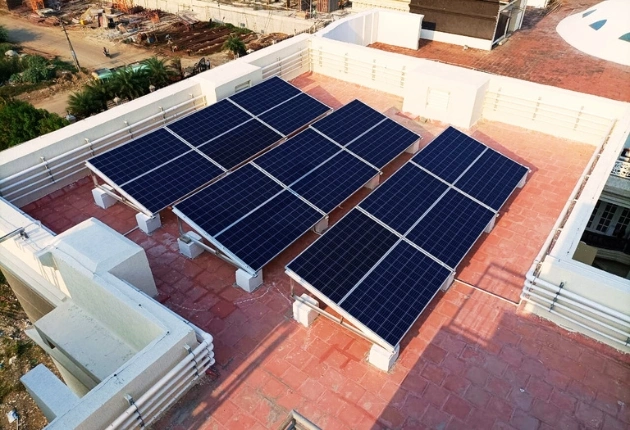
Southern Railway Boosts Chennai Solar Infrastructure
The Chennai division of Southern Railway has expanded its renewable energy infrastructure across suburban and urban rail assets, adding fresh rooftop solar capacity at key passenger stations and training facilities during the current financial year. The move reflects a broader transition underway within Indian transport systems, where energy efficiency and operational sustainability are becoming central to long-term infrastructure planning.
Rail officials confirmed that new solar installations with a combined capacity of 140 kilowatt peak (kwp) have been commissioned at St Thomas Mount, Guindy and railway training centres in Avadi. Together, the additions are projected to generate more than two lakh units of electricity annually, reducing dependence on conventional grid power while lowering operational expenditure for the division. The latest expansion takes the Chennai division’s cumulative solar power capacity to nearly 2.5 megawatt peak, positioning the network among the more active railway zones pursuing decentralised clean energy systems. According to railway estimates, solar generation across the division has already crossed 23 lakh electricity units during 2025–26, translating into significant annual savings in energy expenditure.
The solar power rollout is spread across a diverse railway ecosystem rather than limited to station rooftops alone. Installations have been integrated into office buildings, maintenance sheds, platform shelters and passenger infrastructure at transit nodes including Chennai Central, Tambaram, Chengalpattu, Arakkonam, Katpadi and Royapuram. Urban mobility experts say this distributed model is increasingly important for large transport operators seeking to reduce emissions without waiting for large-scale grid transformation.The expansion comes at a time when Indian cities are under growing pressure to decarbonise public infrastructure while managing rising electricity demand. Rail systems, which already offer lower carbon mobility compared to private vehicles, are now being viewed as critical assets in wider climate-resilient urban planning strategies. By embedding solar power into everyday transit operations, railway authorities are also attempting to shield public transport networks from long-term energy price volatility. Officials familiar with the programme indicated that hybrid renewable systems integrating both solar and wind energy are also being deployed within the division. Such systems can help stabilise power generation patterns across seasons and reduce dependence on fossil-fuel-based backup supply.
Urban planners note that renewable integration within public transport infrastructure has wider civic implications beyond cost savings. Reduced energy intensity in rail operations can contribute to cleaner urban air, lower municipal carbon footprints and more resilient metropolitan infrastructure networks, particularly in dense cities such as Chennai where transport demand continues to rise. The railway division has now set a target of adding another 2,600 kwp of solar power capacity during 2026–27. The next phase is expected to focus on scaling renewable energy use across additional stations and operational facilities, signalling a deeper institutional shift towards low-carbon transit infrastructure in one of India’s busiest rail corridors.