


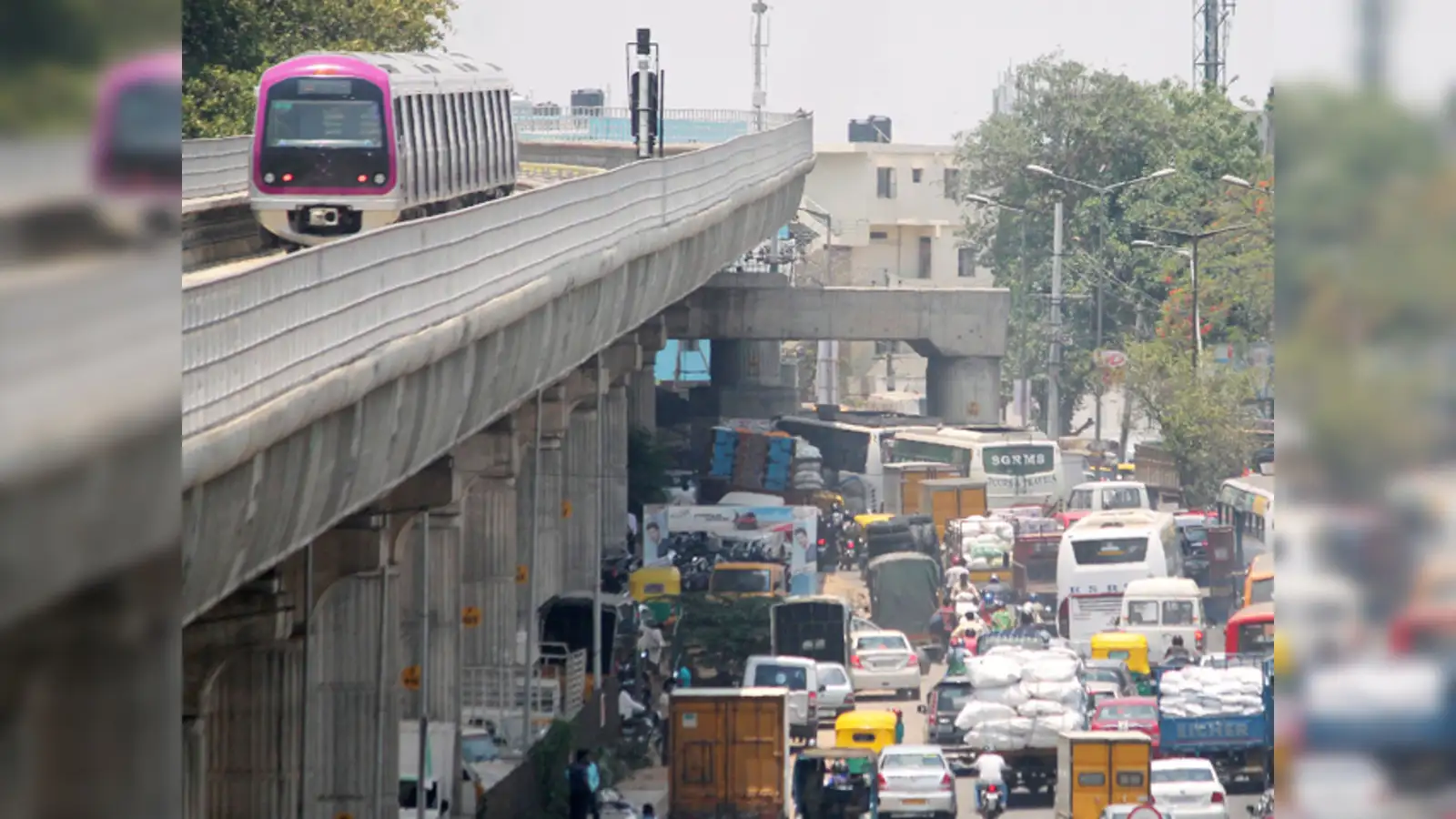
Urban planners in Bengaluru are advancing an 80-hectare transit-linked development strategy aimed at reshaping how the city grows around public transport infrastructure rather than private vehicle dependency.The proposed transit-oriented development, or TOD, model is being positioned as part of Bengaluru’s broader effort to address mounting congestion, fragmented urban sprawl, and rising pressure on civic infrastructure.By concentrating housing, commercial activity, and public amenities near high-capacity transit corridors, authorities hope to create denser and more walkable urban districts with lower travel dependence.
The Bengaluru transit-oriented development project reflects a growing shift in Indian urban policy toward integrating land use and mobility planning. Urban researchers say cities that expand without coordinated transit systems often face longer commutes, increased emissions, and costly infrastructure stress. Bengaluru’s rapid outward expansion over the past decade has intensified many of these challenges, especially across technology and residential corridors.Planning experts believe the 80-hectare project could serve as a testing ground for future growth models centred on metro accessibility, mixed-use neighbourhoods, and pedestrian-first infrastructure. If implemented effectively, the project may reduce pressure on road networks while improving access to employment zones and public services.The proposal also arrives at a critical moment for Bengaluru’s transport ecosystem. Despite ongoing metro expansion, the city continues to struggle with traffic congestion, disconnected last-mile mobility, and uneven public transport integration. Sustainable mobility specialists argue that transit-oriented development can improve the effectiveness of mass transit systems by increasing the number of residents and workplaces located within walking distance of stations.
However, urban governance experts caution that TOD frameworks must balance density with liveability. Without affordable housing mandates, public spaces, and social infrastructure, transit-linked districts risk becoming commercially driven enclaves that exclude lower-income residents.Environmental planners further stress that Bengaluru transit-oriented development should integrate climate-responsive design features such as shaded pedestrian pathways, water-sensitive urban planning, green open spaces, and reduced surface concretisation.As the city faces more frequent flooding and rising temperatures, experts say future development cannot rely solely on transport efficiency without considering ecological resilience.The project may also influence real estate trends across Bengaluru by shifting investment interest toward mobility-connected corridors. Analysts expect mixed-use commercial districts and higher-density housing to increasingly cluster around metro-linked infrastructure over the coming years.For policymakers, the initiative represents a broader attempt to redefine urban expansion in one of India’s fastest-growing metropolitan regions.
Rather than extending low-density sprawl outward, the Bengaluru transit-oriented development model seeks to encourage more compact, accessible, and infrastructure-efficient growth patterns.Its long-term success, however, will likely depend on how effectively planners integrate affordability, sustainability, and public transport connectivity into the city’s next phase of urban transformation.
Also Read:Bengaluru Green Ring Plan Targets Urban Resilience
