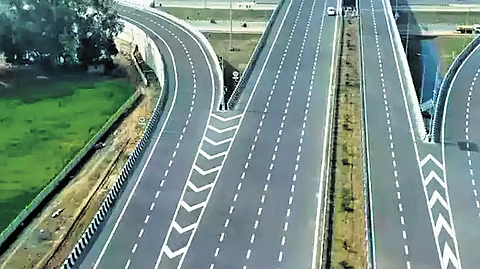
Two Kerala towns known for their legendary traffic bottlenecks are finally seeing movement on long-stalled bypass projects, but the revived plan reveals a sharp shift in how highway authorities now approach land acquisition. The National Highways Authority of India has fast-tracked bypass corridors for Muvattupuzha and Kothamangalam, aiming to break a deadlock that shelved the original proposal nearly two years ago.
The original project, which had funds allocated in 2023, collapsed after land acquisition notices failed to translate into actual handovers. A notification issued in December 2023 led nowhere. Now, the authority has revived the bypasses on a critical condition: minimise land take to ensure feasibility. According to a senior official overseeing the alignment, both bypasses will initially be built as two-lane roads with paved shoulders, totalling roughly 15 kilometres. The carriageway width will be 12 metres. However, the authority will acquire a wider corridor of 25 to 30 metres to accommodate service roads, side drains, pedestrian paths, and future expansion. Construction is targeted to begin by September, with a one-year completion deadline.
The strategic restraint is telling. A local representative confirmed that the central government revived the project only after the authority committed to keeping land acquisition to a “strategic minimum.” This marks a quiet but significant policy shift away from the earlier approach of acquiring broad swaths of land upfront—a practice that repeatedly triggered litigation and local resistance. For residents and small businesses in Muvattupuzha, where traffic from five major directions converges daily, the bypass cannot come soon enough. The town’s congestion has long choked local commerce, increased fuel waste, and lowered quality of life. Urban mobility analysts point out that the new approach—building a narrower core road while reserving land corridors for future expansion—mirrors successful models in dense Asian cities where land values and litigation risks are high.
The bypasses are part of the larger Kochi-Munnar NH 85 upgrade, a Rs 910-crore corridor. But that broader project remains fragmented. While most of the 124-kilometre stretch is being widened, a 12-kilometre section between Neriamangalam and Adimali remains frozen after a high court order, pending environmental clearance from the Union ministry of environment and forests. The contrast is sharp: one project moves forward by acquiring less land. Another stands still because it touches ecologically sensitive terrain. For commuters, relief on the Muvattupuzha and Kothamangalam stretches may arrive by next year. But the larger lesson for Kerala’s highway planning is that speed and sustainability are no longer optional—they are the only viable path forward.
Kochi Region Roads Get Faster Bypass Corridors