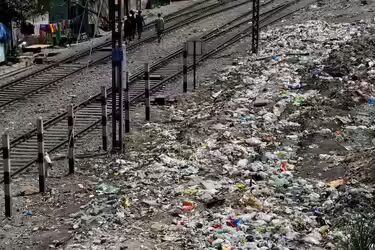
Despite multiple clean-up drives and coordinated efforts between civic bodies and railway authorities, waste accumulation along Delhi’s railway tracks continues to pose a persistent urban challenge. The issue, spanning several corridors across the city, highlights gaps in waste management systems and enforcement in densely populated zones adjoining railway land.
Recent assessments indicate that garbage dumping remains widespread even after targeted sanitation campaigns. This ongoing Delhi railway waste crisis reflects not just a maintenance problem, but a deeper structural issue tied to informal settlements, weak monitoring, and limited access to formal waste disposal systems. Authorities have undertaken large-scale interventions in recent months, removing thousands of tonnes of legacy waste from railway corridors. In some stretches, nearly half the network has undergone cleaning, with significant manpower and machinery deployed to reclaim these areas. Yet, the reappearance of garbage soon after clearance suggests that preventive systems remain inadequate. Urban experts point out that railway tracks often run alongside informal or high-density residential areas where formal waste collection services are inconsistent. In the absence of accessible disposal infrastructure, open dumping becomes a default practice.
This creates a cycle where periodic clean-ups are unable to deliver lasting results without behavioural change and systemic improvements. The environmental implications are considerable. Waste accumulation along tracks contributes to soil and water contamination, while also increasing the risk of fires and air pollution—particularly when waste is burned. In a city already grappling with multiple environmental stressors, unmanaged dumping further exacerbates public health risks for nearby communities and railway workers. The Delhi railway waste crisis also affects urban mobility and safety. Garbage on tracks can obstruct maintenance work, attract animals, and create hazardous conditions for train operations. Railway corridors are critical infrastructure, and their degradation has implications that extend beyond sanitation to operational efficiency and commuter safety.
Data on citywide waste generation adds context to the scale of the challenge. Delhi produces nearly 13,000 metric tonnes of solid waste daily, a figure that has been steadily rising with urban expansion. Without robust segregation, collection, and processing systems, a portion of this waste inevitably spills into unregulated spaces such as railway land. Officials have begun introducing measures such as designated dumping points, dustbins along tracks, and awareness campaigns to discourage open disposal. However, urban planners argue that these interventions need to be supported by stronger enforcement mechanisms and community-level engagement to ensure compliance. The persistence of the problem underscores a broader lesson for rapidly growing cities: infrastructure clean-ups alone cannot address systemic waste challenges. Long-term solutions require integrated planning that combines service delivery, behavioural change, and institutional coordination.
As Delhi continues its push towards cleaner and more sustainable urban systems, addressing waste along railway corridors will be a critical test of its ability to move from reactive clean-ups to preventive, citizen-centric waste management. The next phase of action will determine whether these highly visible urban spaces can transition from chronic dumping grounds to maintained public assets.