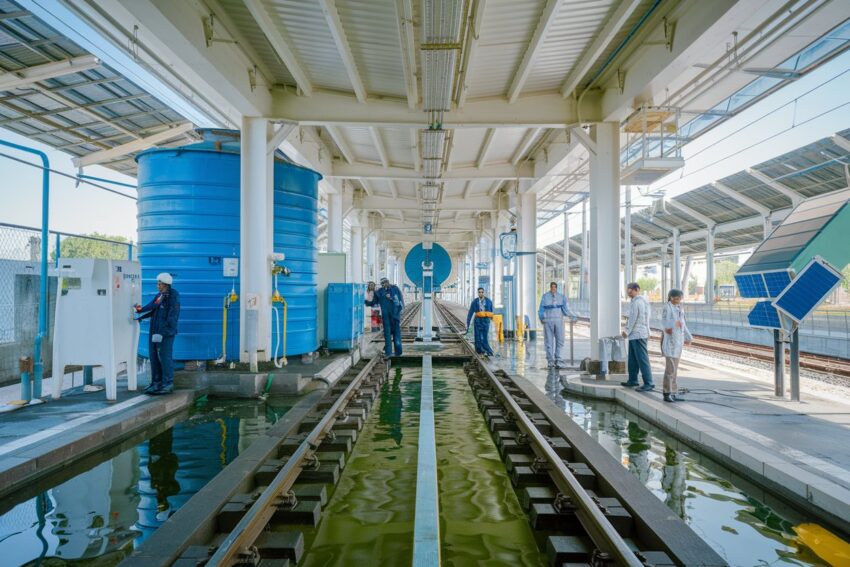
A railway depot in the heart of Gujarat has quietly achieved what most industrial facilities only promise: water neutrality. The Kankaria Coaching Depot, which services coaches for Indian Railways, now recycles nearly every drop of water it uses — saving an estimated 5.84 crore litres annually. The method involves no expensive imported technology. Just plants, sand, carbon, and ultraviolet light.
At the core of this transformation is phytoremediation — an eco-friendly technique where plants naturally absorb and filter contaminants from wastewater. Instead of sending used water from coach washing and maintenance into the drainage system, the depot now channels it through a constructed wetland. There, plants act as biological filters, pulling out impurities before the water moves to carbon and sand filtration stages. A final ultraviolet disinfection ensures it is safe for reuse. The numbers are striking. Daily savings amount to nearly 1.60 lakh litres — equivalent to more than 300 household water tanks. For a city like Ahmedabad, which faces recurring water stress, every litre recycled at an industrial scale reduces pressure on freshwater sources and groundwater extraction.
A railway official described the initiative as a breakthrough in reducing freshwater dependence in operations. But what makes Kankaria notable is not just the volume saved — it is the replicability. Phytoremediation requires land for constructed wetlands, but it does not require high energy inputs or chemical coagulants. For a cash-conscious yet land-rich entity like Indian Railways, the model offers a low-carbon, low-operating-cost pathway to water neutrality. Urban water management experts have long argued that Indian cities focus too heavily on centralised sewage treatment plants while ignoring decentralised, nature-based solutions at the facility level. Kankaria depot is precisely that: a decentralised system treating wastewater at its source, eliminating the need to pump dirty water across the city to a distant plant.
The Ministry of Railways has confirmed that the system adheres to environmental standards and reduces operational costs. But the broader implication is systemic. If every major railway depot, bus terminus, and industrial yard adopted similar phytoremediation-based recycling, the cumulative water savings across urban India would be immense. What changes next is whether other depots follow. Kankaria is India’s first water-neutral railway facility. The question is how long it will remain the only one.
Ahmedabad Depot Becomes Indias First Water Neutral Railway