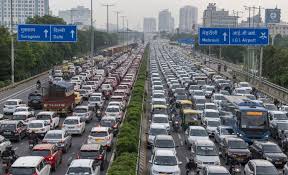
A major transport overhaul across the Delhi–Gurugram corridor is set to significantly reduce travel time between the two cities, with planners targeting a 15-minute commute along one of the most congested urban stretches in the National Capital Region (NCR). The initiative combines road redesign, grade-separated infrastructure, and integration with mass transit systems to address chronic congestion and improve mobility efficiency.
The plan centres on converting key arterial routes—particularly the Mehrauli-Gurugram (MG) Road—into signal-free corridors through the construction of multiple flyovers and multi-level interchanges. High-density junctions such as IFFCO Chowk and Ashram-Badarpur are expected to be redesigned to eliminate traffic signals and reduce bottlenecks that currently extend peak-hour travel times to over an hour. Authorities are also focusing on redesigning a critical 5.5-kilometre stretch between the Delhi border and IFFCO Chowk into a “model road,” with uninterrupted traffic flow as the central objective. A multi-level cloverleaf interchange at IFFCO Chowk is planned to streamline movement across major business and residential districts, reflecting a shift toward grade-separated mobility systems in high-density corridors. Beyond road infrastructure, the project is closely aligned with the expansion of regional transit systems such as the Namo Bharat rapid rail network. The convergence of high-speed rail, metro lines, and upgraded roadways at key nodes is intended to create multimodal transit hubs, allowing seamless interchange between different transport modes.
From an urban development perspective, the proposed 15-minute commute represents more than a travel-time reduction. It signals a shift toward integrated corridor planning, where mobility infrastructure is designed to support economic clustering, reduce fuel consumption, and optimise land use. Improved connectivity between Delhi and Gurugram could effectively merge the two into a more unified economic zone, influencing real estate demand, workplace geography, and daily commuting patterns. However, experts caution that signal-free road infrastructure alone may not guarantee sustainable outcomes. While reduced idling time can lower emissions in the short term, increased road capacity may induce higher private vehicle usage if not balanced with strong public transport integration. This makes the role of rapid rail and metro connectivity critical in ensuring that mobility gains translate into long-term environmental benefits. The project also raises questions around equitable access. While faster corridors may benefit car users immediately, ensuring that public transport users experience similar time savings will be essential for inclusive urban mobility.
Integrating feeder systems, pedestrian infrastructure, and last-mile connectivity will determine how widely these benefits are distributed. As Delhi-NCR continues to expand, the success of such corridor-based interventions will depend on execution, coordination between agencies, and the balance between road expansion and sustainable transport systems. If implemented effectively, the initiative could redefine daily commuting across one of India’s busiest urban regions—while setting a precedent for future high-capacity, low-friction mobility networks.