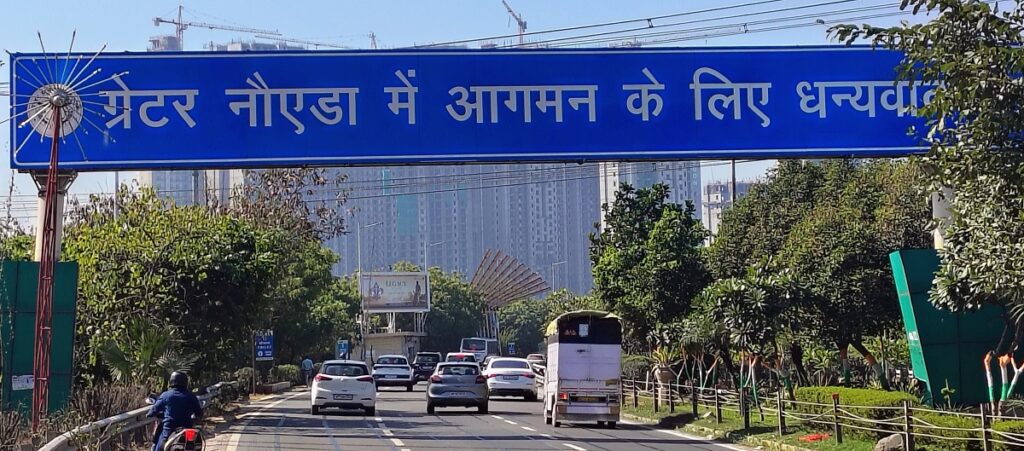
Greater Noida Growth Driven By Mega Infra Projects
A cluster of large-scale infrastructure projects across Noida and Greater Noida is set to significantly reshape mobility, urban growth, and real estate dynamics in the National Capital Region (NCR), with a strong emphasis on multi-modal connectivity and future-ready planning.
Among the most transformative is the expansion of the Namo Bharat rapid rail network, which aims to link Noida with Gurugram, Faridabad, and emerging economic zones. The semi-high-speed corridor is expected to reduce travel time across NCR while supporting a shift away from road-based commuting. Regional rapid transit systems are increasingly being positioned as low-emission alternatives that can absorb growing intercity demand. Complementing this is a proposed high-speed link between Ghaziabad and the upcoming Noida International Airport at Jewar, designed to strengthen airport accessibility and integrate aviation infrastructure with regional transit. Such corridors are expected to anchor new economic clusters along their routes, particularly in peri-urban zones. Road infrastructure is also being reimagined. A 30-km-plus six-lane elevated corridor along the Yamuna floodplain is planned to ease congestion on the Noida-Greater Noida Expressway and support airport-bound traffic. The alignment, stretching from Okhla Barrage to the Yamuna Expressway, is expected to act as a parallel high-capacity route for both residential and commercial zones.
Further easing cross-border traffic, the proposed Chilla elevated corridor and associated flyovers aim to streamline connectivity between Delhi and Noida, reducing dependency on existing choke points such as DND and Sector 14A. This reflects a broader strategy of decentralising traffic flows rather than expanding single corridors. Metro expansion remains another critical pillar. Extensions linking Noida’s Aqua Line to Delhi Metro’s Blue and Magenta lines are expected to create seamless intra-city connectivity, particularly between residential sectors and employment hubs. These last-mile integrations are essential for increasing public transport adoption and reducing private vehicle dependence. The infrastructure push is closely tied to economic ambitions. The operationalisation of the Noida International Airport, alongside projects such as a proposed film city and a logistics hub at Bodaki, is expected to transform the region into a multi-sector growth corridor. The logistics hub, in particular, is being planned as a multimodal facility integrating rail and freight movement, signalling a shift towards more efficient supply chains.
Urban planners note that while these projects promise enhanced connectivity and economic expansion, they also raise critical questions around sustainability and land use. Large-scale road and real estate development along riverbanks and greenfield areas will require careful environmental safeguards, particularly in ecologically sensitive zones like the Yamuna basin. At the same time, the emergence of “New Noida” as a planned urban extension highlights the region’s long-term vision of decentralised growth. Spread across thousands of hectares, the new city is expected to redistribute population pressure while creating new residential and industrial zones. As Noida enters its next phase of expansion, the success of these infrastructure investments will depend not just on scale, but on how effectively they integrate sustainability, public transport, and inclusive urban design into a rapidly evolving metropolitan landscape.