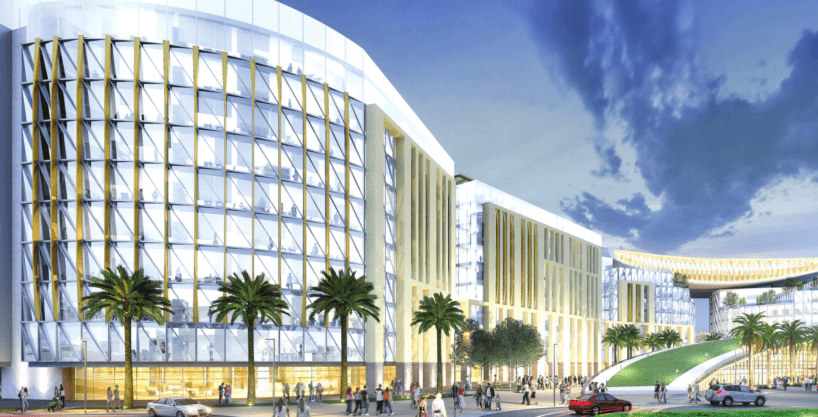
A large-scale Delhi commercial space sale in the capital’s southern precinct has generated ₹5,779 crore, underlining the growing financial role of public land monetisation in funding urban redevelopment. The transaction, involving over 14 lakh sq ft of built-up office space in Sarojini Nagar, signals a shift in how government agencies are leveraging high-value land parcels to support housing renewal and infrastructure upgrades.
The commercial inventory was released through an electronic auction process, attracting participation from a mix of institutional investors, multinational firms and domestic corporates. According to officials familiar with the development, the pricing discovered during bidding marginally exceeded the base valuation, indicating sustained demand for Grade A office assets in well-connected parts of the national capital.This Delhi commercial space sale is part of a broader redevelopment strategy where ageing government housing colonies are being rebuilt into higher-density, mixed-use neighbourhoods. Proceeds from such transactions are being channelled into financing residential reconstruction, reducing reliance on budgetary allocations. Urban planners say this model reflects an evolving approach to land economics, where underutilised public land is repurposed to unlock value.
However, the approach also raises important questions around urban form and sustainability. Sarojini Nagar and surrounding areas are already dense, with pressure on transport networks, water supply and public services. While commercial intensification can improve economic productivity, experts caution that infrastructure provisioning must keep pace. Without adequate transit integration, green cover preservation and pedestrian-friendly planning, such developments risk exacerbating congestion and environmental stress.From a market perspective, the strong response to the Delhi commercial space sale suggests continued confidence in the capital’s office sector, even as hybrid work patterns reshape demand globally. Industry analysts note that prime locations with established connectivity and civic infrastructure remain resilient, particularly for firms seeking long-term operational bases. There is also a social dimension to the redevelopment model. Rebuilding government housing colonies often involves relocation and phased construction, affecting existing residents and local communities. Ensuring that redevelopment remains inclusive, with minimal disruption and equitable access to upgraded amenities, will be critical to maintaining public trust.
The monetisation of public land is increasingly being seen as a tool for financing urban transformation in Indian cities. Yet, as this Delhi commercial space sale demonstrates, its success depends not just on financial outcomes but on how effectively it aligns with broader goals of sustainable growth, liveability and climate resilience. Going forward, the focus is likely to shift towards integrating such high-value commercial developments with public transport systems, energy-efficient building practices and inclusive urban design ensuring that redevelopment benefits extend beyond balance sheets to the everyday experience of city residents.