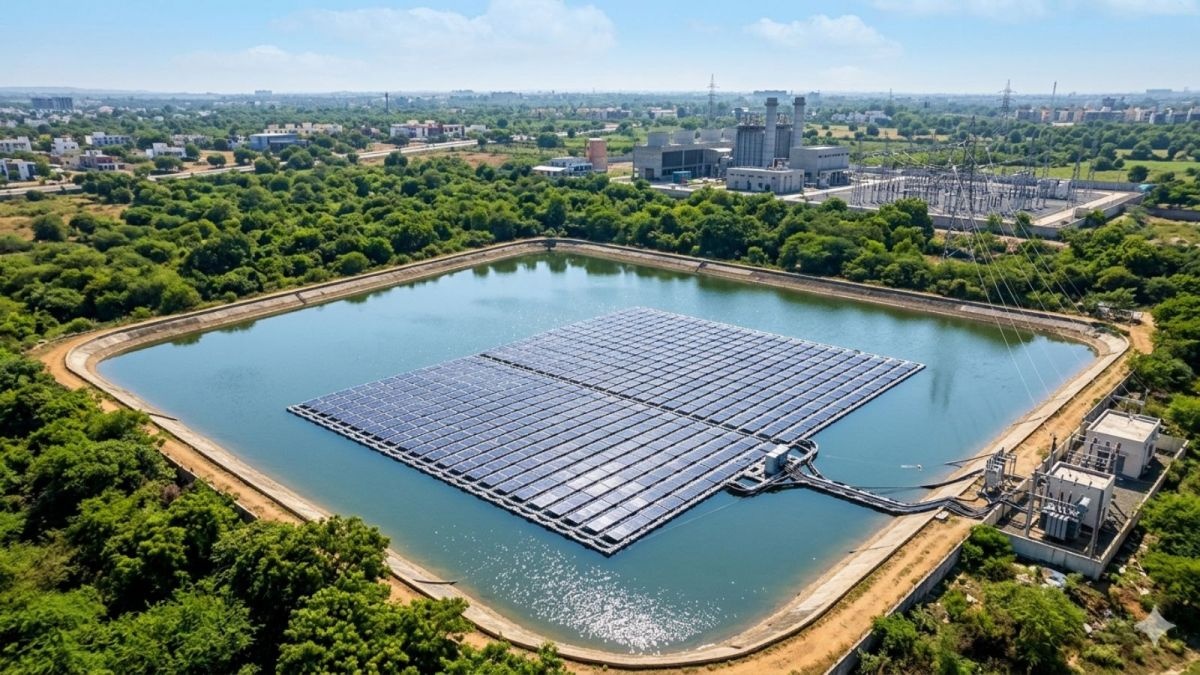
Delhi is preparing to test a new model of urban renewable energy by launching a Delhi floating solar pilot project that places photovoltaic panels directly on water bodies. The initiative, planned at the Bawana thermal power complex in northwest Delhi, signals a broader strategy to generate clean electricity without consuming scarce urban land. Officials involved in the project say the pilot will install solar panels on floating platforms across two artificial ponds located inside the Bawana facility. Together covering roughly four acres, the reservoirs are currently used to store cooling water for plant operations. Once operational, the floating array is expected to produce close to two megawatts of electricity.
The proposal forms part of a larger effort to integrate renewable power generation into existing urban infrastructure. Unlike ground-mounted solar farms that require significant land parcels, Delhi floating solar installations can utilise idle water surfaces such as reservoirs, drainage channels, and treatment plant ponds. Authorities believe this approach could unlock new clean energy capacity in a densely built city where land availability remains limited. Government engineers are currently preparing the tender process to identify a developer for the Bawana installation. If the demonstration proves technically and financially viable, similar projects could be introduced across other artificial ponds, sewage treatment facilities, and selected drainage corridors across the capital. Urban energy analysts say floating solar systems offer multiple advantages for dense cities. The presence of water beneath the panels helps regulate temperature, allowing photovoltaic cells to operate more efficiently than on hot rooftops or open land. At the same time, the panels reduce evaporation from water bodies, helping conserve limited water resources.
Officials have also indicated that other infrastructure corridors may soon be explored for renewable energy generation. One proposal under examination involves installing solar panels along stretches of the Munak canal, a major water channel that transports raw water to the capital. Covering parts of the canal could both generate electricity and reduce water loss from evaporation during peak summer months. The Delhi floating solar initiative aligns with the capital’s wider energy transition strategy. City planners have set an ambitious target to scale up solar generation capacity to around 4,500 megawatts within the next few years, with rooftop installations forming a major share of the plan. Floating solar projects are now being explored as an additional pathway to expand renewable energy production without competing with residential or commercial land use. Experts note that integrating solar generation into water infrastructure can also reduce transmission losses if electricity is used locally at nearby facilities or distributed through existing urban grids.
If the Bawana pilot proves successful, it could establish a new template for Indian megacities seeking to combine clean energy expansion with efficient land use. For Delhi, where energy demand continues to rise alongside population growth, such innovations could play a significant role in reducing dependence on fossil fuels while supporting a more climate-resilient urban infrastructure network.