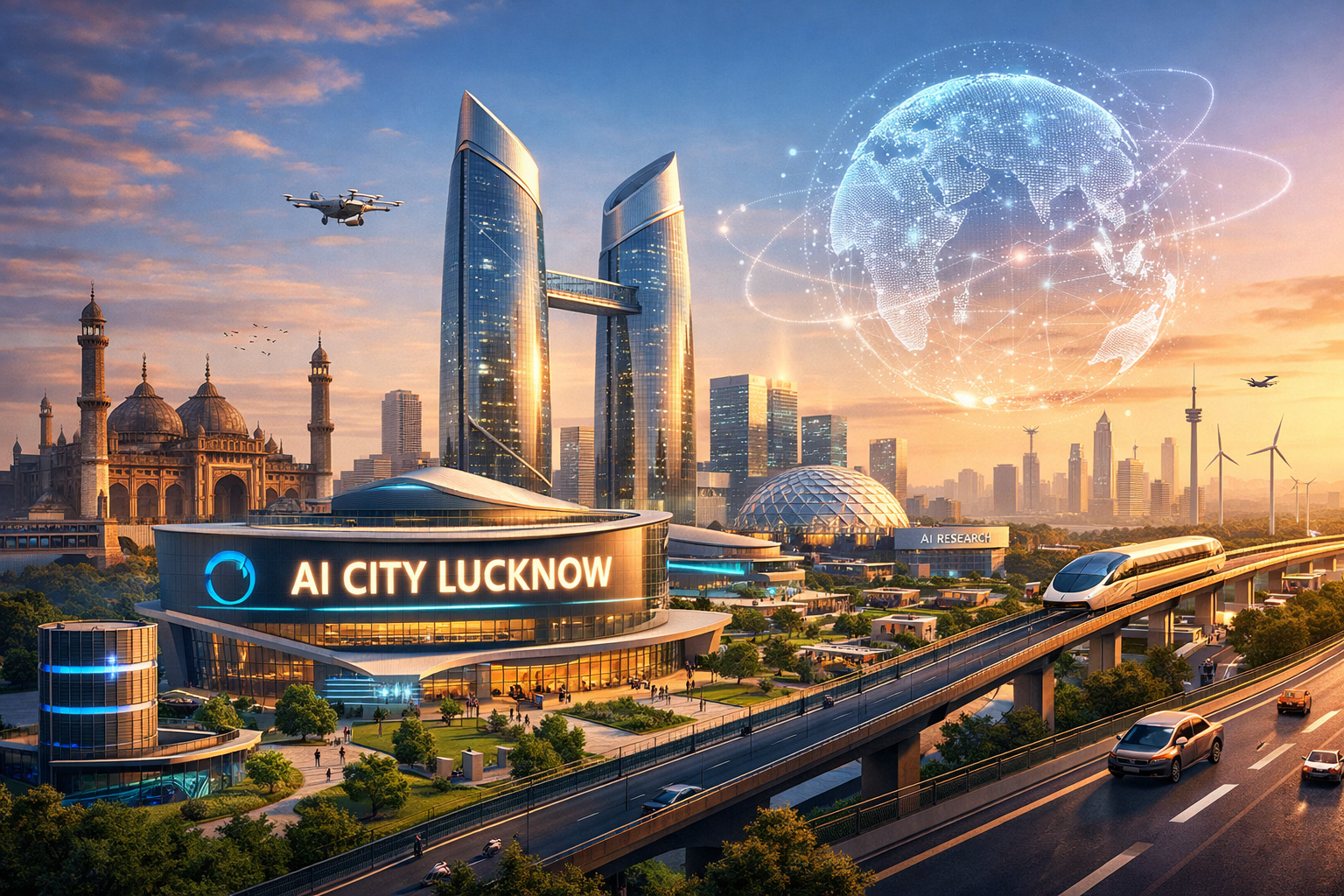
Lucknow AI City Project Reshapes Future Urban Growth
The Uttar Pradesh government has accelerated plans to build what it describes as the country’s first dedicated artificial-intelligence-driven urban hub in Lucknow, a move that could reshape how future cities in India are designed around technology, research and digital infrastructure.
The proposed Lucknow AI city project is being positioned as a long-term economic engine for the state’s capital while also supporting the government’s broader goal of expanding high-value technology industries beyond traditional metros. Official project documents show that the initiative is not limited to a conventional technology park. Instead, it is planned as an integrated urban ecosystem combining artificial-intelligence research centres, startup incubation facilities, data-centre infrastructure and grade-A commercial workspaces. The master plan also includes residential zones, public amenities and educational infrastructure designed to support a “walk-to-work” model—an approach increasingly seen as critical for sustainable urban growth. The timing of the Lucknow AI city project is significant. Over the past few weeks, the state government has announced a series of technology-driven initiatives aimed at positioning Uttar Pradesh as a digital investment hub. These include plans for innovation centres in Lucknow and Noida and a push to develop multiple data-centre parks across the state with large-scale private investment.
Urban economists say the proposed AI city is intended to anchor these initiatives in a single high-technology corridor and attract companies working in robotics, healthcare technology and data analytics. For the city itself, the project reflects a broader transformation already underway. Lucknow has traditionally grown as an administrative and cultural centre, but new infrastructure projects—ranging from technology parks to transport upgrades—are gradually reshaping its economic profile. Planning authorities expect the AI-focused urban hub to generate demand for commercial real estate, rental housing and supporting services such as public transport, water supply and power infrastructure. Urban-development experts say such projects also represent a shift in how states compete for investment.
Instead of relying only on industrial zones, governments are increasingly creating specialised urban districts focused on emerging sectors such as artificial intelligence, semiconductors and clean-energy technologies. In the case of Lucknow, the proposed AI city is expected to focus heavily on skill development and research partnerships, which could help smaller cities attract high-quality employment opportunities that were earlier concentrated in Bengaluru, Hyderabad or Pune. However, planners also note that the success of the project will depend on how effectively the city balances rapid technology-driven expansion with sustainable urban planning. Data-centre-driven development can significantly increase energy demand, and large-scale commercial growth often puts pressure on housing affordability and urban infrastructure. The proposal therefore places emphasis on integrated planning, including renewable-energy-supported infrastructure and mixed-use development that reduces long daily commutes.
If executed effectively, the Lucknow AI city project could mark a turning point in how second-tier cities in India position themselves in the global digital economy. More importantly, it may influence how future urban districts are designed—not only as places to live but as long-term technology ecosystems built around research, innovation and sustainable infrastructure.