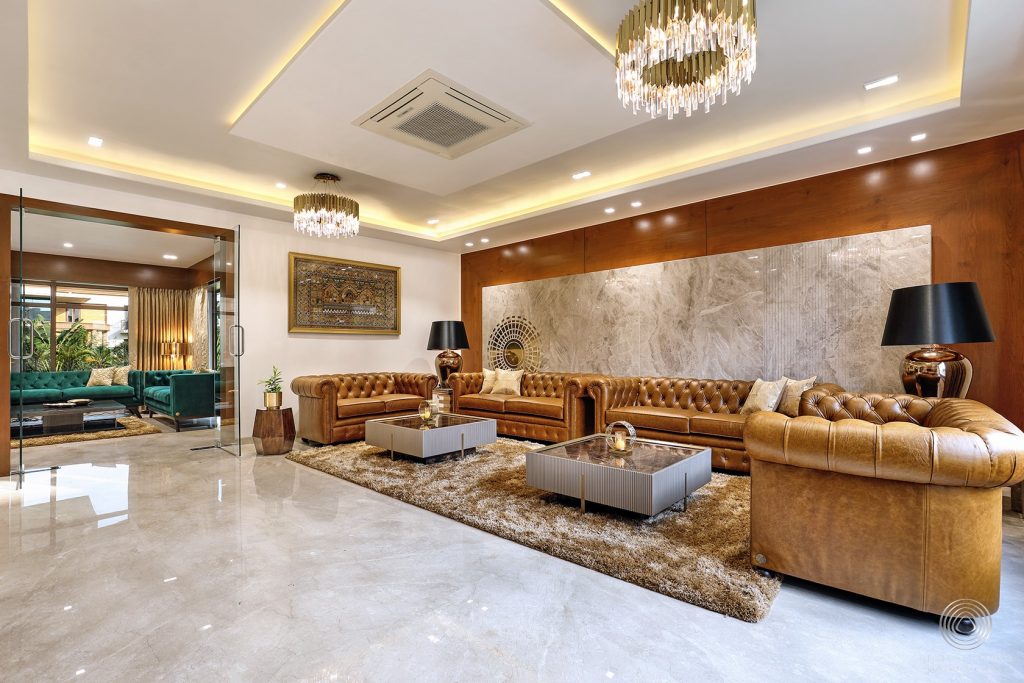
Vadodara Residence By Design Studio Redefines Family Living
A 2,800 sq ft residence in Vadodara, designed by architecture and interior practice Dipen Gada and Associates, is offering a fresh perspective on how Indian homes are evolving to accommodate multigenerational living, blending spatial efficiency with emotional connectivity in rapidly urbanising contexts.
Located in a quiet residential neighbourhood, the home has been conceived as a response to changing family structures, where multiple generations coexist under one roof while seeking both privacy and shared engagement. The project reflects a broader architectural shift across Indian cities, where housing must balance density with liveability.The layout developed by Dipen Gada and Associates places shared living areas at the core, enabling interaction across generations, while private zones are carefully articulated to ensure independence. This dual strategy is increasingly relevant in urban India, where rising land costs and changing social dynamics are encouraging families to consolidate living arrangements.Design choices within the residence prioritise natural light, cross-ventilation, and spatial continuity. Large openings and interconnected spaces reduce dependence on artificial lighting and cooling, contributing to energy efficiency. Material selections further reinforce durability and long-term usability—an important consideration for homes intended to serve multiple generations over time.
Beyond functionality, the home reflects evolving cultural expectations. It accommodates traditional family bonds while supporting contemporary lifestyles, including work-from-home needs and flexible daily routines. Dedicated areas for gathering, retreat, and productivity allow the residence to function as a layered environment rather than a rigid layout.Urban development experts point to such projects as indicators of a shift towards more compact and efficient housing models. By accommodating extended families within a single footprint, multigenerational homes can reduce land consumption and ease pressure on urban infrastructure. This is particularly relevant for growing cities like Vadodara, where expansion must be managed alongside resource constraints.
The project also highlights the importance of adaptability in residential design. Spaces have been planned to evolve with changing family requirements, minimising the need for future structural alterations. This approach aligns with broader sustainability goals by extending the lifecycle of built assets and reducing material waste.At a systems level, such design thinking contributes to more resilient urban environments. Housing that integrates flexibility, efficiency, and social cohesion can support long-term urban stability, especially in tier-two cities experiencing rapid transformation.As India’s urban landscape continues to evolve, the role of design firms in shaping housing typologies is becoming more pronounced. Projects like this demonstrate how architecture can respond to demographic shifts while aligning with sustainability and inclusivity goals.
Looking ahead, scaling such multigenerational housing solutions across income segments will be key. The ability to deliver adaptable, efficient, and climate-responsive homes at varying price points will determine how effectively cities can accommodate future growth while maintaining quality of life.