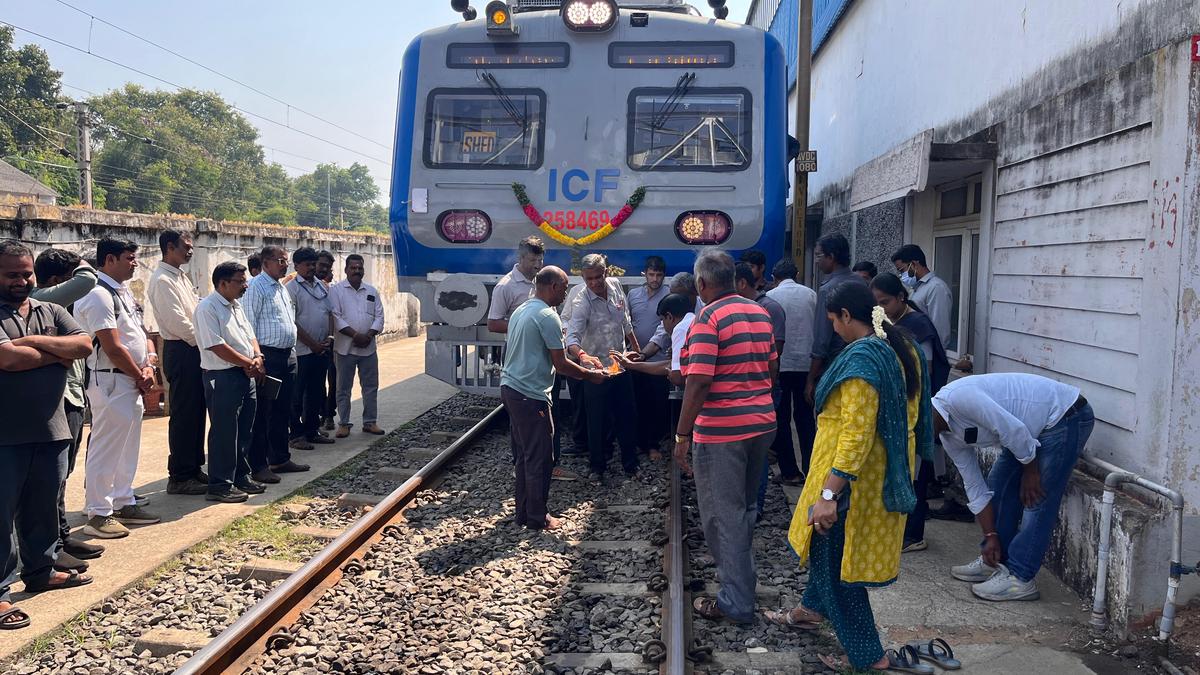
Chennai Trials Faster AC Suburban Trains For Commuters
Chennai’s suburban rail network is preparing for a significant commuter upgrade as trial operations begin for AC suburban trains on the busy Chennai–Arakkonam corridor. The test run, conducted between Avadi and Arakkonam, signals a likely rollout of climate-controlled services on one of the metropolitan region’s most heavily used suburban lines ahead of the summer travel season. Officials involved in the exercise said the trial assessed track stability, signalling coordination and operating speeds to determine readiness for regular services. If operational clearance is granted, the corridor could soon see the introduction of a 12-coach AC suburban trains set designed to serve high-density peak-hour travel.
The proposed service builds on Chennai’s earlier experiment with air-conditioned suburban rolling stock on the Beach–Chengalpattu line, which was introduced in 2025. Transport planners say the move reflects growing demand for more comfortable public transport options as daily ridership expands alongside the city’s outward urban growth. The Chennai–Arakkonam section functions as a vital commuting spine connecting industrial clusters, residential suburbs and satellite towns to the metropolitan core. Thousands of office workers, traders and factory employees rely on this route daily to access employment centres in the city. Improved train quality and faster travel times could therefore reshape commuting patterns across north-western parts of the Chennai metropolitan region.
Railway officials indicated the proposed trains would operate on a limited-stop pattern similar to the existing fast suburban services on the corridor. Major stations such as Basin Bridge, Perambur, Ambattur, Avadi and Tiruvallur would serve as key boarding points before the train reaches Arakkonam. The service is expected to run at speeds ranging from around 90 km/h to a maximum of approximately 110 km/h, allowing faster travel compared with conventional suburban trains. For urban planners, the development highlights a broader shift underway in Indian cities where suburban rail is evolving from a purely mass-transit system into a more diversified mobility service. By integrating higher-comfort trains alongside traditional non-AC services, transport authorities aim to retain middle-income commuters who might otherwise shift to private vehicles. However, infrastructure capacity remains a constraint. The corridor currently operates on two main tracks that accommodate both suburban and long-distance trains. With more than a hundred express services already moving through the section daily, balancing operational efficiency with additional commuter services requires careful network management.
Railway authorities have begun preparatory work to create additional track space along the corridor to expand capacity in the future. Such upgrades are critical as Chennai’s metropolitan footprint continues to extend toward peripheral districts. Transport analysts note that improving suburban rail quality can play an important role in shaping sustainable mobility. Comfortable, high-frequency trains encourage a modal shift away from private vehicles, reducing congestion and lowering urban emissions. If implemented successfully, the AC suburban trains initiative could strengthen Chennai’s push toward a more resilient and commuter-friendly urban transport network.