


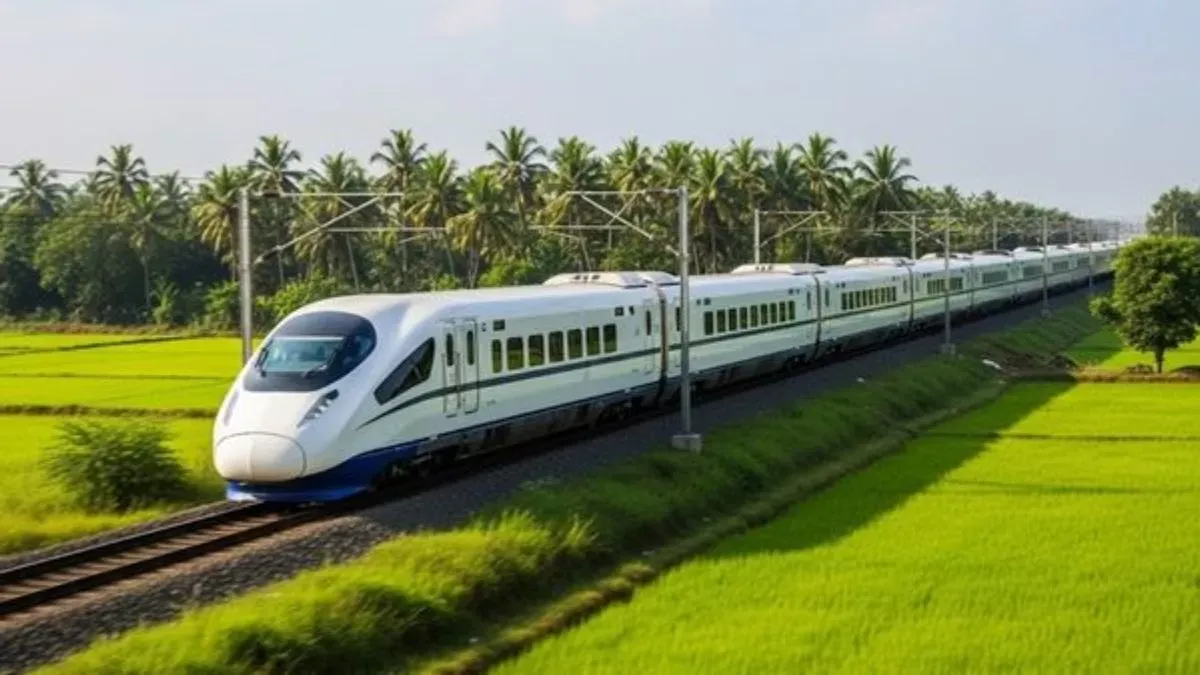
Plans for a Hyderabad Bengaluru bullet train corridor are moving into a detailed planning phase as central and state authorities advance discussions on land acquisition, route alignment and technical feasibility for one of southern India’s most ambitious intercity transport projects.The proposed high-speed rail link, stretching roughly 626 kilometres, aims to connect the two major technology hubs in around two hours once operational. If realised, the corridor would significantly reduce travel times between the cities, where current rail journeys can range from eight hours to nearly an entire day depending on the service.
Transport planners say the Hyderabad Bengaluru bullet train project reflects a broader push to modernise India’s intercity mobility infrastructure. High-speed rail systems are increasingly viewed as a strategic investment capable of improving regional connectivity, reducing aviation congestion and supporting economic integration between major metropolitan regions.Preliminary route planning indicates that the corridor could include about a dozen stations distributed across Telangana, Andhra Pradesh and Karnataka. The alignment is expected to pass through several mid-sized cities and regional centres before reaching the Bengaluru metropolitan area.In Karnataka, potential station locations under consideration include areas near Bengaluru’s international airport and other fast-growing suburban zones. One proposed stop in Bengaluru Rural district could also function as a major interchange if additional high-speed rail corridors linking other southern cities are developed in the future.Officials involved in the planning process say engineering surveys are currently being conducted by a national infrastructure consultancy tasked with preparing the project’s Detailed Project Report. The report is expected to outline route design, station locations, ridership forecasts and financial viability.
The Hyderabad Bengaluru bullet train corridor is expected to operate using dedicated high-speed tracks built largely on elevated alignments. Trains on the route could run at maximum speeds of around 350 kilometres per hour, with regular operational speeds expected to remain slightly lower to ensure safety and efficiency.Urban economists note that high-speed rail networks can reshape regional development patterns by strengthening connections between major employment centres and emerging economic corridors. Faster rail travel often enables greater business mobility, reduces dependence on short-haul flights and stimulates investment in cities along the route.The corridor could also influence real estate development and logistics infrastructure in intermediate regions that gain improved connectivity. Transit-oriented development around major stations has become a common feature of high-speed rail projects globally, creating new commercial districts and residential clusters.For Hyderabad and Bengaluru—two of India’s largest technology and innovation centres—the project could reinforce economic collaboration across industries such as information technology, biotechnology, advanced manufacturing and digital services.Infrastructure experts caution that the success of the Hyderabad Bengaluru bullet train will depend on coordinated planning across multiple states, efficient land acquisition processes and long-term financial planning. If implemented successfully, however, the corridor could become one of the most transformative transport links in southern India’s evolving economic landscape.
Hyderabad Bengaluru Bullet Train Corridor Advances Planning
