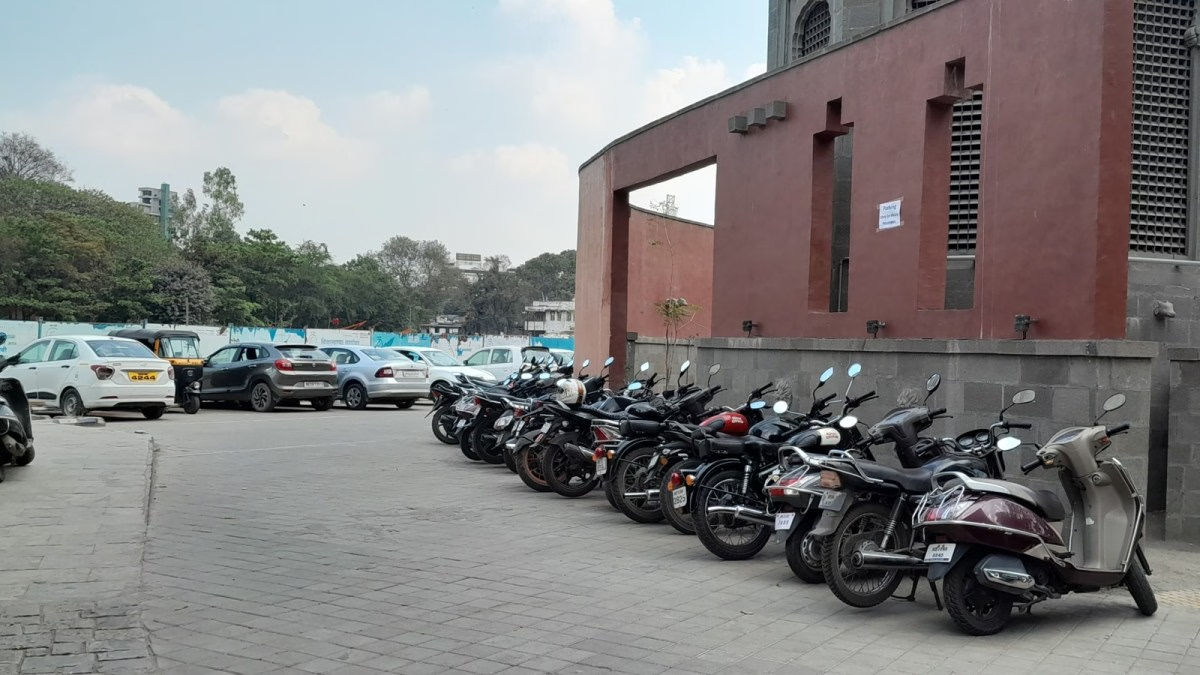
Pune’s civic administration has mapped dozens of locations near operational and upcoming Metro stations for organised vehicle parking, signalling a new push to improve commuter access to the city’s expanding rail-based transit system. The initiative is expected to strengthen last-mile connectivity and address one of the key barriers limiting public transport adoption in rapidly growing urban regions.
Municipal officials confirmed that more than thirty sites have been shortlisted within walking distance of stations along the Metro corridors. These plots, located largely within civic amenity zones, are being evaluated for structured parking infrastructure intended to serve passengers arriving by two-wheelers and private cars. According to planners involved in the project review, the majority of these locations lie within roughly half a kilometre of Metro stations an urban planning benchmark often used to define the immediate catchment area of a transit node. Out of the identified sites, most have been found technically feasible for development, while construction activity has already begun at a handful of locations.
The programme forms part of the city’s broader strategy to improve Pune Metro station parking and ensure that commuters can reach transit hubs more conveniently. Transport experts note that inadequate parking and poor feeder connectivity often discourage residents from switching from private vehicles to rail-based transit, even when Metro systems are operational. Several stations across the Vanaz–Ramwadi and PCMC–Swargate corridors have seen increasing passenger volumes since different sections of the network began service. Areas such as Deccan, Yerawada, Bund Garden and Anandnagar have emerged as important mobility nodes where commuters frequently combine private vehicle travel with Metro journeys.
Urban mobility specialists say that improving Pune Metro station parking could reduce roadside congestion around stations, where informal parking has become common in the absence of designated facilities. Organised parking infrastructure, if well managed, can also improve pedestrian safety and help regulate traffic circulation in busy neighbourhoods. The proposed facilities are being planned within zones earmarked under Transit Oriented Development frameworks. TOD planning encourages compact, mixed-use urban development around major transit nodes, allowing residents to access employment centres, commercial districts and public amenities with reduced reliance on long-distance road travel.
While parking near stations may appear counterintuitive in cities seeking to reduce vehicle dependence, planners argue that transitional strategies are necessary. In cities with dispersed residential layouts and limited feeder transport, park-and-ride infrastructure can act as a bridge toward wider public transport adoption. Officials also indicated that development will be phased based on demand and feasibility assessments. Initial locations currently under construction are expected to provide operational insights before additional sites are rolled out across other stations.
The expansion of Pune Metro station parking comes as the city continues to invest in multimodal mobility infrastructure. Alongside Metro expansion, municipal agencies are examining improvements in pedestrian pathways, cycling access and feeder bus services to support more sustainable travel patterns. As Pune’s Metro network matures, planners believe the success of the system will depend not only on rail infrastructure but also on how easily residents can access stations from their homes and workplaces. Integrating parking, pedestrian access and local transport will therefore play a decisive role in shaping the long-term viability of the city’s public transport ecosystem.
Pune Metro Station Parking Plan Expands Access