


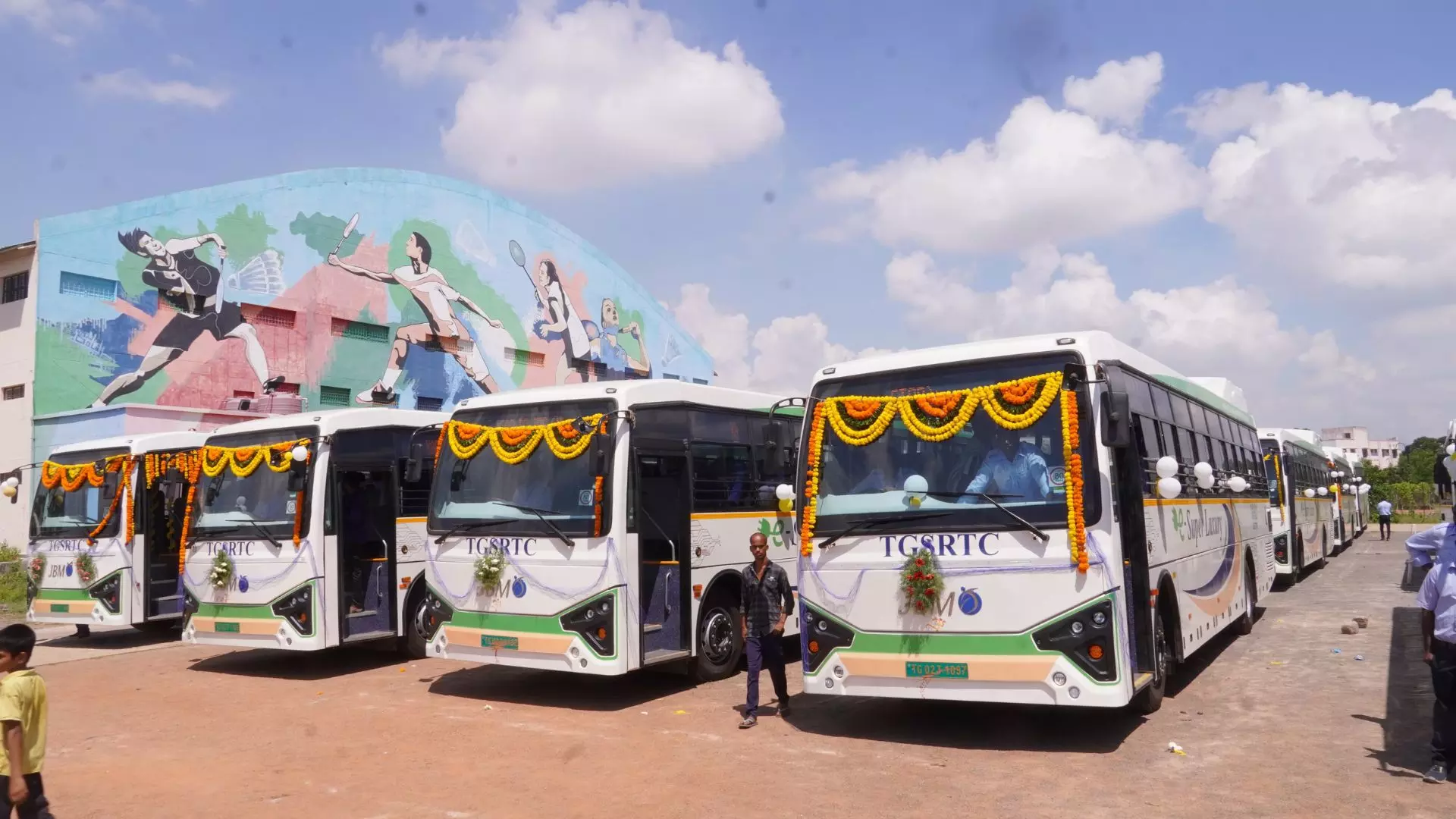
Telangana’s state-run bus operator is set to undertake one of its largest fleet transitions yet, with plans to induct 2,000 electric buses over the next year — a move that could significantly reshape the city’s urban mobility and emissions profile.Telangana State Road Transport Corporation has formalised procurement arrangements following its selection under the Centre’s PM e-Drive initiative, which supports state transport undertakings in shifting towards zero-emission public transport. The order will be executed in phases between September 2026 and August 2027, marking a structured expansion of the corporation’s electric fleet.
The supply contracts have been awarded to two private operators — Olectra Greentech in partnership with EV Trans, and GreenCell Mobility. Manufacturing is expected to commence once contractual formalities and financial guarantees are completed.Of the sanctioned fleet, more than half will comprise low-floor non-air-conditioned buses, along with a smaller batch of air-conditioned variants. The remaining 915 units were initially planned as standard-floor buses, reflecting operational preferences for certain suburban routes in Hyderabad where frequent speed breakers and uneven road geometry can affect low-floor vehicle durability.However, a recent advisory from the Union Ministry of Road Transport and Highways mandating low-floor configurations for city operations after October 1 has introduced regulatory ambiguity. TSRTC has sought clarification from the Centre on whether suburban and peri-urban routes within the Hyderabad metropolitan region would fall under the same requirement.
Officials familiar with the discussions indicate that manufacturers have been instructed to align production with the final policy position. Should the Centre insist on a uniform low-floor standard, the entire 2,000-bus fleet may adopt that configuration.The induction schedule is staggered to support depot readiness, charging infrastructure rollout and driver training. The first tranche of 300 buses is slated for September 2026, followed by successive batches through December 2026 and April and August 2027.Urban transport analysts say the scale of deployment could meaningfully reduce diesel consumption and tailpipe emissions across Hyderabad’s busiest corridors. Road-based public transport accounts for a significant share of particulate matter and nitrogen oxide emissions in Indian cities. Electrification, when paired with cleaner grid power, can cut lifecycle emissions while also lowering operating costs over time.
Yet experts caution that fleet electrification must be integrated with route rationalisation and priority bus lanes to maximise impact. Without improvements in service frequency and travel speed, ridership gains may remain modest.For Hyderabad, the 2,000-bus programme represents more than fleet renewal. It is a test case for how quickly large metropolitan regions can pivot towards low-carbon mobility while balancing operational realities. If executed effectively, the rollout could strengthen the case for accelerated electrification across Telangana’s expanding urban network.
Hyderabad TSRTC Electric Buses Rollout Plan
