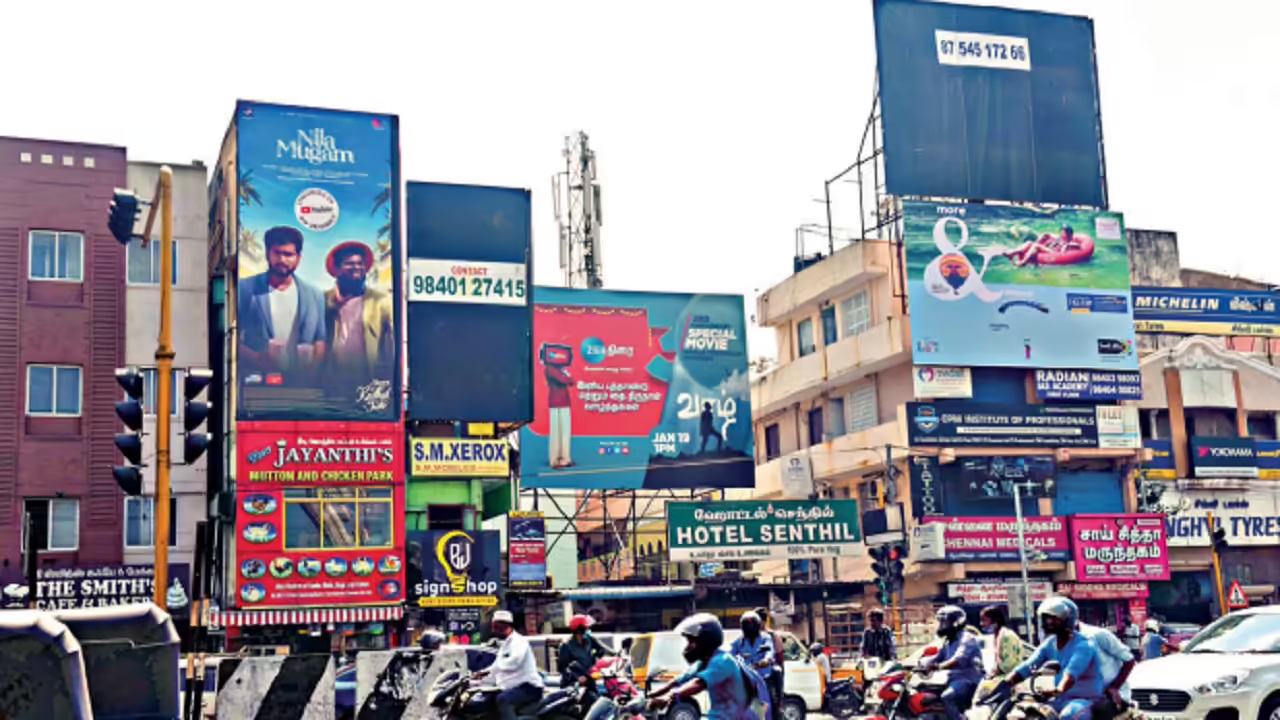
Chennai’s municipal authorities are set to tighten controls over outdoor advertising, imposing fines of ₹25,000 on unlicensed hoardings from March 7. The move follows newly established urban signage regulations under the Tamil Nadu Urban Local Bodies Rules, 2023, aiming to bring transparency, safety, and revenue predictability to the city’s outdoor media sector. Experts note that such enforcement could significantly reshape Chennai’s street-level visual landscape while bolstering municipal finances.
The Greater Chennai Corporation (GCC) requires all advertisement boards to secure licences via a single-window online portal. Applications undergo scrutiny for compliance with material, structural, and safety standards, with fees ranging from ₹3,000 to ₹6,000 per square metre. LED and digital displays incur a 20% surcharge. Licences must be renewed annually, reflecting a broader effort to institutionalise accountability in urban advertising. Urban planners emphasise that the crackdown addresses multiple concerns. Precariously installed hoardings along major thoroughfares, including arterial roads and commercial hubs, pose structural risks to pedestrians and motorists. The regulatory framework caps hoarding heights at 10 metres and restricts installations to the second floor of buildings, while digital displays must adhere to minimum visual durations to prevent driver distraction. Authorities will remove boards lacking structural integrity, recovering demolition costs from owners or operators.
From an economic standpoint, the licensing drive represents a potential windfall for municipal coffers. Current estimates indicate the city hosts several thousand hoardings, yet only a fraction are legally approved. Urban economists suggest that universal compliance could generate recurring revenues in the multiple-crore range, funding infrastructure or civic improvement projects. Early data indicates over 100 firms have already initiated licensing applications, signalling strong sector engagement. City authorities are deploying teams of revenue inspectors and assistant engineers equipped with digital payment devices to monitor compliance ward by ward. The systematic approach underscores a broader policy objective: integrating urban revenue collection with public safety and planning oversight. Policy analysts note that this model could serve as a template for other Indian metros struggling with unregulated outdoor advertising.
Observers highlight that, beyond fiscal and safety benefits, regulating hoardings aligns with long-term urban sustainability goals. Controlled visual environments enhance streetscape aesthetics, reduce visual clutter, and limit energy consumption from digital displays. In a city experiencing rapid real estate and commercial expansion, such interventions offer a balance between economic activity and public welfare. The GCC has indicated that enforcement will be phased, prioritising hazardous and high-traffic areas before extending citywide. Urban stakeholders anticipate that consistent monitoring, coupled with annual licensing, will institutionalise a safer, more organised, and financially sustainable outdoor advertising ecosystem.