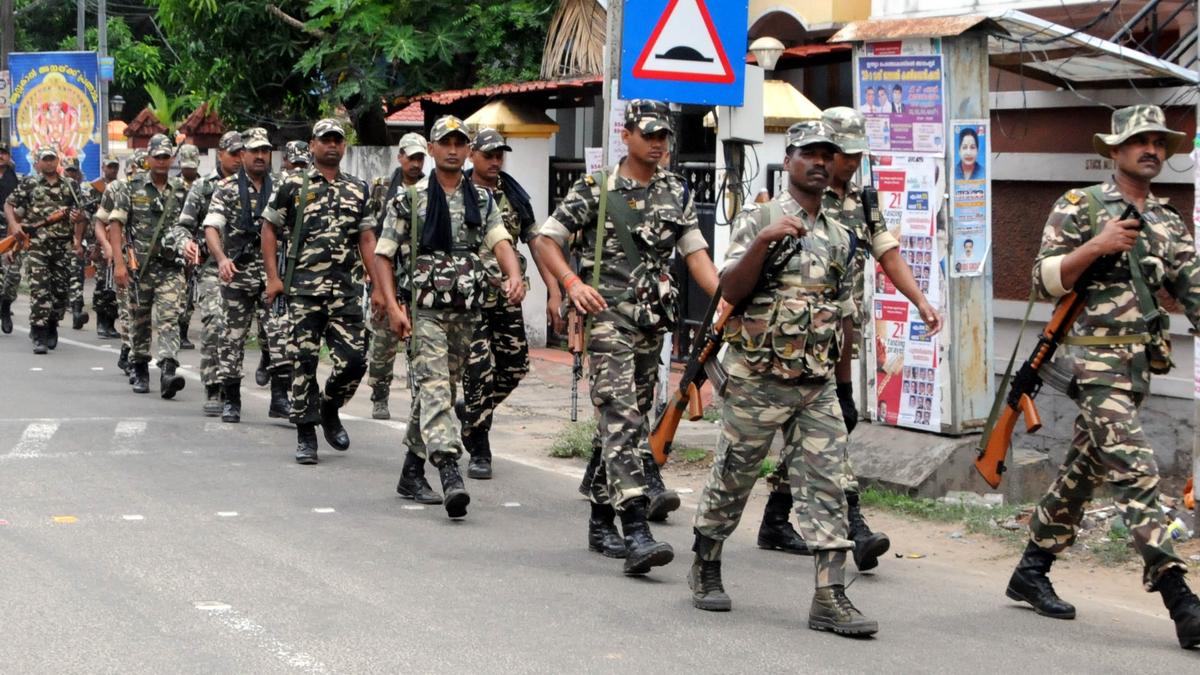
Kolkata is set to witness a significant rise in central security presence as the second phase of CAPF deployment begins ahead of upcoming elections. Eighteen additional companies are scheduled to reach the city from March 10, taking the total to 30 companies, as authorities intensify preparedness across West Bengal’s urban and semi-urban districts. The second wave forms part of a broader statewide rollout in which another 240 companies will be positioned across districts. North 24 Parganas, already a high-focus administrative zone, will see its central forces strength climb to 58 companies, the largest in the state. The district’s complex administrative geography spanning multiple police districts and commissionerates has long required layered security planning due to its dense population, cross-border proximity and rapid peri-urban expansion.
The expanded CAPF deployment reflects a calibrated approach by election authorities to prioritise districts with high voter density, logistical complexity and history of political contestation. For Kolkata, which functions as both the state’s economic engine and governance hub, security planning carries wider implications beyond polling booths. Increased central forces presence affects mobility management, traffic circulation, public transport coordination and neighbourhood-level policing all critical to maintaining economic continuity during election season. Murshidabad and South 24 Parganas will also see substantial additions, while districts such as East Midnapore, Hooghly, Nadia and Howrah are receiving sizable allocations. Several industrial and logistics corridors fall within these districts, underscoring the importance of stable law-and-order conditions during a period when freight movement, warehousing operations and port-linked trade remain active.
Urban planners note that election-time security mobilisation often tests a city’s operational resilience. Temporary accommodation, movement planning and coordination between central and state agencies require careful spatial planning to avoid strain on civic infrastructure. In high-density districts like North 24 Parganas and Kolkata, such exercises can reveal both strengths and bottlenecks in emergency response networks. The CAPF deployment also intersects with broader conversations about inclusive and accessible voting environments. Ensuring secure public spaces is particularly critical for women voters, elderly residents and first-time participants in densely populated neighbourhoods. Authorities have indicated that deployments are being distributed to maximise coverage across sensitive and high-footfall areas. For districts such as Darjeeling, Malda, Bankura and Jhargram each with distinct geographic and developmental challenges, calibrated force allocation reflects an attempt to balance terrain, distance and administrative capacity.
While election-related deployments are temporary, governance experts argue they offer insight into how urban regions handle large-scale logistical mobilisation. The experience often informs disaster preparedness, climate response coordination and inter-agency communication models increasingly vital in a state vulnerable to cyclones and flooding. As the second phase of CAPF deployment rolls out, attention will shift to execution: ensuring that heightened security coexists with uninterrupted civic life, business continuity and safe public participation in one of the country’s largest democratic exercises.