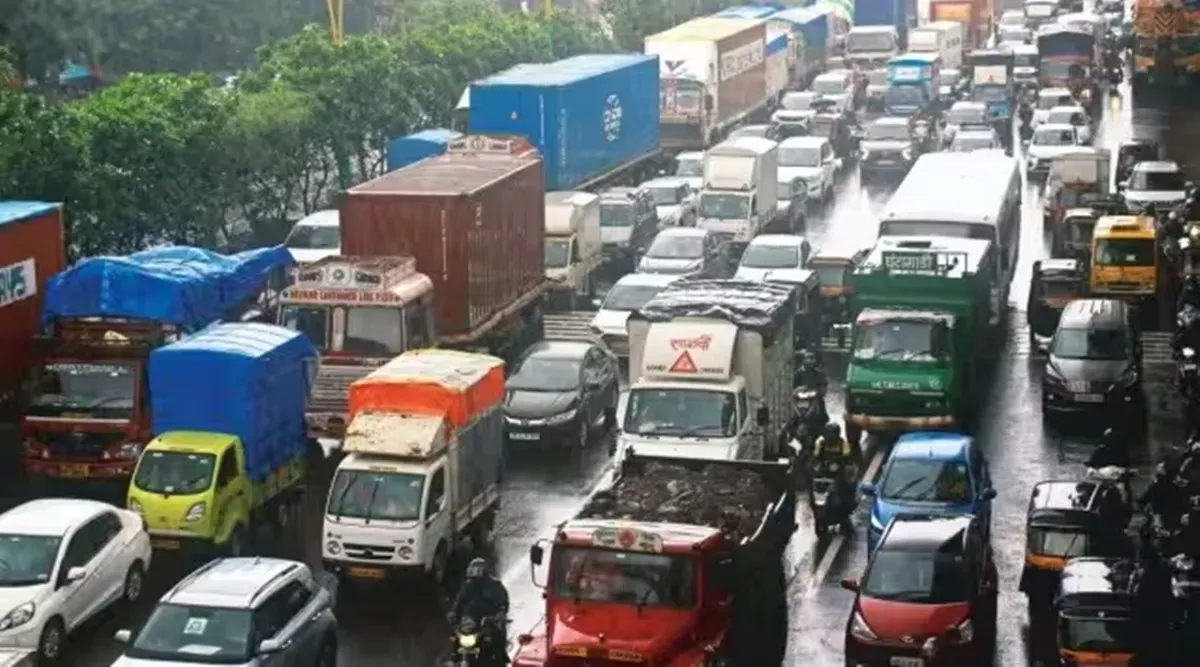
A major traffic breakdown along the Mumbai Nashik Highway near Bhiwandi on Saturday brought vehicular movement to a crawl, underscoring persistent coordination gaps in highway infrastructure upgrades across the Mumbai Metropolitan Region. Several kilometres of congestion were reported on the Nashik-to-Mumbai carriageway, leaving commuters stranded for hours and disrupting the movement of emergency vehicles.
The congestion was triggered by ongoing and incomplete flyover and bridge works that have narrowed traffic flow at multiple points. While a stretch between Rajnoli and Pimplas accommodates up to five lanes, including a service road, the highway abruptly constricts further ahead. Transport planners say such sudden reductions in carriageway width create systemic choke points, especially on freight-heavy corridors like this one, which serves as a critical logistics spine linking Mumbai with northern Maharashtra. The situation worsened due to the presence of a gradient along the affected section, where heavy vehicles were forced to slow down significantly. In some cases, stalled trucks added to the bottleneck, resulting in long queues of buses, private cars and goods carriers. Regular commuters reported delays running into several hours, affecting work schedules, school transport and commercial deliveries.
Of particular concern was the impact on emergency services. Multiple ambulances were caught in the gridlock, raising questions about emergency response preparedness on arterial highways undergoing construction. Urban mobility experts point out that infrastructure projects on live corridors must integrate dedicated emergency lanes or phased construction planning to avoid such risks. Traffic management officials deployed personnel on-site to manually regulate vehicle movement and prevent further escalation. However, authorities acknowledged that these measures offer only temporary relief. With several flyovers and bridges under construction simultaneously, traffic pressure on this corridor has intensified, particularly during weekend and peak morning hours.
The Mumbai–Nashik Highway plays a vital role in regional economic activity, supporting daily commuter flows as well as industrial freight linked to warehousing, manufacturing and agricultural markets. Recurrent congestion not only increases fuel consumption and emissions but also raises logistics costs, directly impacting businesses operating across the Mumbai–Nashik belt. From a sustainability perspective, transport analysts note that prolonged idling traffic significantly worsens local air quality and heat exposure, particularly in peri-urban zones like Bhiwandi where residential areas sit close to highway infrastructure. The absence of seamless traffic transitions during construction also undermines public confidence in large-scale infrastructure expansion.
Officials indicated that until the pending flyover and bridge works are completed, commuters may continue to face intermittent disruptions. Urban planners argue that the episode highlights the need for better sequencing of infrastructure projects, real-time traffic diversion planning, and transparent timelines for completion. As the Mumbai Metropolitan Region continues to expand northward, the pressure on legacy highways is expected to grow. Ensuring that construction-led upgrades do not paralyse daily mobility will be critical to building a more resilient, people-first transport network that supports both economic growth and public safety.
Bhiwandi Congestion Raises Alarms On Mumbai Nashik Highway