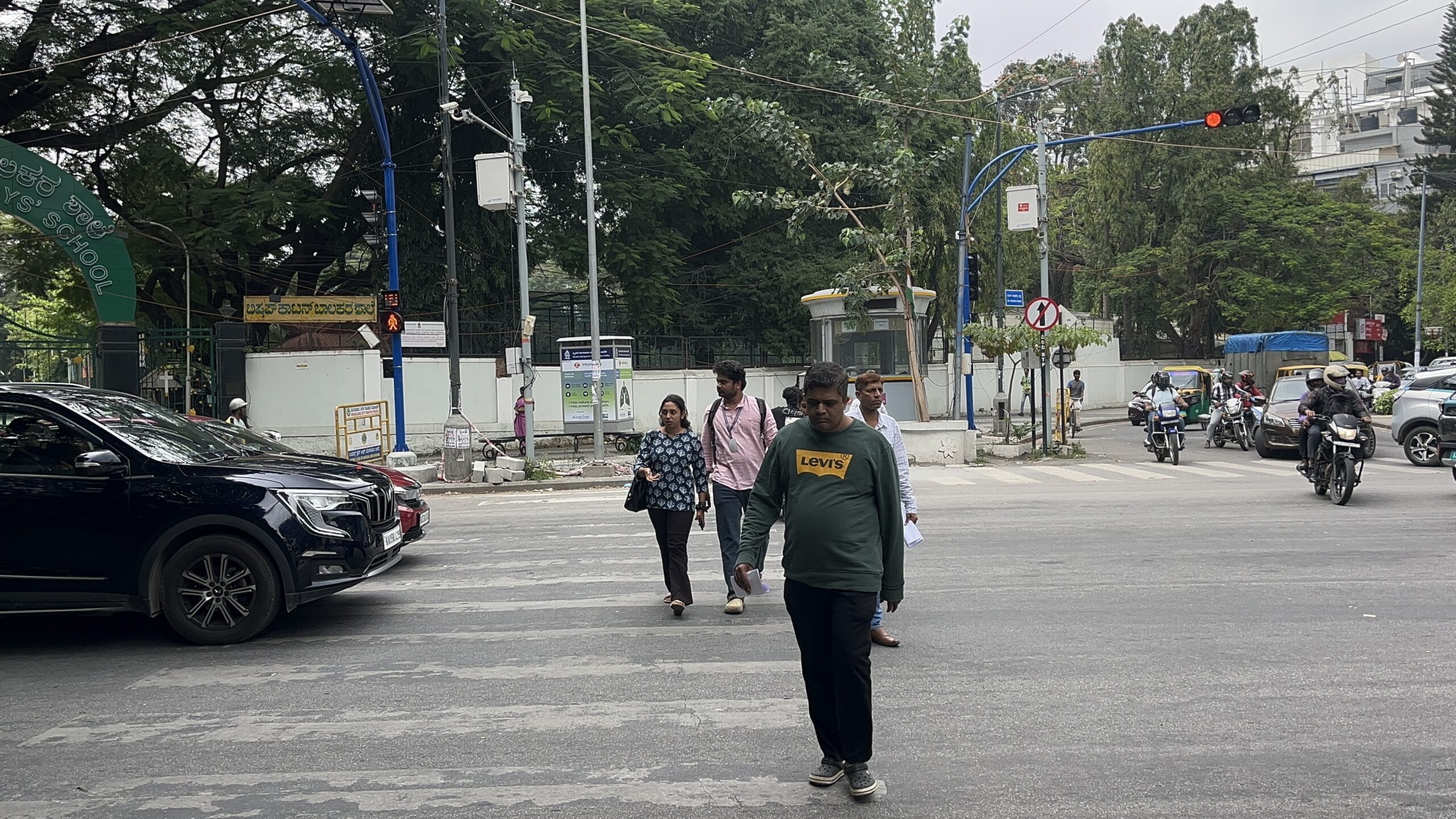
Bengaluru Streets Face Hazard As Zebra Lines Vanish
Bengaluru’s growing urban mobility network is creating new safety challenges for pedestrians as zebra crossings across key junctions fade, disappear, or remain unmarked. City commuters and traffic authorities alike are grappling with unclear crossing points, increasing the risk of accidents in areas witnessing heavy vehicular movement.
Urban planners highlight that well-marked pedestrian infrastructure is crucial for inclusive, people-first city mobility. In Bengaluru, several high-density intersections including Banashankari, Vega City Mall junction, and Anil Kumble Circle show deteriorating or absent crosswalks. At Banashankari, newly resurfaced roads have no visible pedestrian markings, leaving students and office-goers uncertain where to cross. Similarly, near Vega City Mall, ongoing Metro construction has intensified traffic congestion, with missing zebra lines forcing pedestrians to negotiate moving vehicles in unsafe conditions.
At heritage-linked areas such as Old High Grounds Circle, the challenge is compounded by persistent informal crossings despite existing skywalks. Residents report that school children and the elderly often rely on traffic police intervention to navigate these intersections safely. The lack of consistent pedestrian demarcation also impacts compliance with traffic regulations: faded stop lines and worn stripes make it difficult for motorists to judge where to halt, resulting in frequent inadvertent violations captured by automated surveillance systems. Urban mobility experts note that these deficiencies are symptomatic of broader issues in city road management. Zebra crossings fall under the jurisdiction of the city’s traffic engineering cell, yet maintenance remains sporadic. Patchwork resurfacing, heavy bus and two-wheeler movement, and insufficient monitoring contribute to rapid degradation of pedestrian markings, particularly at peripheral junctions such as RR Nagar and Doddanekundi. In these zones, stripes are either partially visible or entirely absent, leaving pedestrians exposed to high-speed traffic.
The implications extend beyond immediate safety. Poorly defined crossings disrupt traffic flow, reduce compliance with urban mobility regulations, and hinder equitable access to public transport and city services. Cities aspiring to achieve zero-carbon, inclusive transport networks require not only the construction of pedestrian facilities but also their systematic upkeep and integration into urban design. City planners suggest prioritising high-footfall corridors for repainting, incorporating reflective or thermoplastic markings to enhance night visibility, and synchronising infrastructure upgrades with public awareness campaigns. With Bengaluru’s transport network set to expand further under Metro extensions and road widening schemes, reinstating visible and durable zebra crossings is increasingly critical to ensure safe, climate-resilient, and inclusive urban mobility.