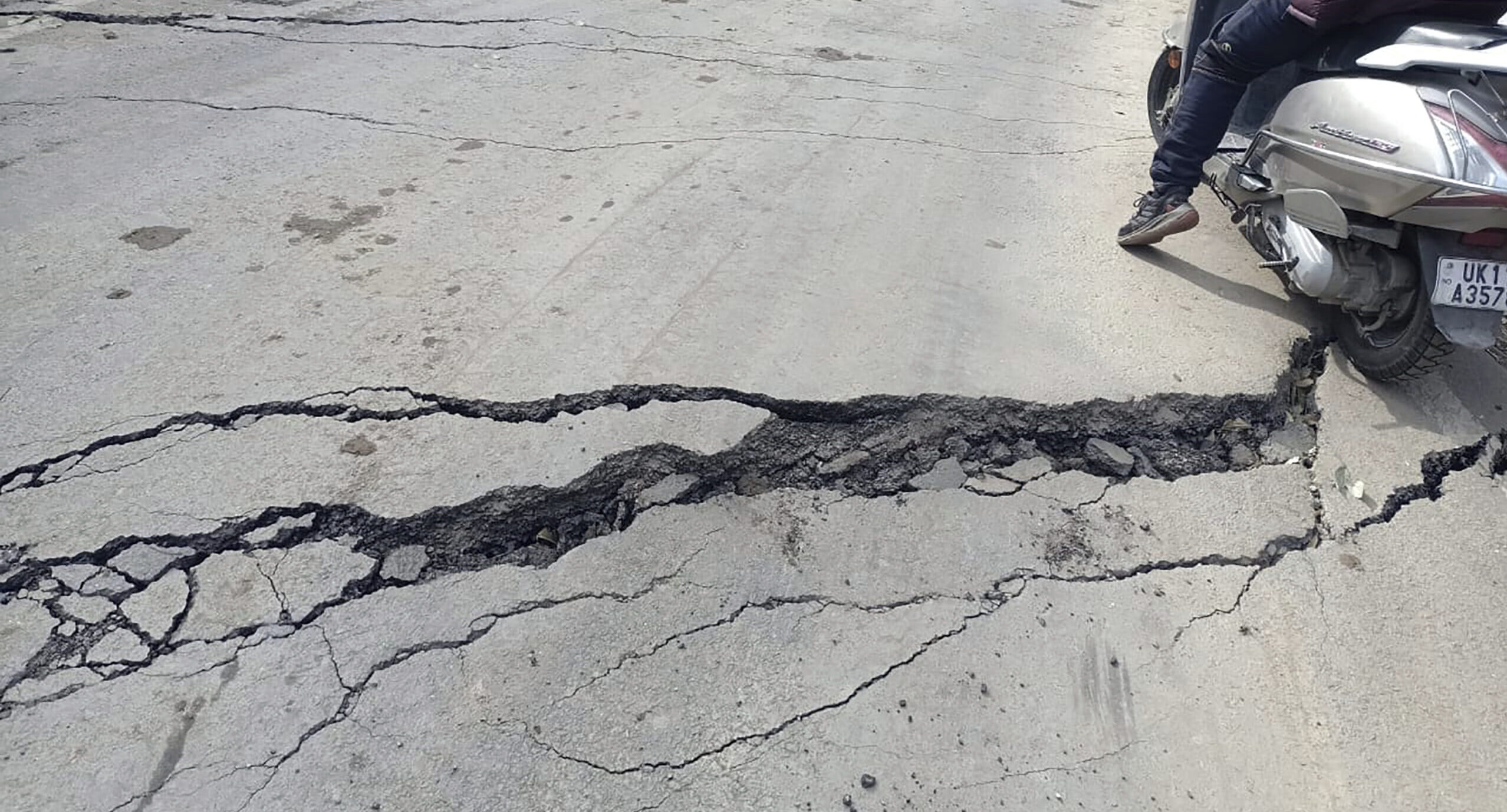
A recently resurfaced neighbourhood lane in south-west Kolkata split apart within hours of an earthquake tremor, raising fresh questions about ground stability and construction oversight in low-lying urban pockets. The 15-foot-wide stretch along Sagar Manna Road in Behala developed a long fissure and partial surface collapse, prompting civic engineers to assess soil conditions and nearby structures. The incident occurred near Mannapara, close to a cluster of multi-storey residences built over what local residents describe as a former water body. While no injuries were reported and major buildings remained structurally intact, the sudden road subsidence alarmed households who rushed outdoors during the tremor and later discovered the asphalt surface fractured and uneven.
Officials from the Kolkata Municipal Corporation (KMC) inspected the site within hours. Preliminary assessments indicate that the tremor destabilised a retaining edge abutting a pond, loosening underlying soil and triggering the road subsidence. An earthmoving machine was deployed to open up the cracked stretch and examine the base layers beneath the newly laid asphalt. Urban planners say the episode underscores a recurring vulnerability in parts of the city where marshland and ponds were gradually filled to enable real estate expansion. Such reclaimed parcels often require deep soil compaction, engineered drainage and long-term monitoring to withstand seismic shocks and heavy monsoon loads. Without adequate sub-base preparation, freshly laid bitumen can conceal underlying voids until stress events expose them.
A senior civic engineer, speaking on condition of anonymity, noted that Kolkata sits in Seismic Zone III, where moderate tremors can reveal weaknesses in older embankments and reclaimed tracts. “Surface repair alone is insufficient if the subgrade is compromised,” the official said, adding that a broader audit of similarly situated roads is underway. The road subsidence has also reignited debate over development patterns in flood-prone wards. Environmental researchers have repeatedly warned that converting wetlands into buildable land not only heightens flood risk but also reduces natural soil binding capacity. In a city already grappling with climate volatility, resilient urban infrastructure demands closer integration between land-use planning, drainage design and seismic safety.
Residents in the affected pocket have called for geotechnical testing before the road is relaid. Civic authorities confirmed that structural safety checks are being extended to adjoining lanes and embankments. Engineers are expected to recommend reinforcement measures, including soil stabilisation and improved retaining structures, before traffic resumes fully. For Kolkata’s fast-urbanising fringes, the episode serves as a cautionary signal. As real estate growth pushes into historically waterlogged zones, climate-resilient and scientifically engineered foundations will determine whether neighbourhood infrastructure can withstand both natural shocks and the pressures of dense habitation.