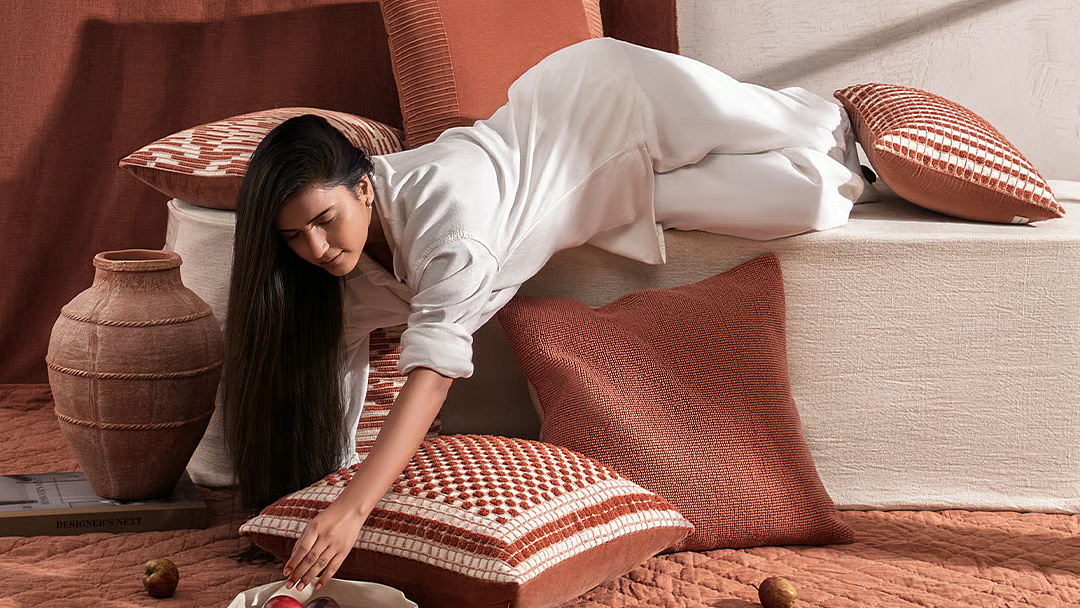
Playhaus Unveils Artisanal Geometry For Modern Homes
A growing cohort of Indian interior designers is redefining modern residential spaces by blending textured geometry with artisanal craft, signalling a shift away from flat minimalism toward richly layered, tactile environments in premium urban homes. This trend, visible in recent projects by design studio Playhaus, underscores how spatial aesthetics are adapting to evolving lifestyle expectations in India’s luxury housing market.
Design professionals say the emerging aesthetic goes beyond ornamentation — it reflects a deeper desire among affluent homeowners for interiors that engage the senses, anchor emotional well-being and reflect individual narratives. In dense urban contexts such as Mumbai, Delhi NCR and Bengaluru, where living spaces are increasingly compact, designers are using three-dimensional forms, material layering and handcrafted detailing to enhance spatial dynamism without increasing footprints.Playhaus — known for its design explorations centred on structural geometry and artisanal materials — has integrated such approaches in recent residential commissions, from apartment interiors to bespoke townhouses. Its work often features angular planes, textured surfaces, and custom joinery that respond not only to aesthetics but also to functional needs such as acoustics, light modulation and spatial differentiation.
Urban design consultants note that this stylistic evolution aligns with broader real estate trends where luxury buyers seek personalised, human-centred environments rather than generic high-end finishes. “Homeowners today want interiors that feel crafted, contextual and emotionally resonant,” says a senior industry strategist. “Textured geometry and craft are tools to create depth and meaning — important distinctions in premium urban markets.”The movement also dovetails with sustainability narratives gaining traction in India’s urban design discourse. Material choices such as natural wood, hand-finished plaster, and artisanal metals not only elevate tactile quality but can also lower embodied carbon compared with high-gloss, synthetic surfaces when sourced and manufactured responsibly. Designers emphasise the responsible selection of local materials and craftspeople to reduce supply chain emissions and support regional creative economies.
Playhaus’s projects frequently integrate such sustainable considerations through locally sourced materials, custom fabrication techniques and modular elements designed for longevity — priorities that resonate with environmentally conscious urban homeowners seeking durability over disposability. In cities where renovation cycles are shortening due to fast-paced lifestyle changes, durable craftsmanship and thoughtful geometry help future-proof interiors against aesthetic obsolescence.The trend also reflects shifting client expectations shaped by global design dialogues and domestic socio-cultural influences. As Indian urban households grow more design aware, there is increased openness to experimental textures, sculptural furniture and layered spatial compositions that balance drama with daily functionality. This shift contrasts with earlier phases of urban luxury design dominated by flat minimalism influenced by corporate branding of high-end interiors.
Critically, the adoption of textured geometry and craft requires new skill sets and closer collaboration between designers, artisans and builders. Project teams are investing more time in prototyping, custom joinery design and on-site detailing to ensure that complex forms are executed with precision — a trend that could stimulate deeper artisanal engagement within India’s interior fabrication ecosystem.
As India’s luxury housing sector continues to mature, the merging of geometric design languages with artisanal craftsmanship represents a meaningful evolution — one that enriches living environments while foregrounding spatial intelligence, cultural depth and sustainable material practice.