


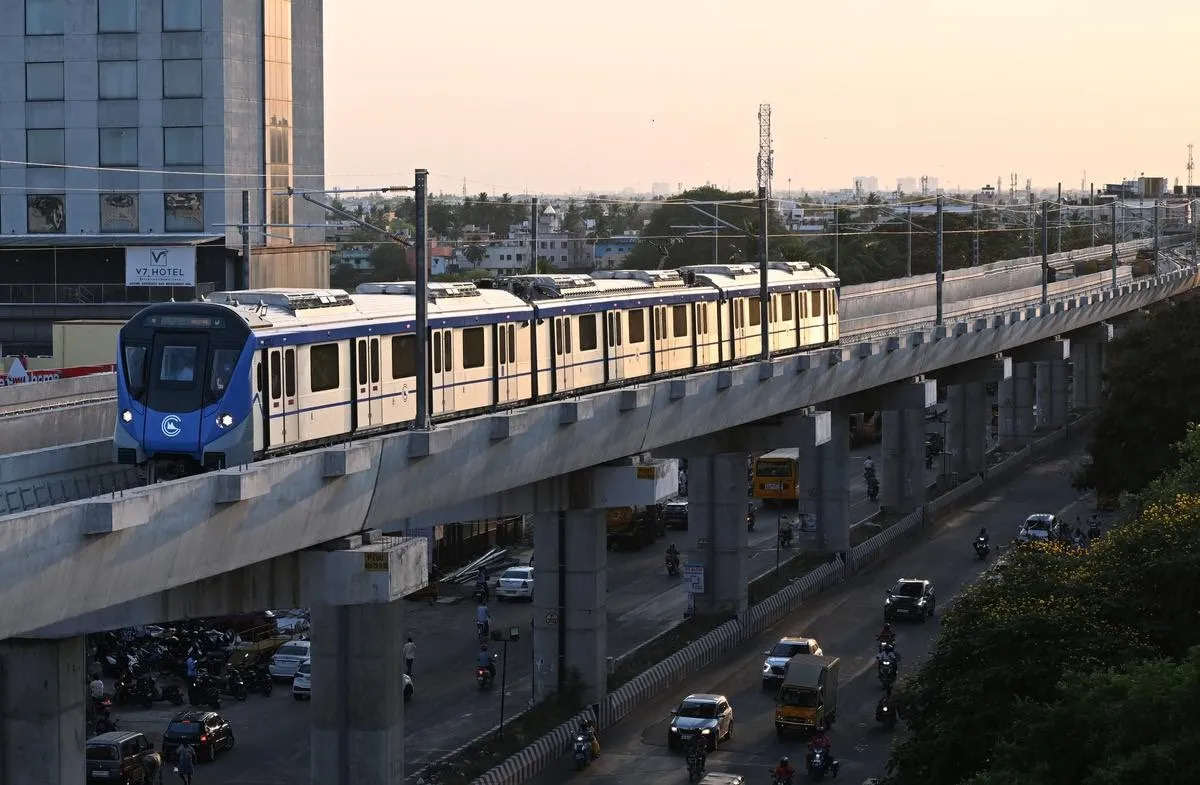
Chennai Metro Rail’s Phase II expansion has moved closer to operations, with the Commissioner of Metro Rail Safety completing statutory inspections on the Vadapalani–Poonamallee Bypass stretch ahead of a scheduled speed trial later this month. The development marks a critical milestone for the city’s western mobility corridor, where rapid residential growth has outpaced transport capacity.
Officials confirmed that the final speed certification exercise for the priority section of Corridor 4 is expected before month-end, subject to regulatory clearance. The inspected elevated segment spans roughly 8.5 km and forms part of a larger 14.6 km priority package under Chennai Metro Phase II.The safety review covered 11 stations between Poonamallee Bypass and Vadapalani, including key junctions such as Porur and Iyyapanthangal. Technical teams assessed track alignment, overhead electrical systems, signalling integration and structural stability. These checks are mandatory before commercial passenger services can begin.
Chennai Metro Phase II has been designed to strengthen east–west connectivity and link emerging suburbs to the operational Phase I network. Transport planners note that extending services up to Vadapalani, rather than terminating earlier at Porur, improves interchange access and ridership viability. Vadapalani already connects with the active metro grid, offering seamless transfers to central business districts.Urban mobility experts say that corridor integration is crucial for financial sustainability. “Ridership improves significantly when new stretches connect directly with functioning transit nodes,” said a senior transport analyst tracking metro expansions in southern India. “Standalone sections without interchange options tend to underperform in the initial years.”
The Vadapalani–Poonamallee alignment serves dense residential catchments, educational institutions and healthcare clusters. Real estate consultants observe that metro construction has already influenced land values and development patterns along the corridor. Mixed-use projects and mid-income housing have gained traction, reflecting expectations of improved commute times.From a climate standpoint, Chennai Metro Phase II is central to reducing dependence on private vehicles. The city continues to face congestion and rising vehicular emissions, particularly along arterial roads leading to IT parks and manufacturing zones. Electrified mass transit offers lower per-capita emissions and supports long-term decarbonisation targets.
However, experts caution that last-mile connectivity and pedestrian access must evolve in parallel. Without safe footpaths, feeder buses and integrated ticketing, the full benefits of high-capacity rail systems remain underutilised.Once the speed trial is completed and regulatory approvals are granted, commercial services on the priority section are expected to commence soon after. For Chennai, the opening of this Chennai Metro Phase II segment will not only ease pressure on road networks but also signal progress in aligning infrastructure expansion with sustainable urban growth.The coming weeks will determine how swiftly operations begin — and how effectively the corridor integrates into the city’s wider transport ecosystem.
Also Read:Mumbai B Right Realestate SRA Project Boost
