


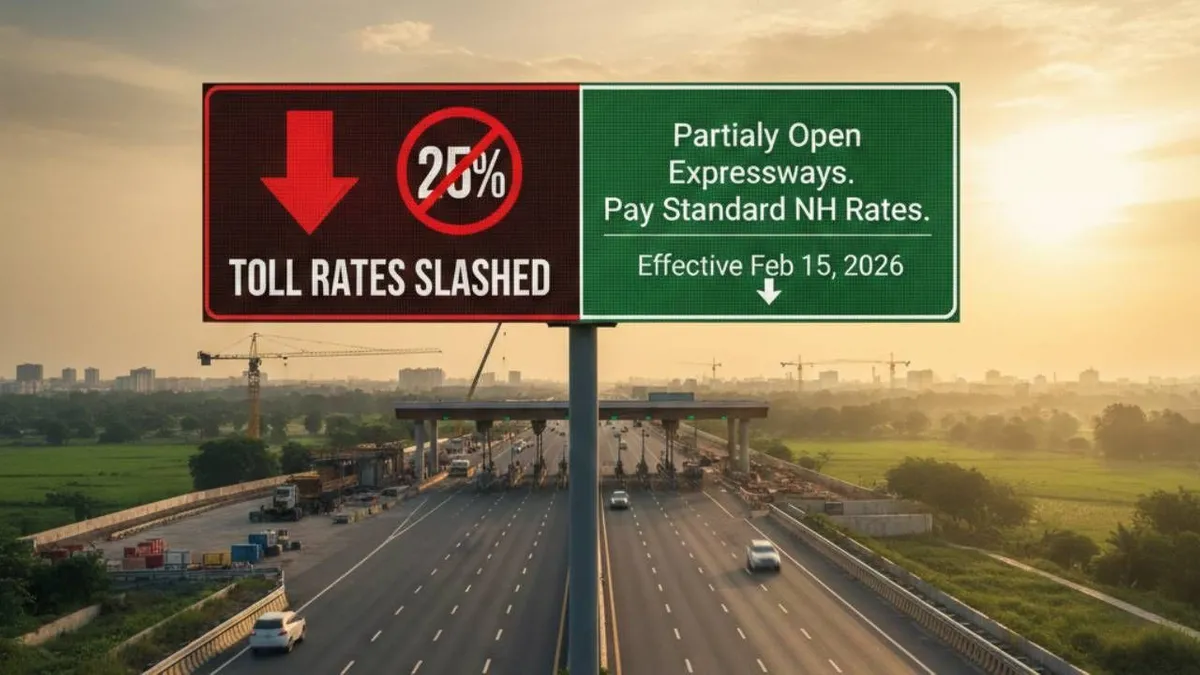
The Union government has enabled toll collection on stretches of national highways that are not fully completed, introducing a framework for partial toll charges linked to project progress. The policy, administered through the National Highways Authority of India under the oversight of the Ministry of Road Transport and Highways, seeks to balance revenue recovery with service delivery realities on under-construction corridors.
Officials indicated that partial toll charges may be levied where a substantial portion of the highway is operational, even if ancillary works or specific segments remain incomplete. The approach is intended to prevent prolonged revenue gaps for concessionaires and public agencies while ensuring that users pay in proportion to available infrastructure. India’s highway expansion programme has accelerated in recent years, with thousands of kilometres awarded under engineering, procurement and construction (EPC) and public-private partnership models. However, land acquisition delays, utility shifting and environmental clearances have often led to staggered completion timelines. In such cases, toll plazas have sometimes remained non-operational until full completion, affecting project cash flows. Infrastructure finance experts note that allowing partial toll charges can improve liquidity for highway developers and reduce stress on project debt. Early revenue generation supports maintenance of completed sections and lowers the risk of stalled construction due to funding constraints.
At the same time, transport economists stress that tolling must reflect service quality. If motorists encounter bottlenecks, diversions or incomplete stretches, fee calibration becomes critical to maintaining public trust. Transparent disclosure of project status and proportionate toll calculation will be central to acceptance. Urban planners argue that highway funding reforms should also integrate safety benchmarks. Operational sections opened ahead of full completion must meet minimum standards for signage, lane marking and crash barriers. Partial toll charges, they say, should not incentivise premature opening of unsafe stretches. For logistics operators, predictable tolling frameworks help stabilise freight costs. Sudden changes or ambiguity in toll application can disrupt supply chains and inflate transport expenses. A clearly defined policy on partial toll charges may reduce disputes between concessionaires and road users. The move comes amid broader efforts to strengthen asset monetisation and lifecycle management across India’s transport infrastructure. As capital expenditure remains high, policymakers are seeking mechanisms that sustain financial viability without compromising user experience.
Environmental analysts add that smoother, well-maintained highway segments can reduce idling time and fuel consumption, indirectly lowering emissions. However, they caution that road expansion must be complemented by rail freight and public transport investments to prevent car-dependent growth patterns. Implementation guidelines are expected to clarify thresholds for operational readiness and the percentage of toll permissible under different scenarios. As the policy unfolds, its success will depend on transparent enforcement, consistent communication and alignment with long-term infrastructure sustainability goals.
Also Read: India Revises National Highways Fee Rules
India Allows Partial Toll Charges On Highways
