


The Thiruvananthapuram Metro project has reached a stage where the city’s most important question is no longer only whether it needs mass rapid transit, but whether its institutions can align around a project that has already spent years moving through proposals, reviews and revised plans. The detailed project report (DPR) and revised comprehensive mobility plan (CMP) submitted by Kochi Metro Rail Ltd (KMRL) have remained under examination by the Kerala government for two months, and officials now indicate that a final decision could take at least another month.
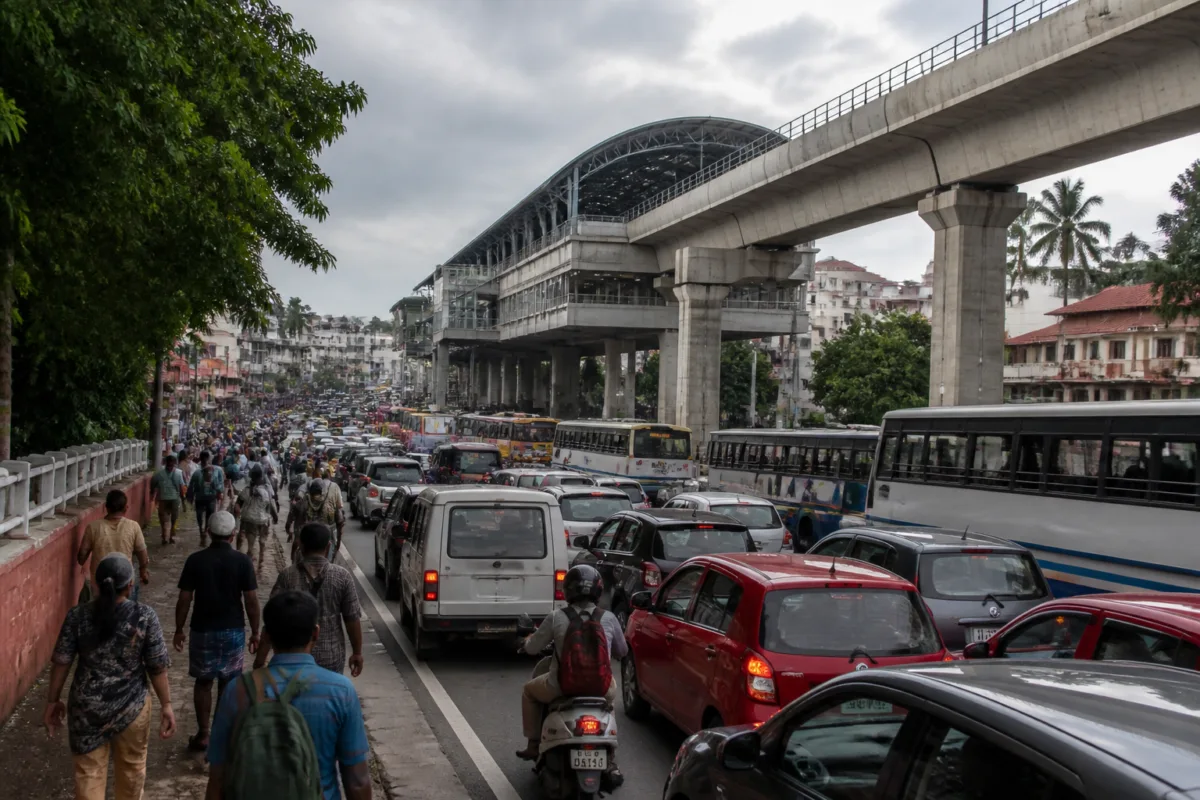
That delay matters because the proposed project is intended to address a transport problem that is already visible in the capital city: rising congestion and a steady increase in the number of vehicles. At the same time, the government is considering flyovers and other road infrastructure at key junctions. The contrast places the Metro proposal within a familiar urban policy choice—whether to continue responding to congestion through individual road improvements or advance a higher-capacity public transport system that connects residential, commercial, administrative, educational and technology districts.
The immediate obstacle is administrative rather than construction-related. The Metro rail division, transport department and local self-government department are examining the proposal, but requests for clarifications and a lack of coordination among departments have prevented the file from reaching a final decision. A senior government official said the DPR and revised CMP were being examined, with clarifications sought from KMRL being processed. The proposal, the official said, would be placed before the chief minister after the examination was completed.
This means the project has not yet crossed the state-level approval threshold. Once the state government takes a decision, the proposal must still go before the state cabinet and then be forwarded to the Union government for final approval. The current delay is therefore occurring before the project enters the larger sequence of cabinet consideration, central scrutiny, financing decisions, tendering and construction. No construction timeline has been announced in the supplied material.
The project’s institutional path has already involved several stages. The alignment received in-principle approval from the previous LDF government in November 2025 after review by a high-level committee. KMRL subsequently submitted the DPR prepared by the Delhi Metro Rail Corporation, with technical inputs, to the state government. The current examination of that document and the revised CMP is therefore a test of whether earlier in-principle support can be converted into a formal proposal capable of moving through the state and Union approval systems.
The central technical and policy question concerns the population criterion under the National Metro Rail Policy, 2017. The criterion requires a minimum population of 20 lakh for a conventional Metro system. According to KMRL, the relevant urban planning area is not limited to the Thiruvananthapuram municipal corporation. It includes the corporation, three municipalities and 51 grama panchayats spread across 1,194 sq km, with an approximate population of 26 lakh based on the 2011 Census.
KMRL has submitted detailed clarifications to establish that the wider urban planning area meets the prescribed population requirement. The issue illustrates how the definition of a city can shape the infrastructure it is permitted to build. A transport network does not serve only the administrative boundary through which its tracks pass. Its ridership catchment can extend across municipalities and panchayats, particularly when it connects employment, education, healthcare, technology and transport hubs. In this case, however, the state government is still examining whether the project’s population case satisfies the applicable policy framework.
The proposed first phase is planned as a 31-km corridor from Pappanamcode to Enchakkal, with 27 stations. The alignment would connect Thampanoor, Palayam, Medical College, Sreekaryam, Technopark, Kazhakkoottam and the international airport, among other locations. These destinations represent more than a sequence of stations: they are the city’s major administrative, commercial, medical, educational, technology and regional-access nodes. The corridor’s usefulness will ultimately depend on how effectively it connects these places to surrounding neighbourhoods and other modes of transport, but the supplied project details indicate an attempt to structure the first phase around the city’s existing activity pattern.
The proposal also includes intermodal transport hubs at Pappanamcode and Anayara and a dedicated Metro yard at Kazhakkoottam. These components are important because a Metro line is not an isolated civil structure. Its urban performance depends on the movement of passengers to and from stations, the availability of connecting services and the operational facilities required to maintain trains. The planned hubs suggest that the project documents recognise the need to link the Metro with other forms of transport, although the supplied material does not provide details on feeder services, interchange design, fares, parking or last-mile access.
The estimated cost of the first phase is around Rs 8,000 crore. At this stage, that figure describes the scale of the proposal rather than an approved expenditure commitment. The project has not yet reached the state cabinet or Union government for final approval, and no funding structure or financing arrangement is identified in the supplied report. Those decisions will become important if the proposal advances, but they remain unresolved in the current approval process.
The delay also shows why comprehensive mobility planning can become difficult when multiple departments share responsibility for the same urban system. KMRL has prepared and submitted the project documents, while state departments are reviewing its transport, planning and administrative implications. Local self-government bodies are involved because the proposed urban planning area crosses several layers of local administration. The result is a project whose physical alignment may be defined, but whose institutional ownership and policy justification must still be reconciled across departments.
For Thiruvananthapuram, the immediate consequence is that the city remains without a confirmed implementation schedule for its proposed Metro. Road projects and flyovers may continue to be examined as responses to congestion, while the mass transit alternative remains at the approval stage. The two approaches address mobility differently: junction improvements can target specific bottlenecks, whereas a Metro corridor is intended to provide a large-scale transit spine between major urban destinations. The report does not establish how the government is comparing these interventions or whether they are being planned as complementary projects.
The evidence currently confirms three things. First, a 31-km, 27-station Metro proposal exists and has been submitted for state consideration. Second, the state government has not yet completed its examination, with population eligibility and interdepartmental clarifications among the issues under review. Third, even a state decision would be followed by cabinet consideration and referral to the Union government. What remains uncertain is whether the population clarification will be accepted, when the state-level decision will be taken, how the estimated Rs 8,000 crore cost will be financed and whether the project will receive final approval.
The next significant milestone is the completion of the state government’s examination and the placing of the proposal before the chief minister. Until that happens, Thiruvananthapuram Metro remains a defined transport plan but not an approved construction project.

