


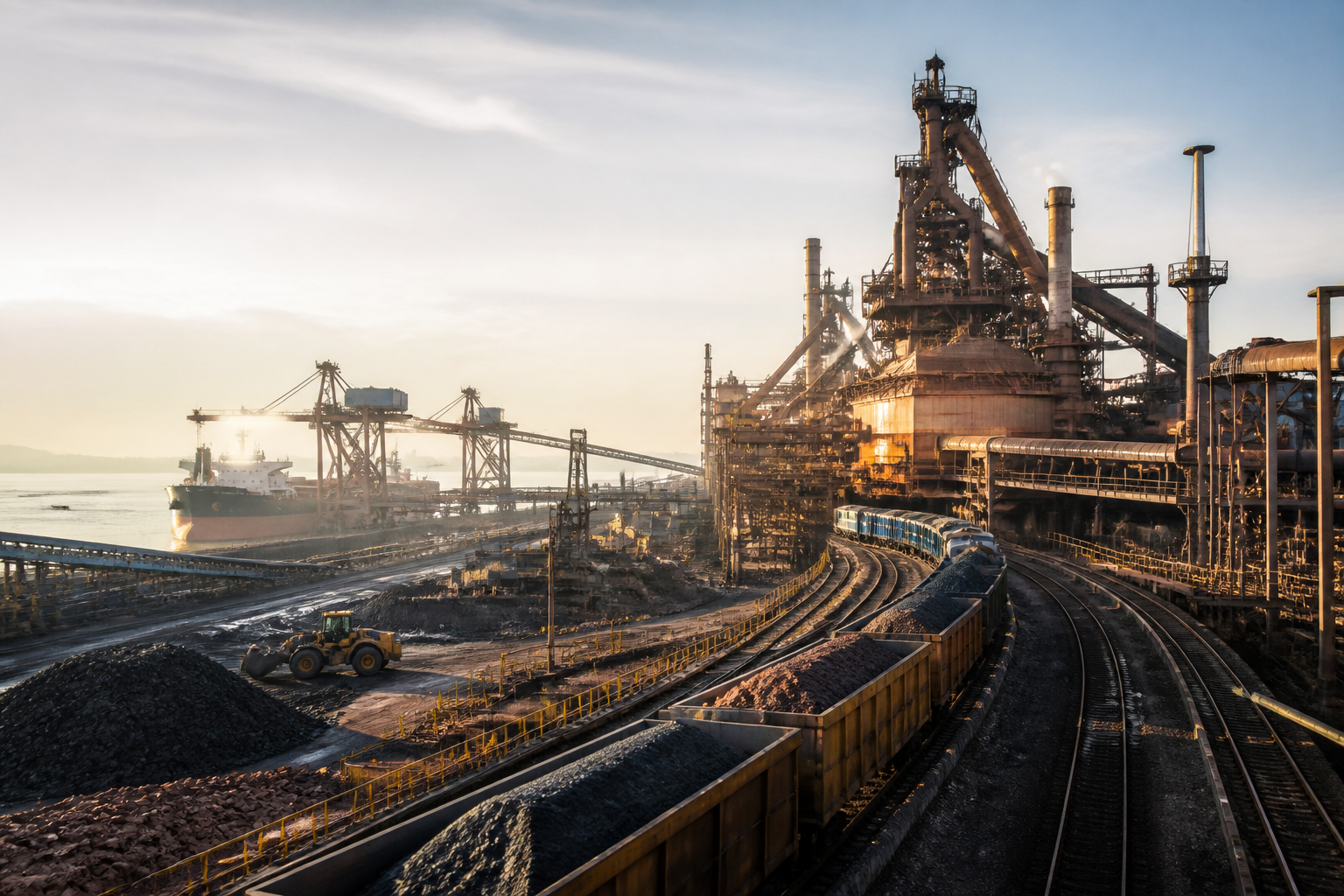
The Steel Ministry’s direction to SAIL and NMDC to explore mining assets abroad signals a shift in how India’s public-sector steel companies may manage one of the industry’s most persistent vulnerabilities: dependence on imported raw materials. The move is aimed at securing long-term supplies and reducing input costs, but it also exposes the limits of domestic resource availability when steel production depends on minerals that India cannot source adequately at home.
According to a report by The Hindu BusinessLine, a senior ministry official confirmed that SAIL and NMDC had been asked to examine overseas mineral assets. The official did not provide details on the countries, minerals, investment structure or timeline involved. That absence of detail makes the announcement an initial strategic direction rather than a defined acquisition programme.
The institutional roles of the two companies are significant. SAIL is India’s largest public-sector steel-making entity, while NMDC is the country’s leading iron ore producer. Their proposed overseas search therefore brings together steel manufacturing and mining expertise within the public sector. For the government, the objective appears to be broader than simply increasing iron ore supply: it is to secure the raw-material chain that determines the cost and continuity of steel production.
Iron ore is available in abundance in India, but it is only one of the principal inputs required to make steel. The industry also relies on coking coal, limestone and pulverised coal injection coal. The BusinessLine report states that Indian steel producers, including SAIL, import 85-90 per cent of their coking coal requirements, mainly from countries such as Australia and Mozambique. Limestone is also imported from the West Asia region.
This dependence creates a structural imbalance in the domestic steel chain. India may possess substantial iron ore resources, yet the availability of iron ore alone does not guarantee control over steel-making costs. If a critical input such as coking coal remains import-dependent, producers remain exposed to international prices, shipping conditions and the concentration of supply in overseas markets. The ministry’s direction is consequently focused on a gap between domestic mineral abundance and domestic raw-material self-sufficiency.
Overseas mining assets are one way of addressing that gap. A captive asset can potentially provide a producer with a more assured source of supply than spot-market purchases, although the supplied report does not establish whether SAIL or NMDC will pursue acquisitions, joint ventures, long-term contracts or exploration partnerships. The official statement only confirms that the companies have been asked to explore the opportunity. The commercial and regulatory implications will depend on what form that exploration takes.
The proposal also reflects the different positions of SAIL and NMDC within the value chain. SAIL consumes raw materials to produce steel, while NMDC is primarily an iron ore producer. The ministry’s direction could encourage both companies to move beyond their traditional operating roles: SAIL towards greater control over imported inputs, and NMDC towards a wider international minerals portfolio.
NMDC has already indicated that it wants to diversify beyond iron ore. Its chairman, Amitava Mukherjee, recently said that his goal is for at least 20 per cent of the company’s revenues to come from minerals other than iron ore by 2030. The overseas-assets direction fits within that stated ambition, although the report does not say whether any particular foreign asset has been identified or whether the target includes overseas production.
The company’s diversification plan is important because the demand for minerals is broader than the requirements of the steel sector alone. The report says NMDC is looking at other minerals to meet the growing needs of various industries, including steel. This suggests that the company’s future strategy could involve a wider minerals platform rather than a single-minded expansion of iron ore output. However, the available information does not establish the minerals under consideration or the investments needed to develop them.
The private sector provides a relevant comparison. JSW Steel has acquired coking coal assets abroad as part of a plan to meet 50 per cent of its raw-material requirements through captive sources. That example shows that overseas resource ownership is already part of the strategic response available to Indian steelmakers. It also illustrates the distinction between owning or controlling mineral assets and simply purchasing raw materials on the international market.
For public-sector companies, the decision carries an additional institutional dimension. SAIL and NMDC are not standalone private investors operating only according to commercial opportunity; they are government-owned enterprises being directed by the ministry responsible for the sector. Any overseas asset strategy would therefore have to align commercial returns with long-term supply security. The source material does not provide details on capital allocation, due diligence, risk management or approval procedures, so those aspects remain to be clarified.
The immediate evidence points to three linked pressures. First, steel demand requires reliable access to several minerals, not just iron ore. Second, the largest raw-material vulnerability identified in the report is coking coal, for which imports account for 85-90 per cent of requirements among Indian steelmakers including SAIL. Third, companies are seeking greater control over their supply chains, with both public and private producers examining ways to increase captive sourcing or diversify their mineral base.
These pressures matter beyond the steel industry. Steel is a basic input for construction, transport infrastructure, industrial facilities and urban development. The supplied material does not quantify the effect of imported coking coal or limestone on project costs, nor does it establish whether overseas mining would reduce prices for consumers. It does, however, show why raw-material security has become an issue for the wider built environment: the reliability and cost of steel production are linked to mineral supplies that extend well beyond India’s borders.
The proposal also raises a question about what self-reliance means in the steel sector. Domestic production of a mineral is not the only measure of security. A company may have access to abundant iron ore but remain vulnerable if another essential input is imported. In that sense, the ministry’s approach appears to treat security as control over the complete input chain rather than ownership of a single resource.
The next stage will determine whether the announcement develops into a substantive overseas investment strategy. Important details include the minerals and countries being examined, the form of participation proposed for SAIL and NMDC, the financial commitments involved and the expected timeline. Until those details emerge, the confirmed position is limited: the Steel Ministry has asked the two public-sector companies to explore overseas mining assets to secure future raw-material requirements and support costs.
What the evidence establishes is that India’s steel-security challenge is not simply a question of iron ore availability. It is also a question of dependence on imported coking coal and limestone, the capacity of public-sector companies to diversify, and the extent to which producers can build captive sources. The ministry’s direction puts those questions at the centre of the next phase of India’s steel and infrastructure supply-chain strategy.
