


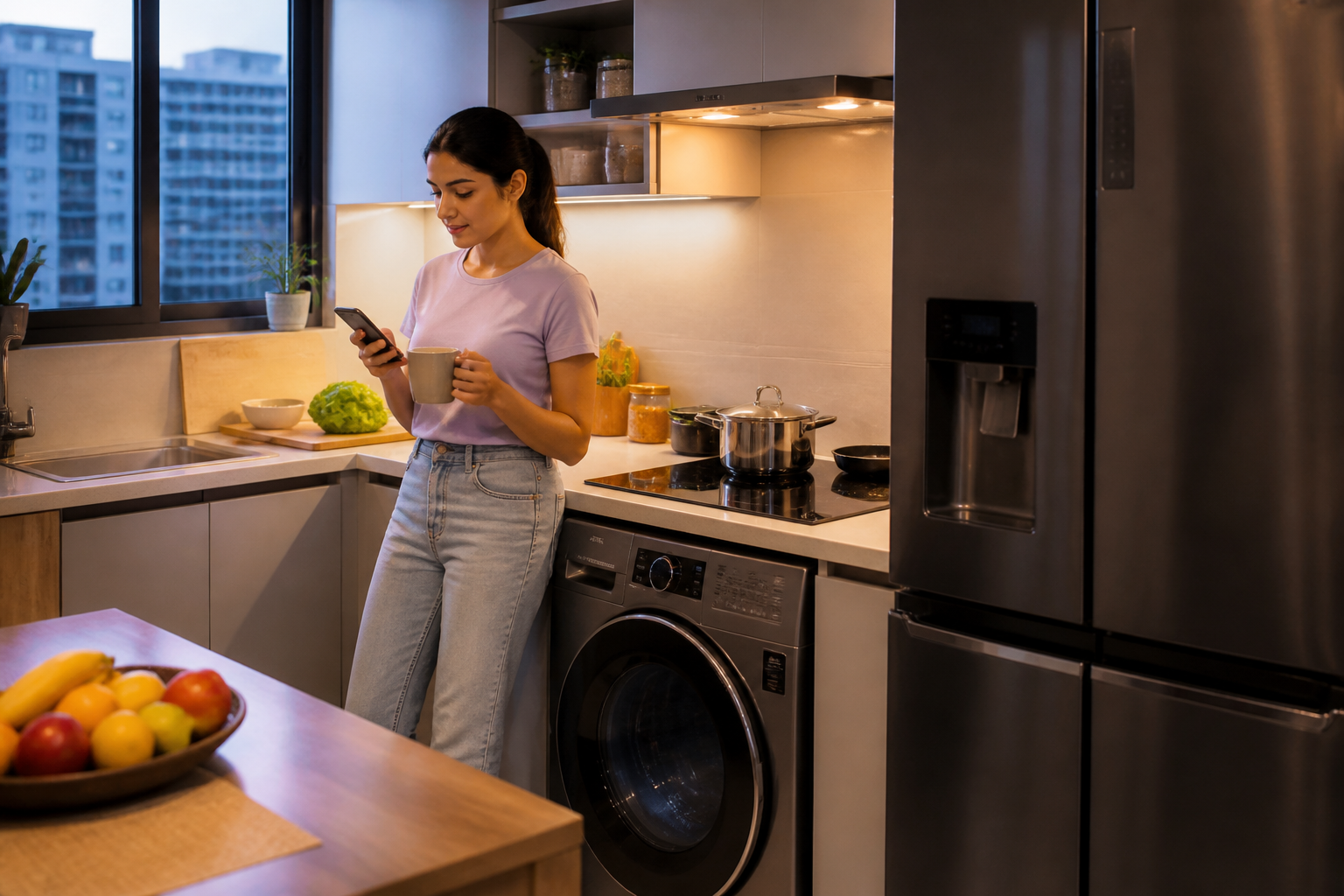
India’s rapid adoption of AI-powered home appliances is not simply a consumer electronics story. It is also a signal of how urban households are responding to time pressure, changing lifestyles and the growing expectation that homes should perform more tasks with less daily effort. Samsung says the number of newly connected appliances in India rose from 82,000 in 2022 to 7,32,000 last year, while demand has already exceeded the previous year’s total in the first eight months of the current year.
The figures, disclosed by Samsung Electronics Vice President and Head of Experience Planning and CX Insight Group, Digital Appliances Business, Bona Lee, place India among the company’s fastest-growing markets for AI-powered appliances. Samsung’s connected-device expansion is being driven particularly by younger consumers. According to Lee, 71 per cent of active SmartThings users in India and Southwest Asia are in their twenties and thirties, compared with a global average of 48 per cent.
That age profile matters because it points to a different route through which technology is entering Indian homes. Connected appliances are not being adopted only as premium lifestyle products or symbols of affluence. Samsung’s account suggests that they are increasingly being evaluated as tools for managing urban routines: appliances that can be monitored, controlled or updated through software while households deal with long working hours, commuting, domestic responsibilities and limited time.
Samsung’s India Consumer Experience unit identified busy and high-stress urban lifestyles as a factor behind demand in a survey covering Delhi, Mumbai, Hyderabad and Bengaluru. The company did not disclose the survey’s sample size or detailed methodology in the supplied report, so the finding cannot be treated as a representative measure of all urban households. It does, however, provide an important explanation for why appliance intelligence is being marketed around convenience and daily usage rather than novelty alone.
The expansion is also changing the geography of Samsung’s connected-device business. Lee said Southwest Asia’s share of Samsung connected devices worldwide increased from 2 per cent in 2022 to 13 per cent in 2026. The company’s regional grouping is broader than India, so the figure should not be read as India’s individual share. But the movement indicates that the region has become more important to Samsung’s global connected-home strategy, with India providing a major part of that growth.
The scale-up is taking place alongside a deliberate effort to move AI features beyond the top end of the market. JB Park, President and CEO of Samsung Southwest Asia, said more than 50 per cent of the appliances Samsung currently sells in India are AI-enabled. Lee said the company plans to extend AI capabilities to mid-range and entry-level appliances so that more consumers can access what Samsung describes as the practical benefits of AI Home.
This shift is crucial in a price-sensitive market, but the company’s own explanation complicates the usual affordability narrative. Lee said the average selling price of home appliances in India is lower than in some other countries, while arguing that this reflects Indian households’ lifestyle needs rather than price sensitivity alone. She cited refrigerator preferences as an example: Indian households tend to prefer smaller refrigerators, unlike markets where large-capacity models are more common because consumers rely more heavily on frozen food.
The distinction between price and use case is important for understanding how global appliance strategies are adapted to Indian cities. A product designed for a different household structure, food system or storage pattern may not find demand simply because it has more capacity or more features. Local adoption depends on whether the appliance fits the rhythms of the home, the available space and the way residents shop, cook and manage everyday work.
Samsung said more than 95 per cent of the appliances it sells in India are manufactured domestically. The company also has a dedicated team working on products tailored to Indian culture and lifestyle. Domestic manufacturing does not by itself establish that products are affordable or locally designed in every respect, but it indicates that India is being treated as a production and product-development base rather than only as a sales destination.
That manufacturing footprint gives the AI-appliance trend an urban economic dimension. The expansion of connected products affects not only households but also factories, supply chains, service networks, software support and retail systems. The source material does not provide employment, investment or production figures, so the wider economic impact cannot be quantified from the available evidence. Still, the company’s localisation claims show that appliance adoption is linked to industrial capacity as well as consumer demand.
The more consequential change may be that appliance ownership is becoming an ongoing software relationship. Samsung said software updates can extend new features to appliances launched in 2024 and beyond, without requiring consumers to purchase new devices. This model potentially lengthens the functional life of products by allowing capabilities to evolve after installation. At the same time, it makes the continued availability of software support part of the ownership experience, alongside hardware reliability, repair and warranty service.
For urban households, that raises a practical question: what exactly is being purchased when an appliance is described as AI-enabled? The answer may include automated functions, remote controls, usage data, software updates and integration with other connected devices. The supplied report does not specify which AI functions are available across product categories, nor does it establish how consumers use them. It does report that the average usage of the feature among Indian consumers is 10 per cent higher than in other countries, according to Lee.
That usage figure is a company-provided comparison, and the report does not define the feature being measured, the countries included or the period of comparison. It should therefore be read as an indication of Samsung’s internal consumer research rather than as an independently verified national benchmark. Even with that limitation, the claim reinforces the company’s argument that Indian consumers are not lagging in AI adoption simply because average appliance prices are lower.
Samsung’s plans also connect India to a much larger corporate target. In January, the company announced an ambition to extend AI features to 800 million devices by the end of the year, up from 400 million the previous year. India’s growth in connected appliances supports that global expansion, but the supplied material does not state how many of those devices are in India or what proportion of the global target the country represents.
The policy environment surrounding this transition is not described in the report, and no public programme or regulatory framework is cited. That absence is significant because connected appliances sit at the intersection of several governance questions: digital privacy, cybersecurity, product standards, electronic waste, repair access, energy use and consumer protection. The source does not provide evidence on Samsung’s data practices, security arrangements or end-of-life management, so those issues cannot be resolved through this announcement alone. They remain part of the institutional landscape that will become more important as connected products spread.
The same applies to energy and resource use. AI capabilities may help appliances operate more efficiently in some circumstances, but the supplied report does not provide energy-consumption data, emissions figures or comparisons with conventional models. It would therefore be premature to describe the expansion as an environmental gain. The immediate evidence is about adoption, connectivity, product availability and user behaviour—not sustainability performance.
What the numbers do establish is the speed of Samsung’s reported growth in India. Newly connected appliances increased nearly nine-fold between 2022 and last year, from 82,000 to 7,32,000. The company says the current year’s number had already surpassed last year’s total after eight months. More than half of its appliances currently sold in India are described as AI-enabled, and younger users account for a larger share of active SmartThings users in India and Southwest Asia than the global average.
These figures point to a market moving from isolated smart-home experiments towards a broader connected-appliance ecosystem. But they do not show how many households are represented, whether multiple devices are being added within the same homes, how frequently features are used or whether adoption is evenly distributed across income groups and cities. Device counts can grow rapidly without demonstrating widespread access or consistent everyday value.
That distinction is especially relevant in India’s urban housing landscape, where household sizes, built-up areas, electricity reliability, internet access and purchasing power vary considerably. A connected appliance may be useful in a compact apartment with a demanding work schedule, but its value will depend on installation, connectivity, maintenance and the user’s willingness to operate it through digital systems. The announcement provides evidence of commercial momentum, not a complete picture of household outcomes.
India’s AI-appliance boom therefore marks a broader transition in the urban home. The kitchen, utility area and living room are becoming sites where hardware, software and daily routines increasingly overlap. Samsung’s reported growth shows that this transition is accelerating, particularly among younger urban consumers and beyond the premium segment. What remains unclear is whether connected features will become durable tools of household convenience, short-lived marketing additions or infrastructure-like services that require stronger standards for privacy, repair and support.
The next stage will be defined by whether mid-range and entry-level products actually broaden access, whether software updates remain available over the life of an appliance and how manufacturers address the institutional questions that accompany connected homes. For now, the evidence confirms that India is no longer a peripheral market in Samsung’s AI-appliance strategy. It is becoming one of the places where the future shape of the urban household is being tested at scale.
