


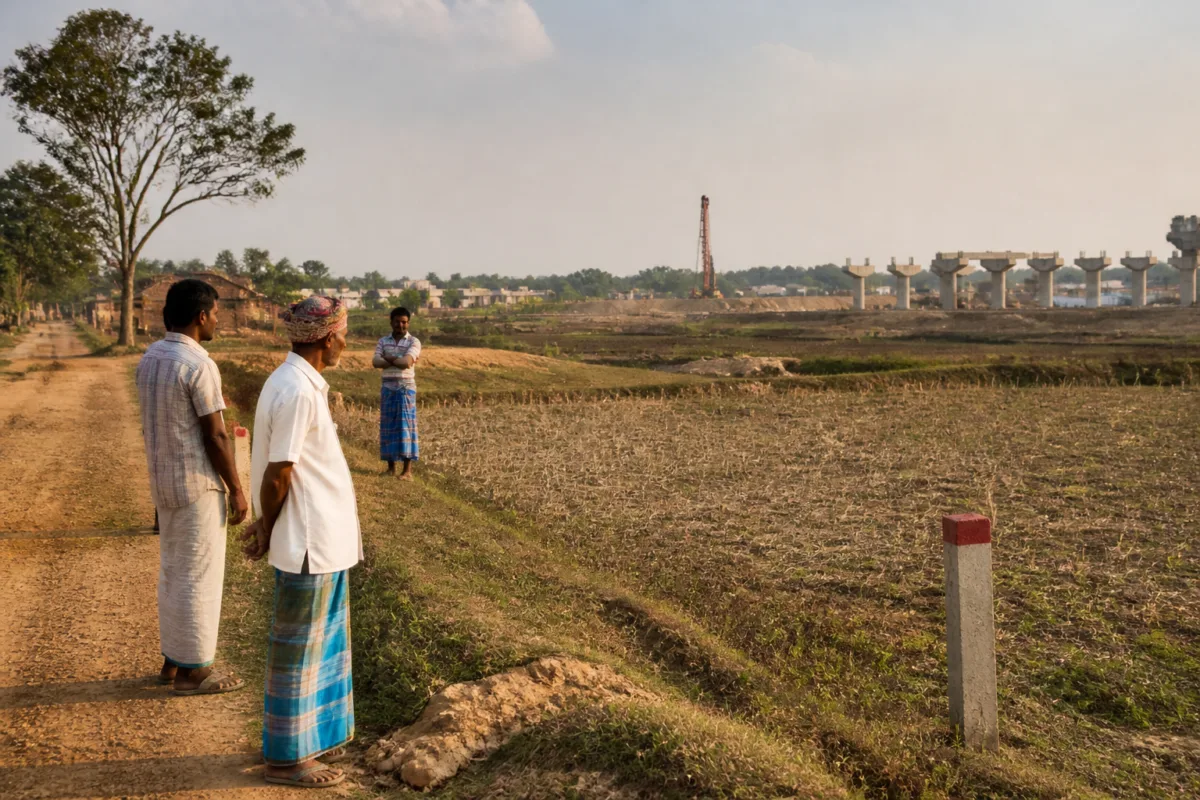
West Bengal chief minister Suvendu Adhikari has urged landowners in Bankura and Purulia to voluntarily sell their plots to the government, signalling that direct land purchase will be the first step in the state’s plan to attract industries and build supporting infrastructure. The proposal was made at a gathering in Raipur, Bankura, on Thursday.
Adhikari said the West Bengal Industrial Development Corporation would buy land from willing owners at a proper price. He also said the government planned to establish environment-friendly industries in the region, along with hospitals, schools, colleges and skill-development centres. The stated aim is to create local employment and reduce the need for young people from Bankura and Purulia to leave the state in search of jobs.
The chief minister asked Ajit Mahato, a leader of the Mahato community in Jungle Mahal, to prepare a list of people willing to sell their land to the government and submit it to him. The appeal is the clearest indication so far of how the government intends to secure land after announcing its industrial promotion policy.
A government official cited in the report said Adhikari was expected to make similar appeals to landowners in other districts after the state’s land policy is announced in the next few days. The government had previously said it would play an active role in arranging land for industries rather than follow what Adhikari described as the hands-off approach of the previous Trinamool Congress administration.
The proposed strategy has two parts. Under the direct-purchase model, the government would buy land from farmers who agree to sell. The likely compensation benchmark is the amount provided under the 2013 Land Acquisition Act, which can offer compensation of up to four times the market value of land and any structures on it, according to the report.
The second option is land pooling. Under this model, the government would acquire plots from willing farmers, develop the assembled land and return between 15 and 30 per cent of it to the original landowners. Farmers would also receive a certain percentage of shares in industrial units established on the developed property.
Sources cited in the report said the government would initially promote direct purchase because land pooling is a more time-consuming process. The direct-purchase route is intended to speed up industrialisation and prevent land availability from becoming a major obstacle to attracting investment.
The proposal places voluntary consent and compensation at the centre of the state’s industrial land strategy. It also links land procurement to a wider promise of public infrastructure and employment, although the announcement did not specify the industries, project locations, investment amounts or implementation timelines for Bankura and Purulia.
The next formal step is the expected announcement of the state’s land policy, after which the government may extend the land-purchase outreach to other districts. Until then, the Bankura meeting establishes the administration’s immediate preference for buying land directly from willing owners before pursuing the more complex land-pooling model.

