


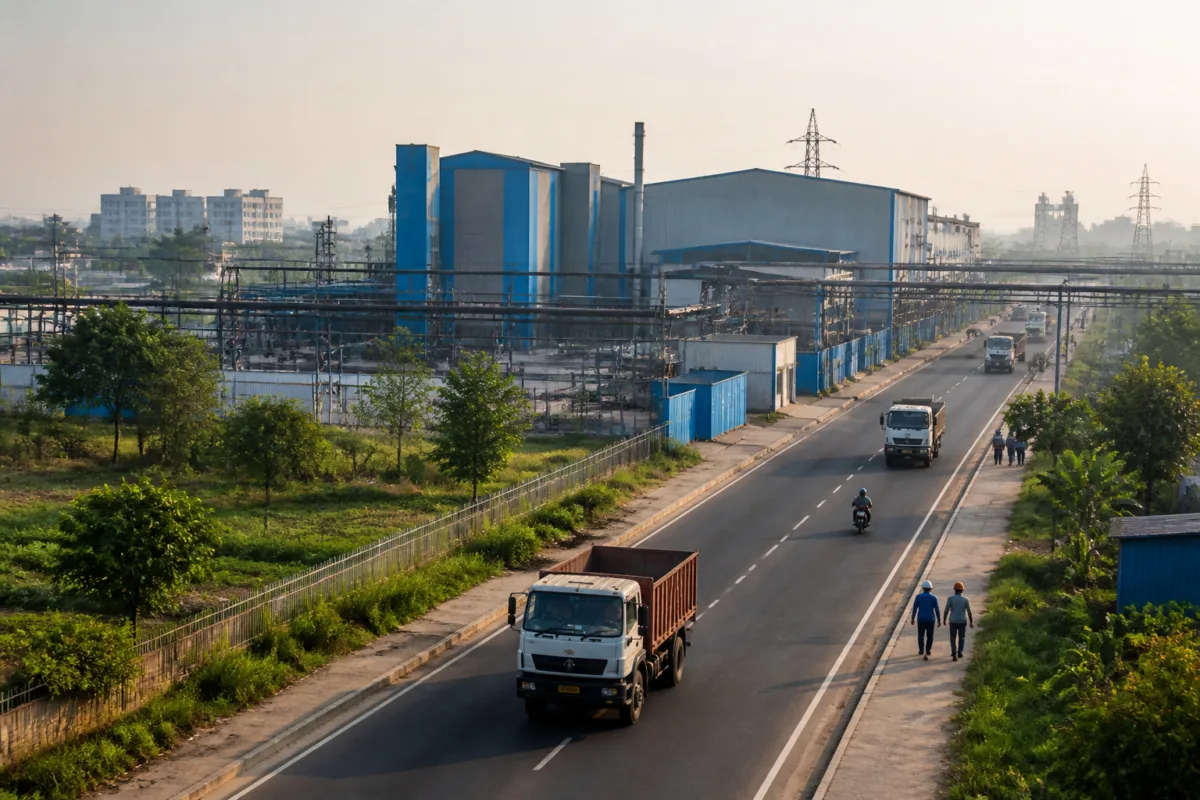
West Bengal’s Industrial Policy 2026 is designed to solve a problem that goes beyond attracting new factories: whether the state can persuade investors that a fiscal promise will survive a change in government. The policy creates a dedicated, non-lapsable fund of ₹5,000 crore for incentives, while making clear that the estimated ₹50,000 crore backlog of past dues will not be paid immediately. That combination makes the policy both an investment offer and an attempt to rebuild institutional credibility.
The policy, announced by Chief Minister Suvendu Adhikari, applies to industries established or expanded after May 9, 2026, the day the BJP government came to power in Bengal. Its stated objectives are to support job creation, increase economic output and reverse the previous government’s decision to remove the word “incentive” from the state’s industrial policy. The new framework covers manufacturing and services, large and small enterprises, and a range of fiscal benefits linked to investment and production.
Its most consequential feature is the proposed fund architecture. The state government says incentives will be paid from a dedicated corpus created through budgetary allocations. Funds left unspent at the end of a financial year will not lapse or return to the exchequer. Instead, they will remain available and be added to subsequent budget allocations. This is intended to address a basic concern in industrial policy: an announced benefit is not the same as a benefit that an investor can reliably claim when an eligible project reaches production.
The distinction matters because investment decisions are made over long time periods, while governments and budgets change more quickly. According to the report by Telegraph India, the government also plans to formally notify that incentives promised to investors will be honoured and that fiscal benefits fixed through a certificate of intent will not be reduced by later policy changes. The proposed arrangement therefore seeks to convert an incentive announcement into a more predictable administrative commitment.
That commitment is being made against a recent rupture in policy continuity. The previous Mamata Banerjee government repealed industrial incentives retrospectively through legislation passed in the Assembly in 2025. The move created concern among industry stakeholders because it challenged the assumption that benefits already promised by the state would remain available for the duration of an investment project. The new policy directly responds to that episode by emphasising certainty, non-lapsing allocations and protection against prospective changes.
However, the policy does not settle the question of past obligations. The chief minister put the estimated arrears at approximately ₹50,000 crore and said the state could not repay them given its fiscal position. The government’s stated position is that the backlog may be considered only after Bengal becomes fiscally surplus, with Gujarat, Maharashtra and Tamil Nadu cited as examples. This leaves two distinct policy tracks: a new framework intended to create confidence for future investors, and an unresolved liability inherited from earlier commitments.
That separation is central to understanding the policy’s credibility challenge. A new investor can receive a formal promise under the 2026 framework, but the wider business community will also judge the policy against the state’s treatment of earlier commitments. The government is attempting to establish a new record of reliability without assuming the full financial burden of the old one. Whether that distinction is accepted by investors will depend on how clearly the promised fund, certificates and payment processes are operationalised.
The incentive structure itself is linked to the scale and location of investment. Incentives can include state Goods and Services Tax refunds, electricity-duty waivers, contributions to employees’ provident fund accounts, and exemptions from stamp duty and registration fees. The benefits will carry an annual cap so that assistance is distributed among a larger number of units. They may be disbursed over a period of up to 10 years, with the amount determined by the fixed capital investment made by the beneficiary industry.
The policy offers assistance of up to 120 per cent of eligible investment in plant and machinery for units in thrust sectors located in priority areas. For regular units, the ceiling is 100 per cent of eligible fixed capital investment. The wording is important: these are not immediate cash payments equal to the entire investment. They represent the maximum assistance that may be disbursed over time under specified eligibility conditions. The framework also allows tailor-made benefits for strategic and mega projects, creating room for negotiations around large investments while retaining a general structure for other units.
The list of priority sectors indicates an attempt to align Bengal’s industrial offer with capital-intensive and strategically important industries. Semiconductors, automobiles, defence, critical minerals, shipbuilding and the maritime industry, and petrochemicals are among the sectors identified. The inclusion of service industries is equally significant. Hospitals, medical colleges and universities, including non-profit institutions, are covered by the policy, widening its scope beyond conventional factory-led industrialisation.
This broader coverage reflects the way urban and regional economies are built. Industrial policy does not operate only inside factory gates. New manufacturing units require land, power, roads, logistics, workers’ housing, public transport and civic services. Service institutions such as hospitals, universities and medical colleges generate employment and demand for surrounding commercial and residential areas. The state’s incentive design will therefore influence not only where companies invest, but also where supporting settlements and infrastructure develop.
At the same time, the policy’s fiscal design places limits on the state’s exposure. Annual caps may prevent a small number of large projects from absorbing the entire incentive budget, but they also mean that the headline benefit cannot be viewed separately from yearly allocation decisions. A project eligible for assistance over 10 years will remain dependent on the continuity of the fund and the administrative process that releases the money. The non-lapsable structure addresses one risk, but it does not by itself establish how applications will be evaluated, payments prioritised or disputes resolved.
The government’s emphasis on certificates of intent is an attempt to address that administrative uncertainty. Once a fiscal commitment is fixed, the government says it will not be reduced by future policy changes. For investors, the value of such a certificate will depend on the legal and procedural force attached to it. For the state, the mechanism will need to balance long-term commitments with budget management. The supplied report does not establish the detailed rules governing that process, including the conditions under which a commitment could be withdrawn or modified.
The policy also raises a question about the relationship between incentives and actual industrial outcomes. The government has presented the package as a route to job creation and higher economic output, but the announcement does not provide projected employment numbers, a target for new investment, or a schedule for measuring the results of the ₹5,000 crore fund. It identifies sectors and benefit mechanisms, yet the evidence supplied does not show how the state will compare the cost of incentives with the number or quality of jobs created.
That missing measurement framework matters because fiscal incentives compete with other public uses of state funds. If benefits are linked to fixed capital investment, the policy may favour projects that require substantial plant and machinery. But the government also wants to include services, where employment, land use and public-service demand may be structured differently. The effectiveness of the policy will therefore depend on whether its eligibility rules can distinguish between investment volume and wider economic value without making the system too complex for smaller enterprises.
The immediate political message is clear: the new government wants to mark a break with the previous regime’s “no-incentive” approach and offer investors a formal assurance that commitments will be honoured. The administrative test is more demanding. The state must convert the announcement into a notified framework, fund it through annual budgets, carry forward unused allocations, issue enforceable commitments and process claims over a decade. The fiscal test is sharper still, because the policy begins with a new ₹5,000 crore provision while leaving an estimated ₹50,000 crore of earlier dues unresolved.
West Bengal’s Industrial Policy 2026 therefore represents a reset rather than a complete resolution. It confirms that the state will again use fiscal incentives to compete for industry, and it introduces a fund intended to make those incentives more credible. But the policy’s long-term significance will depend on implementation details that are not yet established in the supplied report: the final notification, the operation of the dedicated fund, the treatment of certificates of intent and the process for distributing capped annual assistance. The central urban and economic question is whether a new promise can restore confidence while the old promise remains unpaid.

