


The 2026 monsoon has ended with rainfall at just 87 per cent of the long-period average, the weakest performance since 2015. ICRA’s response was to lower its forecast for growth in agriculture, forestry and fishing in FY27 to about 1 per cent from 1.3 per cent. But the larger significance lies beyond the farm-growth number: the rainfall deficit has exposed how uneven water storage, crop choices and regional infrastructure can transmit a climate shock from fields to household budgets, rural demand and food markets.
The rainfall pattern was not simply below normal. It was distributed unevenly across the country and across the four-month season. June received only 60 per cent of its long-period average rainfall, while July recorded 103 per cent, August 84 per cent and September 93 per cent. Central India was the only major region to register normal rainfall, at 97 per cent of its long-period average. The East and Northeast received 74 per cent, and the South Peninsula 76 per cent, both in the deficient category. Northwest India received 94 per cent.
That distribution matters because agricultural exposure is shaped by timing and location, not only by the national rainfall headline. ICRA said the season was affected by the development of El Nino conditions and warned that uneven rainfall could reduce yields even in areas where cropped acreage remained close to normal. For cities, this creates a chain of consequences that begins with regional water stress and can end in higher food prices, weaker rural purchasing power and pressure on public finances.
The first visible response has been in kharif sowing. Total kharif acreage stood at 110.7 million hectares at the end of September, around 1.2 per cent below the year-earlier level but broadly in line with the historical average. That headline conceals sharper crop-specific and regional movements. Rice acreage fell 3.6 per cent and cotton acreage declined 1 per cent, while pulses and coarse cereals recorded increases.
Several southern and central states saw more substantial reductions. Karnataka’s kharif acreage fell 14.8 per cent from a year earlier, followed by Andhra Pradesh at 6.1 per cent, Telangana at 4.9 per cent and Maharashtra at 4 per cent. These numbers show why national averages can be a poor guide to local stress. A country may retain near-normal aggregate acreage while particular states face a combined problem of weaker sowing, lower yields and depleted water reserves.
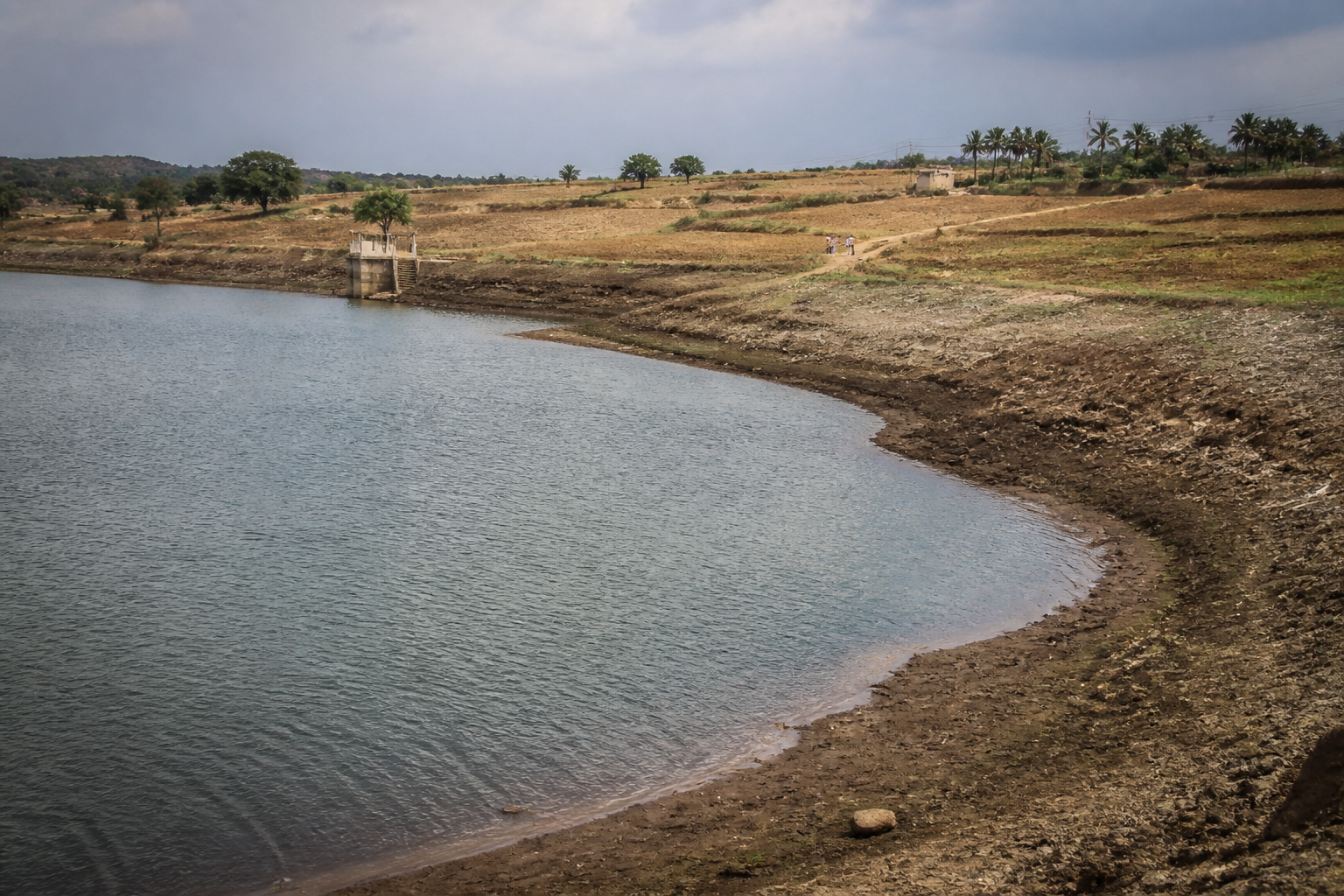
Reservoir storage provides the clearest link between the monsoon’s immediate performance and the next agricultural season. Storage stood at 71 per cent of full reservoir level on September 24, compared with 90 per cent a year earlier and about 80 per cent of the historical average, according to ICRA. The deficit was especially pronounced in southern India, where storage was 36 percentage points below the year-earlier level and 24 percentage points below the historical average. Northern reservoirs were 29 percentage points below last year’s level and 17 percentage points below the historical average.
This is not only a farm-production concern. Reservoirs support irrigation and, depending on the system, are part of the wider water infrastructure on which settlements, industry and households depend. The immediate risk identified by ICRA is to rabi sowing of irrigation-intensive crops, including rice and wheat. Southern states account for about 98 per cent of India’s rabi rice acreage and roughly 33 per cent of coarse cereal acreage. Punjab and Rajasthan together account for about 31 per cent of wheat acreage.
The regional picture again varies significantly. Uttar Pradesh, which accounts for about 28 per cent of India’s wheat acreage, had reservoir storage 14 percentage points above its historical average at the end of September. Rainfall there was 108 per cent of the long-period average. That may offset some of the weakness elsewhere, but it also highlights the difficulty of managing food supply through national aggregates when water conditions are diverging sharply between regions.
The economic effect is likely to extend beyond crop output. ICRA expects weaker farm incomes to dampen rural demand in the second half of FY27 and flagged upside risks to food inflation. Rural consumer sentiment deteriorated sharply in the July 2026 Reserve Bank of India survey, although spending intentions remained relatively resilient. Rural labour-market conditions improved in August, with rural unemployment falling to 4.1 per cent from 4.5 per cent in July. However, nominal rural wage growth slowed to 3.3 per cent in July, a 59-month low, while real rural wages contracted 1.6 per cent year on year.
For urban economies, the rural-demand channel is important even when the rainfall deficit occurs far from city boundaries. Weaker farm incomes can reduce spending on goods and services, while higher food prices can compress household purchasing power in both rural and urban markets. The result is a two-sided pressure: producers may face lower output and income, while consumers confront greater inflation risk. ICRA expects rural inflation pressures to increase in the third quarter of FY27 amid higher food prices, West Asia-related cost pressures and a low base.
Food stocks provide some immediate cushioning, but they do not remove the structural exposure to water and yield conditions. Government rice stocks stood at 39.1 million tonnes on September 1, 5.8 per cent above a year earlier and well above prescribed stocking norms. Wheat stocks were 48 million tonnes, up 44.1 per cent year on year and about 75 per cent above stocking norms. The government’s paddy procurement target for the 2026-27 marketing season is 70.86 million tonnes, below actual procurement of 72.84 million tonnes last year.
These inventories can moderate short-term supply pressure, but the outlook for wheat output and prices still depends on the upcoming rabi sowing season and reservoir conditions. Stocks therefore function as a buffer, not a substitute for reliable rainfall, irrigation and storage management. Their effectiveness also depends on how long the weather-related disruption lasts and where shortages emerge.
The fiscal implications add another layer. ICRA expects the fertiliser subsidy requirement to exceed the FY27 budget estimate of Rs 1.7 trillion by about Rs 900 billion, citing higher raw-material prices amid renewed tensions in West Asia. This means the monsoon shock is interacting with global cost pressures rather than operating in isolation. Public spending may have to absorb pressure from farm support and fertiliser costs at the same time as households face food-price risks.
There are also limits to how far the agricultural economy can be protected by diversification. ICRA said non-crop segments, including livestock, forestry and fishing, could cushion weaker crop output because they have historically been less dependent on monsoon conditions and have recorded stronger growth than the crop sector. That cushion is significant in understanding the forecast: the agency’s reduction to about 1 per cent growth is an assessment of the combined agriculture, forestry and fishing sector, not a claim that every crop or state will perform similarly.
The evidence instead points to a fragmented risk map. Southern India faces especially weak reservoir conditions and significant sowing declines in several states. Parts of northern India also have storage deficits, although Uttar Pradesh has a more favourable position. Central India recorded near-normal rainfall, while the East and Northeast experienced deficient rainfall. The same monsoon season therefore produces different policy problems: irrigation stress in one region, crop-yield risk in another and possible demand weakness across the wider economy.
This fragmentation complicates governance. National rainfall data, procurement stocks and aggregate growth forecasts are necessary for policy, but they cannot by themselves show where water systems are under pressure or which crops are most exposed. Reservoir levels, state-level sowing data, crop composition and rural wage trends must be read together. The 2026 figures demonstrate that an apparently modest decline in total kharif acreage can coexist with much sharper disruption in specific states and crops.
For urban policymakers, the lesson is that food and water resilience cannot be treated as separate sectors. Cities may not control farm production, but they experience the consequences through food prices, labour markets, consumption and demands on public support systems. Reservoir conditions also connect regional climate variability to the infrastructure question: how water is stored, allocated and protected between monsoon seasons affects both agricultural and settlement resilience.
What the available evidence confirms is a chain of vulnerability: deficient and uneven rainfall has reduced sowing in several regions, lowered reservoir storage and prompted ICRA to cut its FY27 sector-growth forecast. What remains uncertain is the eventual effect on yields, rabi acreage, farm incomes and food prices. The next critical indicators are rabi sowing, reservoir recovery, wheat and rice output, rural wages and the government’s response to fertiliser and food-supply pressures.
