


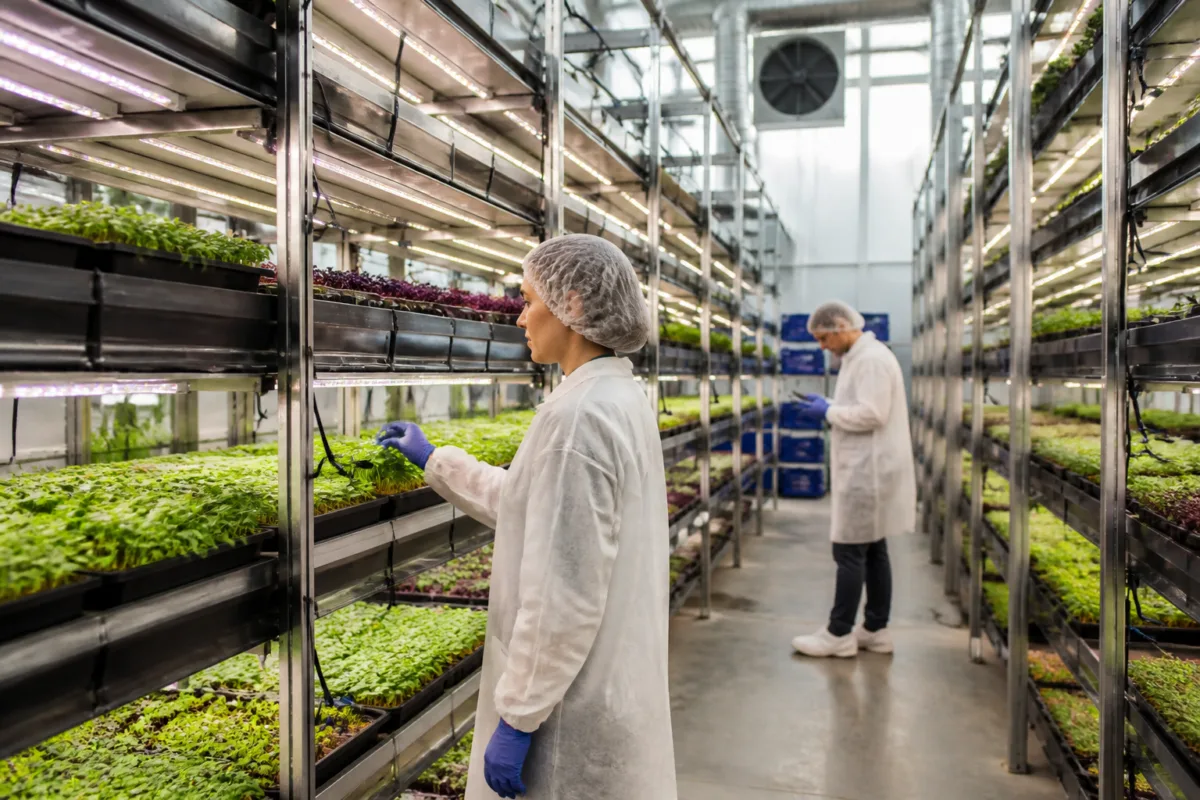
Vertical farming is changing the way limited urban and peri-urban space can be used for food production, but the Dutch experience also shows that technology alone does not guarantee profitability. The model depends on carefully controlled light, water, temperature, hygiene, energy use, labour, packaging and access to a reliable market.
A recent article published by Sakal – Pune, based on an agricultural study tour in the Netherlands and written by Amruta Shelar, examines microgreens as one of the clearest examples of this shift. Instead of measuring farming only in acres, controlled-environment production measures output through square feet, racks and short production cycles. The change is significant for cities, where land is expensive, supply chains are vulnerable and consumers increasingly seek fresh products with a short journey from producer to plate.
Microgreens are not a separate plant species. They are the young edible stage of vegetables, herbs and some cereal crops, harvested after the seed leaves have developed and the first true leaves begin to appear. Depending on the crop, harvesting can take place in roughly seven to 21 days. Radish, mustard, broccoli, red cabbage, pea, sunflower, beetroot, fenugreek, basil, coriander and amaranth are among the crops that can be grown in this form.
That short cycle is one reason microgreens fit controlled environments. Several production cycles can potentially be completed in a year, while dependence on rain, seasonal temperatures and some outdoor crop risks can be reduced. But the source article makes an important distinction: a short production cycle does not automatically mean high profit. Electricity, seeds, growing media, sanitation, labour, packaging and transport all determine whether the operation is commercially viable.
The production system is built around stacking rather than expanding horizontally. Metal racks hold trays across multiple levels, allowing a room to use its vertical volume. The actual capacity depends on rack height, the distance between levels, lighting, air movement and the space needed for workers. The model therefore requires more than shelves and trays. It is a coordinated production system in which the physical layout, environmental controls and workflow must function together.
Microgreens can be grown in soil, but the article also describes cocopeat, fibrous mats and other soilless media. Some systems use water-based methods. This flexibility is important in urban settings because production can be adapted to enclosed rooms and non-traditional sites, although the source does not establish that every vacant urban building is suitable for conversion. The requirements of ventilation, lighting, water quality, hygiene and access remain central.
Artificial lighting is another defining feature. In an enclosed vertical farm, natural sunlight may not be sufficient, so light-emitting diode, or LED, systems are used. These lights do more than illuminate the crop. Their intensity and spectrum can be adjusted, including the balance of red and blue light and the number of hours of exposure. According to the article, such controls can affect plant growth, colour, yield and some bioactive compounds.
This introduces a different relationship between farming and energy. In open-field agriculture, sunlight is largely available as a natural input, even though irrigation, machinery and other systems consume energy. In a closed farm, lighting and environmental control become part of the production infrastructure. The source material highlights the potential for efficient water use, but it does not provide energy-consumption figures or a full comparison with conventional farming. That limitation matters: resource efficiency cannot be judged through water use alone.
The information layer is equally important. Sensors can monitor temperature, humidity, light intensity, water acidity and alkalinity, the electrical conductivity of nutrient solutions and moisture in the growing medium. Connected devices can make this information available through a mobile phone or computer. If temperature or humidity moves beyond a defined range, fans, cooling systems or other controls can be activated.
The next step described in the article is the use of artificial intelligence. Production data, environmental changes and previous crop performance can be combined to determine when water, light or other conditions should be adjusted. The reference to automated greenhouse research in the Netherlands places microgreens within a wider technological transition: farming is increasingly being managed through sensors, data and automated decisions rather than through manual observation alone.
The Dutch model is presented as a response to structural constraints. The article attributes the country’s emphasis on greenhouses, precision irrigation, controlled nutrition, automation, sensors and data-based crop management to limited land and high labour costs. The objective is not only to increase output but also to use water, energy and other resources more efficiently. Wageningen University and Research is mentioned as an institution working on automated greenhouse systems, while an example from Amsterdam describes modern vertical farms producing microgreens, herbs and edible flowers in an industrial area.
The urban significance lies in proximity. Microgreens are delicate and can lose quality quickly after harvesting. Their potential customers include hotels, restaurants, cafés, health-food stores, modern grocery chains, dietician-linked consumers and households using delivery services. Possible sales models include direct supply, weekly subscriptions, restaurant contracts and production based on confirmed demand. Producing closer to the consumer can reduce the distance between harvest and use, although the supplied material does not quantify the transport or emissions savings.
This proximity also changes the type of land that can participate in food production. A microgreens unit does not require the same land area as conventional field cultivation, but it does require an enclosed, serviced environment. In practical terms, the urban question is not simply whether a city has unused rooms or industrial sites. It is whether those spaces can support reliable electricity, clean water, ventilation, drainage, food-safe handling and efficient distribution.
Food safety is a particularly important institutional issue. Microgreens are commonly eaten raw, which means contamination risks can arise at several stages: seeds, water, trays, growing media, worker hygiene, harvesting and packaging. The article identifies microbial contamination as a recognised research concern. That makes sanitation a core part of the business model rather than an optional quality measure. The shorter distance to consumers has value only if the production environment is consistently safe.
Nutrition is another area where precision is necessary. Different microgreens contain different levels of vitamins, minerals, carotenoids, phenolic compounds and other bioactive components. The source notes that broccoli, black radish, red beet, pea, sunflower and bean microgreens have been associated with minerals and phenolic or flavonoid compounds in research. It also cautions against treating all microgreens as nutritionally identical or presenting them as medicines. They are better understood as fresh foods that may be rich in selected nutrients and bioactive compounds, depending on the species and growing conditions.
For Maharashtra, the lesson presented by the article is not that Dutch systems can be copied wholesale. It is that agricultural productivity can be considered in terms of value created per square metre, not only total acreage. That is a useful urban lens because cities compress land, labour and logistics into a small geography. Yet adoption would require a market that can pay for the product, operators who can maintain controlled conditions and institutions capable of supporting food safety and technical training.
The business model also exposes a tension between premium food and broad food access. The likely customers listed in the article are largely higher-value commercial and urban segments. This can make microgreens attractive as a specialised enterprise, but the supplied evidence does not show that vertical farming can replace conventional vegetable supply or improve affordability for all residents. Its immediate role appears narrower: producing selected, high-value, perishable crops close to consumers.
The Netherlands example therefore points to a specific form of urban agriculture rather than a universal solution. Vertical farming can reduce the need for horizontal land, enable production in controlled conditions and bring certain crops closer to city markets. At the same time, it shifts dependence towards electricity, equipment, monitoring systems, hygiene protocols and specialised management. The central question for future projects is not whether crops can be grown indoors, but whether the complete operating system can remain safe, affordable and commercially reliable.
The evidence supplied by Sakal – Pune confirms the potential of microgreens, racks, controlled lighting, sensors and short production cycles, while leaving several important questions unanswered, including comparative energy use, capital costs, operating margins and the scale at which the model becomes viable. Those are precisely the issues that will determine whether vertical farming remains a niche urban enterprise or develops into a broader component of resilient city food systems.

