


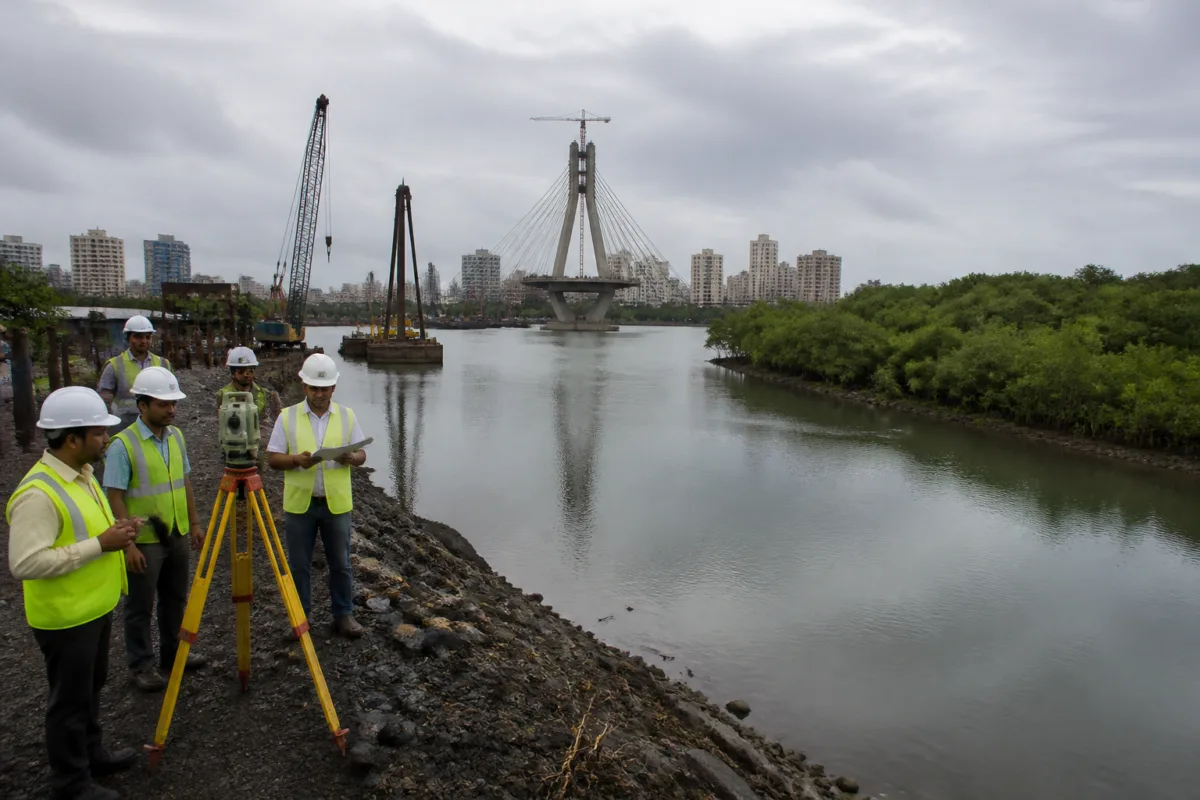
The Brihanmumbai Municipal Corporation has begun ground assessment for the Versova-Madh cable-stayed bridge after the Bombay High Court cleared the felling of 1,237 mangroves required for the project, which is planned to create a direct connection across Malad Creek in Mumbai’s western suburbs.
The bridge is expected to cut the current peak-hour journey between Versova and Madh from as much as 1.5 hours to between five and 10 minutes, according to a civic official cited by The Indian Express. At present, the two areas have no direct road link and commuters must travel through Lokhandwala, Oshiwara, Link Road or Marve Road.
The proposed 2.06-km connection will begin at Madh Jetty Road and land near Fisheries University Road in Versova, in Andheri. It is intended to serve residents and commuters travelling towards Madh, Marve, Malad and Kandivali, besides providing access to areas including the Air Force station and INS Hamla.
The bridge will include a 600-metre cable-stayed section, with 150-metre back spans on either side. A civic official told The Indian Express that the cable-stayed design had been selected to reduce piling and limit the project’s environmental impact. The project, however, will require the removal of 1,237 mangroves following the court’s clearance.
The connection is also planned as part of a wider coastal-road network. The proposed bridge is expected to provide access to the Mumbai Coastal Road Project, while an arm is planned to connect towards the Dahisar-Bhayandar coastal road. This would place the Versova-Madh link within a broader set of road connections being developed along Mumbai’s western edge.
The project was first envisaged in Mumbai’s 1967 Development Plan. Its blueprint was finalised in 2020, and tenders were floated in March 2023. The project subsequently received in-principle approval from the Union Ministry of Environment, Forest and Climate Change before the Bombay High Court cleared the mangrove felling.
The civic official described the bridge as important for reducing congestion in the western suburbs, where existing routes are heavily burdened during peak travel periods. The official said the bridge would reduce travel time to five to 10 minutes from the present one to one and a half hours.
The latest ground assessment marks the next reported step before construction begins. The supplied project details do not specify the construction cost or a completion deadline. Further implementation milestones will depend on the BMC’s assessment and subsequent construction activity.

