


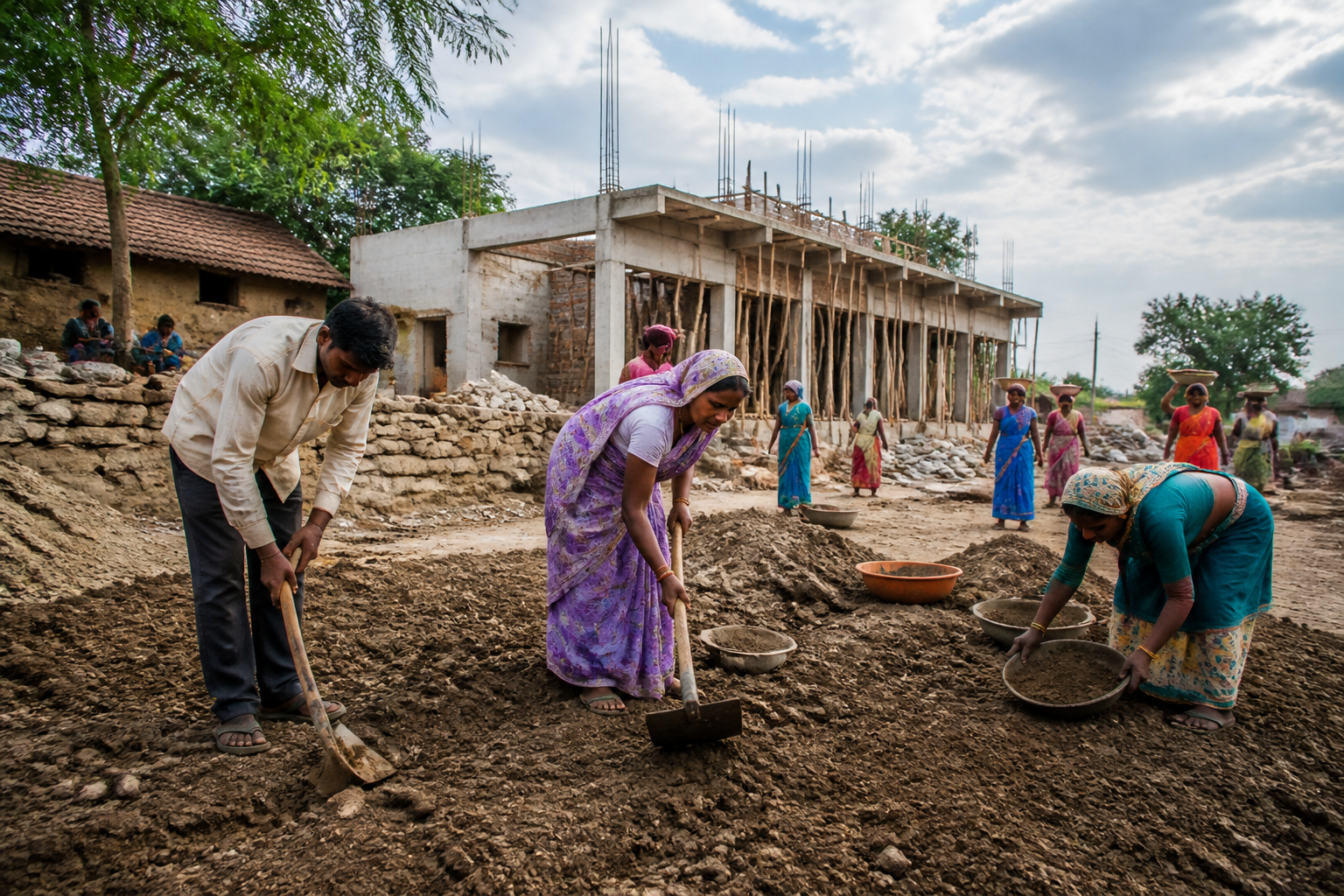
The VB G Ramji scheme generated 2.04 crore person-days of employment in Karnataka between July 1 and the 13th, Rural Development Minister Eshwar Khandre said after reviewing the programme’s progress with officials.
The figure is higher than the 1.71 crore person-days generated during the corresponding period last year. Khandre attributed the increased demand for work to rainfall shortages linked to El Nino, saying the scheme had provided employment to rural poor households, Dalit communities and landless labourers.
Raichur recorded the highest employment generation in the state, with 24 lakh person-days during the period. Bidar followed with 21 lakh person-days, while Koppal recorded 18 lakh person-days. Compared with last year, employment generation rose by 340% in Vijayanagara, 257% in Kalaburagi, 207% in Koppal, 175% in Ballari and 173% in Bidar, according to figures shared by the minister.
The department also issued 87,164 new job cards this year after conducting e-KYC for existing cards and organising job-card camps. Khandre said the process had helped families that would otherwise migrate find work in their own locations.
The minister said the scheme would now place greater emphasis on constructing houses, community halls and rural bus stands. These works would extend the programme beyond short-term wage support and connect employment generation with the creation of village-level public assets, although the statement did not provide project-wise expenditure or completion timelines.
A household can receive up to 125 days of employment in a year under the scheme. The wage is ₹382 per day for both men and women, allowing a family to earn up to ₹47,750 annually if it receives the full entitlement, Khandre said.
The state is generating an average of 2.5 lakh person-days each day, with 86,042 works listed as active during the current financial year. Of these, 497 works had been completed and 85,048 were in progress, according to the minister’s figures.
The programme has also recorded participation among historically vulnerable groups. Employment was provided to 195,871 Scheduled Caste households, involving 302,153 workers, while 141,449 Scheduled Tribe households received work for 228,200 unskilled workers. Women accounted for 85,71,58? workers, as reported in the source, while the minister said women received around 1.12 crore of the 2.04 crore person-days generated since July 1.
The department said Scheduled Caste workers accounted for 39.97 lakh person-days and Scheduled Tribe workers for 29.62 lakh person-days during the period. The next phase will determine how quickly the proposed housing, community building and rural bus-stand works move from approval and employment allocation to completed public assets.

