


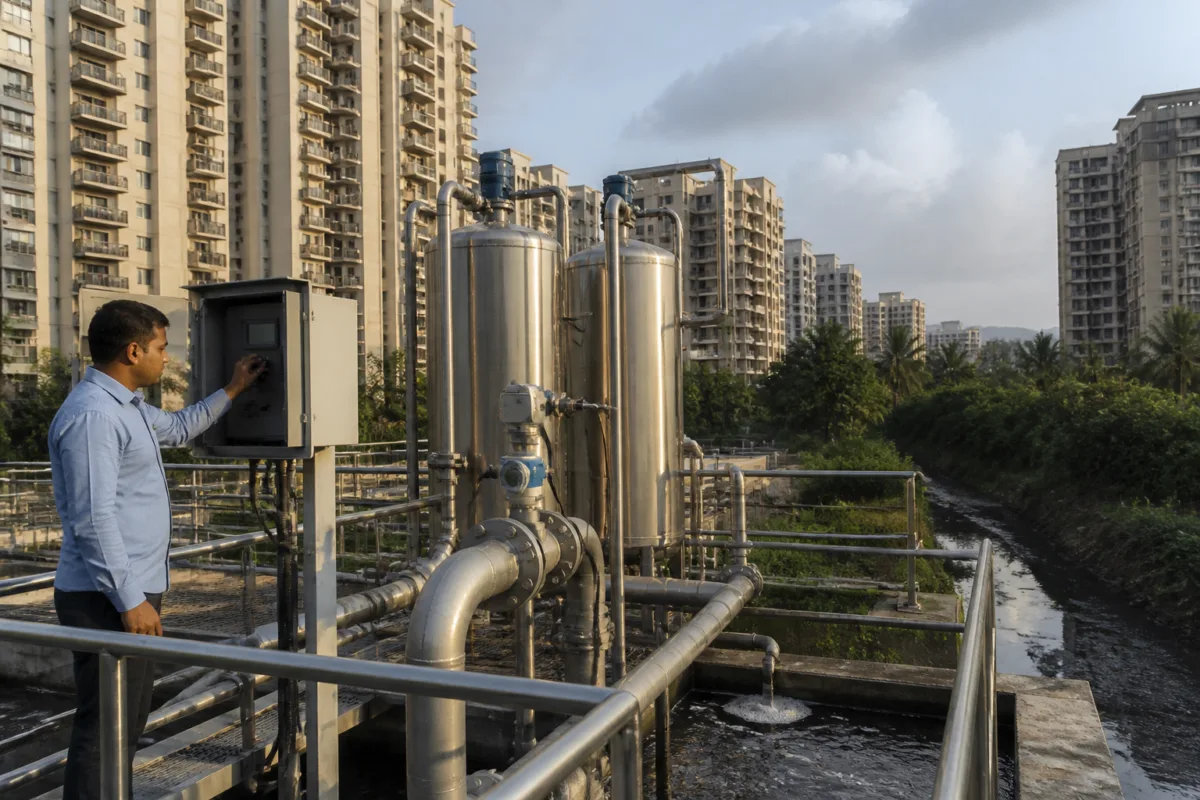
Vasai-Virar Municipal Corporation has proposed online monitoring of sewage treatment plants (STPs) in large housing complexes to detect untreated or inadequately treated wastewater being discharged into public drains, according to a report by Loksatta.
The proposal, placed by Municipal Commissioner Prithviraj B. P. before the civic general body for approval, would require eligible housing complexes to install modern sensors and monitoring equipment at their own cost. The system is intended to provide continuous oversight of private STPs and enable action when treatment standards are breached.
The proposed Online Continuous Monitoring System would be supported by a central server, a command-and-control centre, a mobile application and a geographic information system-based dashboard. The corporation expects to spend between Rs 18 lakh and Rs 20 lakh on the system through the 2026-27 budget, the report said.
Housing complexes covered by the STP requirement would have to install flow meters, water-quality sensors, data loggers and internet connectivity. These systems would be linked to the corporation’s central control room, allowing officials to track plant performance remotely.
The civic proposal comes against the backdrop of rapid urbanisation in Vasai-Virar, where large residential, commercial and mixed-use developments have expanded in recent years. Loksatta reported that more than 200 million litres of sewage generated in the city is currently discharged into creeks and the sea without treatment. The report did not provide a separate municipal document or technical assessment supporting that figure.
Under environmental clearances and conditions issued by the Maharashtra Pollution Control Board, large developments are required to establish independent STPs. Treated water is expected to be reused for activities such as gardening, toilet flushing and construction.
The report said some housing societies allegedly keep STPs shut to avoid electricity and maintenance costs, or release partially treated wastewater into public drains at night. These claims were attributed to complaints received by the administration and were not supported in the report by named society representatives or inspection records.
If approved and implemented, the proposed monitoring network would shift part of municipal oversight from periodic inspections towards continuous data-based supervision. It could also make it easier to identify non-compliant plants and improve enforcement, although the effectiveness of the system would depend on sensor reliability, data access, inspections and timely action against violations.
The corporation has said the initiative is aimed at reducing water pollution, protecting public health and increasing the reuse of treated wastewater. The immediate next step is consideration of the proposal by the civic general body; the report did not specify an implementation date.

