


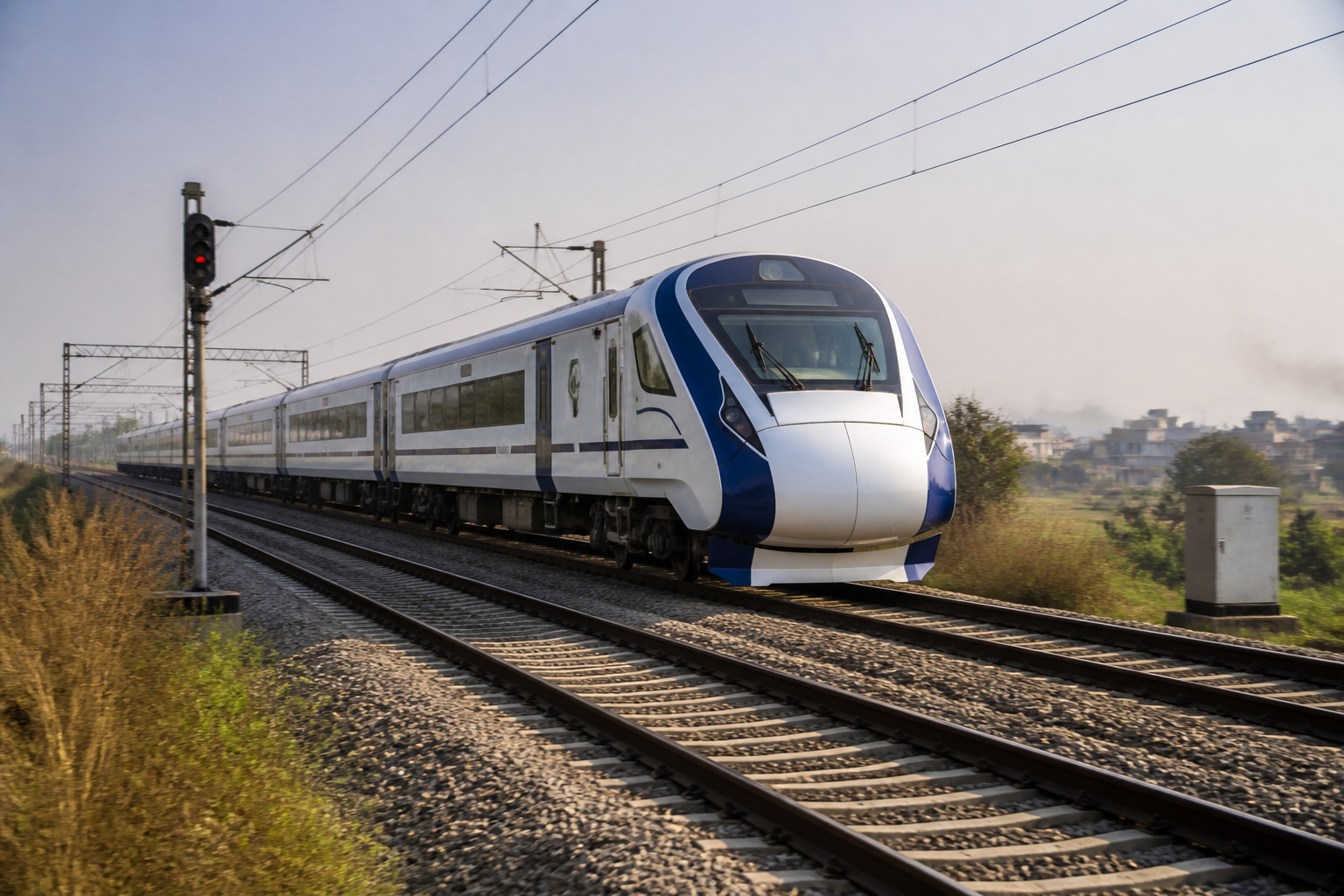
The successful 180 kmph trial of a Vande Bharat trainset manufactured at Rail Coach Factory (RCF), Kapurthala, marks a significant change in how India’s semi-high-speed rail programme is being built. Until the beginning of 2026, Vande Bharat trains had been manufactured only at Integral Coach Factory (ICF) in Chennai. The entry of RCF and Modern Coach Factory (MCF) into production creates a broader manufacturing base for one of Indian Railways’ most visible train programmes.
The 16-coach Vande Bharat Chair Car trainset made at RCF underwent a high-speed trial on the Mathura–Nagda section on 8 October 2026. The test was conducted at 180 kmph under the supervision of the Chief Commissioner of Railway Safety (CCRS). According to the report, the inspection assessed the trainset’s high-speed performance, operational efficiency and compliance with safety parameters.
The immediate significance is technical: the RCF-built trainset has completed an important stage in its development. The larger significance is institutional. Vande Bharat production is no longer confined to the Chennai-based ICF, as RCF Kapurthala and MCF have also rolled out their first trainsets in 2026. This turns the programme from a production capability concentrated in one factory into a capability shared across multiple railway manufacturing units.
That shift matters because a train programme is not defined only by its top speed. It also depends on the ability of manufacturing facilities to produce complete trainsets consistently, meet safety requirements, integrate several systems and support future upgrades. The RCF trial therefore provides evidence of a wider production effort, although the supplied report does not establish how many Vande Bharat trainsets each factory will produce or how production will be divided among the three facilities.
From locomotive-led trains to integrated trainsets
Vande Bharat, initially known as Train 18, was first rolled out from ICF in 2019 and launched on the Delhi–Varanasi route. The train was developed as a fully air-conditioned, self-propelled trainset rather than a conventional passenger train hauled by a separate locomotive. Its design allows traction equipment to be distributed within the trainset, helping it accelerate and decelerate more quickly than conventional locomotive-hauled trains.
The report says this capability can reduce journey times by up to 20% on several routes. It also identifies a set of features intended to improve both operations and the passenger experience, including automatic doors, wider sealed gangways, GPS-enabled passenger information systems, onboard infotainment, European-style seats and improved suspension.
The distinction between a locomotive-hauled rake and an integrated trainset is important for understanding the manufacturing challenge. A Vande Bharat trainset brings propulsion, braking, passenger information, doors, couplers, gangways and safety provisions into a coordinated system. This means that expanding production involves more than adding coach-building capacity. It requires factories to assemble and test a complex combination of systems to a common performance and safety standard.
The 180 kmph trial at RCF is consequently an indicator of system integration as much as speed. The test was conducted under the supervision of the CCRS, and the report states that the inspection covered operational efficiency and safety parameters. The result does not, by itself, establish the regular operating speed of the trainset on passenger routes; it confirms that the trainset successfully underwent the reported high-speed trial.
Why RCF’s entry is important
RCF Kapurthala’s role in the Vande Bharat programme builds on an existing history of coach production. The factory manufactures coaches for advanced trainsets, including Vande Bharat and Amrit Bharat, and has exported railway coaches to countries in Asia and Africa, according to the report. It recorded its highest annual output in financial year 2025–26, producing 2,383 coaches.
These figures place the RCF development within a larger manufacturing context. The factory is not beginning from an absence of railway production capability; it is adding a new and more technologically demanding trainset to its output. The key question raised by its first Vande Bharat trainset is whether that capability can be repeated at scale while maintaining the testing and safety processes required for high-speed operation.
The available information does not provide a production target, a delivery schedule or a comparison of output between RCF, ICF and MCF. It also does not state whether the three factories will manufacture identical configurations or whether future versions will be assigned different technical roles. Those details will be important for assessing whether the expansion represents a sustained increase in national capacity or an initial diversification of production.
The production base is also linked to the evolution of the train itself. The report describes successive upgrades to Vande Bharat, including a Vande Bharat 3.0 version that can accelerate from 0 to 100 kmph in around 52 seconds, along with lower noise and vibration levels. It also refers to regenerative braking, which recovers energy as the train slows, and provision for KAVACH, India’s Automatic Train Protection system certified to Safety Integrity Level-4.
Each additional production facility must therefore work within a moving technical framework. Manufacturing capacity has to support not only the current trainset design but also changes in braking, passenger information, safety systems, ride quality and onboard equipment. The expansion of production makes standardisation and quality control central administrative questions, even though the report does not provide the operating procedures used by the factories.
The infrastructure connection
A train’s technical capability is only one part of its usefulness on the railway network. The RCF trainset was tested at 180 kmph on the Mathura–Nagda section, but the report does not identify a route on which it will operate at that speed in regular passenger service. The distinction matters because train performance is shaped by track conditions, signalling, level crossings, curves, station spacing and the interaction with other services.
Vande Bharat’s faster acceleration and braking can be useful on routes where trains make several stops, as the report notes through its reference to potential journey-time reductions. However, the actual benefit depends on the infrastructure and timetable around the train. A high-speed trial demonstrates the trainset’s tested capability under the specified conditions; it does not by itself indicate the journey time or operating pattern passengers will experience on a particular route.
This is where the manufacturing story connects to railway planning. More trainsets can support the expansion of premium intercity services, but their usefulness depends on the availability of compatible routes, maintenance arrangements and operating capacity. The supplied material confirms the manufacturing and testing milestone but does not provide details on route allocation, fare structures, maintenance depots or passenger demand.
The policy and institutional landscape
The Vande Bharat programme combines the responsibilities of railway manufacturing units, operating divisions and safety authorities. ICF, RCF and MCF are the factories identified in the report as manufacturers of the trainsets in 2026. The CCRS supervises the reported high-speed trial, providing an independent safety oversight role within the railway system.
This institutional separation is significant. The factory develops and produces the trainset, while safety inspection evaluates whether it meets the required parameters for the stage being tested. The report does not state that the 180 kmph trial represents final approval for commercial operation at that speed, and no such conclusion can be drawn from the information provided.
The trainset’s provision for KAVACH also shows how the programme sits within a broader railway safety framework. KAVACH is described in the report as an indigenously developed Automatic Train Protection system certified to Safety Integrity Level-4. The material does not specify the installation status or operational deployment of KAVACH on the RCF-built trainset, so the safety system should be understood here as a stated design provision rather than evidence of a route-level deployment.
The broader industrial signal
RCF’s first Vande Bharat trainset and MCF’s entry into production indicate that Indian Railways is distributing responsibility for an advanced train programme across more than one manufacturing site. That can strengthen the institutional depth of the programme, but the evidence currently establishes the expansion of capability rather than its eventual scale or performance.
The export record cited for RCF adds another dimension. Railway coaches manufactured in Kapurthala have been exported to countries in Asia and Africa, suggesting that the factory’s work is connected to an international railway market as well as domestic requirements. The report does not identify the countries, contract values or technical specifications of those exports, so their precise commercial significance remains unspecified.
The central urban and mobility question is therefore not simply how fast a Vande Bharat train can travel. It is whether India can build a reliable, repeatable and geographically distributed production system for modern trainsets, and then connect that system to infrastructure capable of using the trains effectively. The RCF trial is evidence of progress on the manufacturing side of that equation.
What the evidence confirms—and what remains open
The available evidence confirms that RCF Kapurthala manufactured a 16-coach Vande Bharat Chair Car trainset and that it successfully completed a supervised 180 kmph trial on the Mathura–Nagda section on 8 October 2026. It also confirms that RCF and MCF have joined ICF in manufacturing Vande Bharat trainsets during 2026, and that RCF produced 2,383 coaches in financial year 2025–26.
What remains unclear is how quickly production will expand, how the three factories will share future orders, which routes will receive the new trainsets and what operating speeds will be used in passenger service. Those milestones will determine whether the 2026 production expansion becomes a durable change in India’s railway manufacturing system or remains an important but limited addition to existing capacity.

